2020/08/11-2020/08/12
I just had to break out, bust loose, escape. I started a new job in January and my bicycling habit changed drastically. My new office was too far to commute to by bicycle and even if wasn’t I was putting in too much overtime. Then COVID19 hit. I followed government guidelines and stayed home. Working from home 5 days a week just made it easier to work more. I thought I could take a little time off during Golden Week in the beginning of May but it didn’t happen. Too busy. Then June brought an unusually long and wet rainy season that went all the way into July. August didn’t get any better but I was ready for a break. I had been working from January without taking any time off, not even for national holidays. In the immortal words of Popeye, “I can takes it no more.”
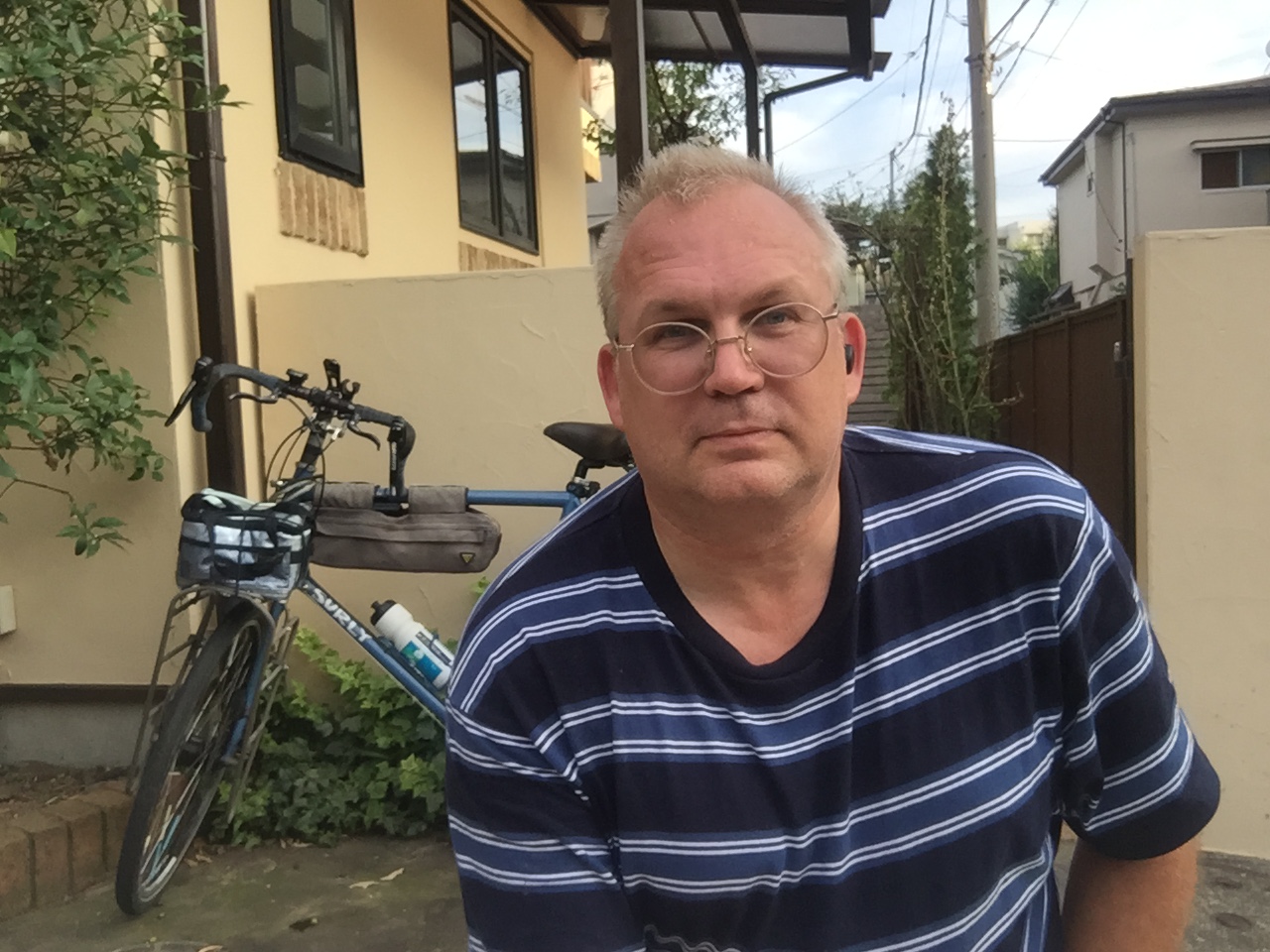
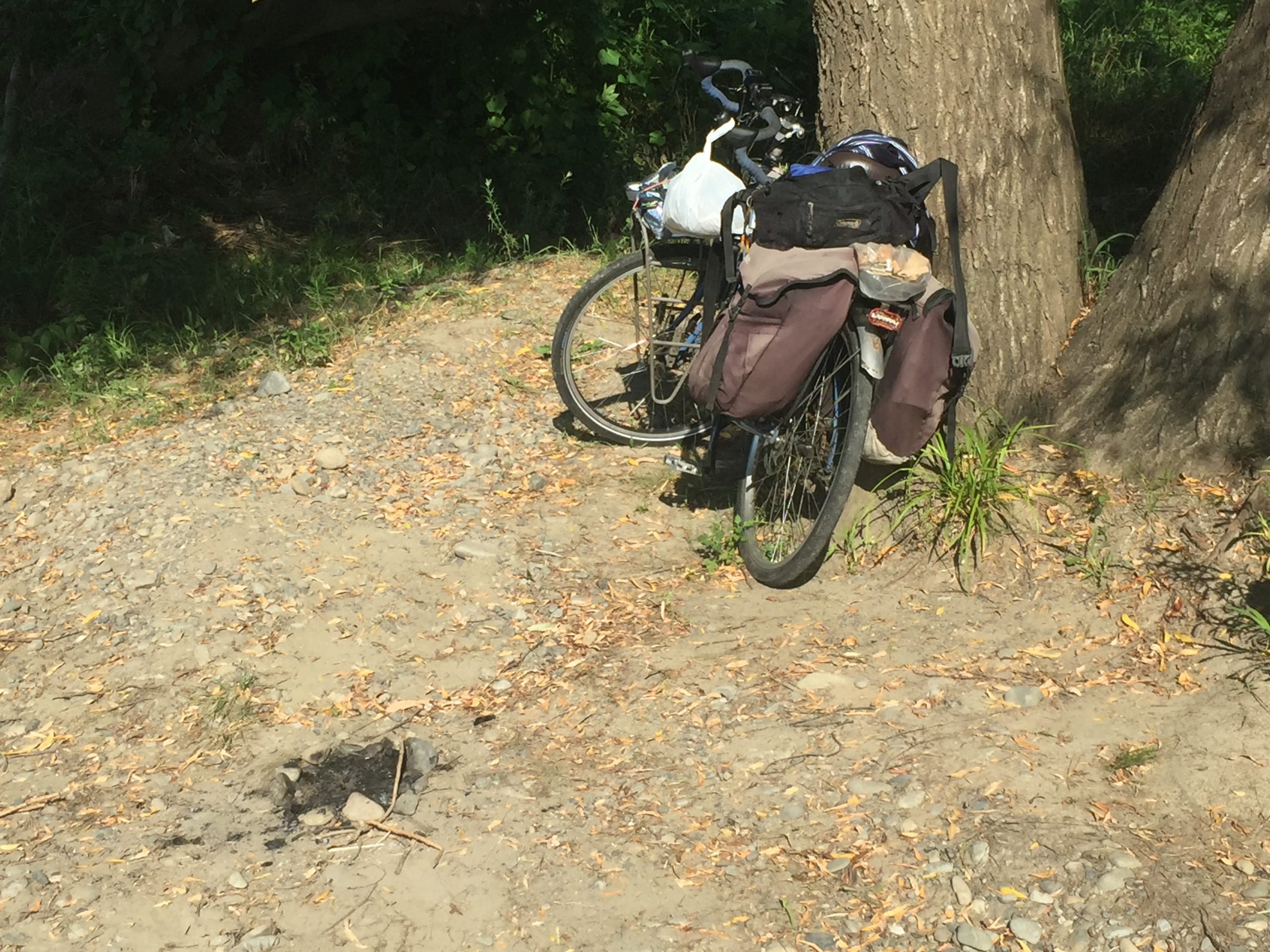
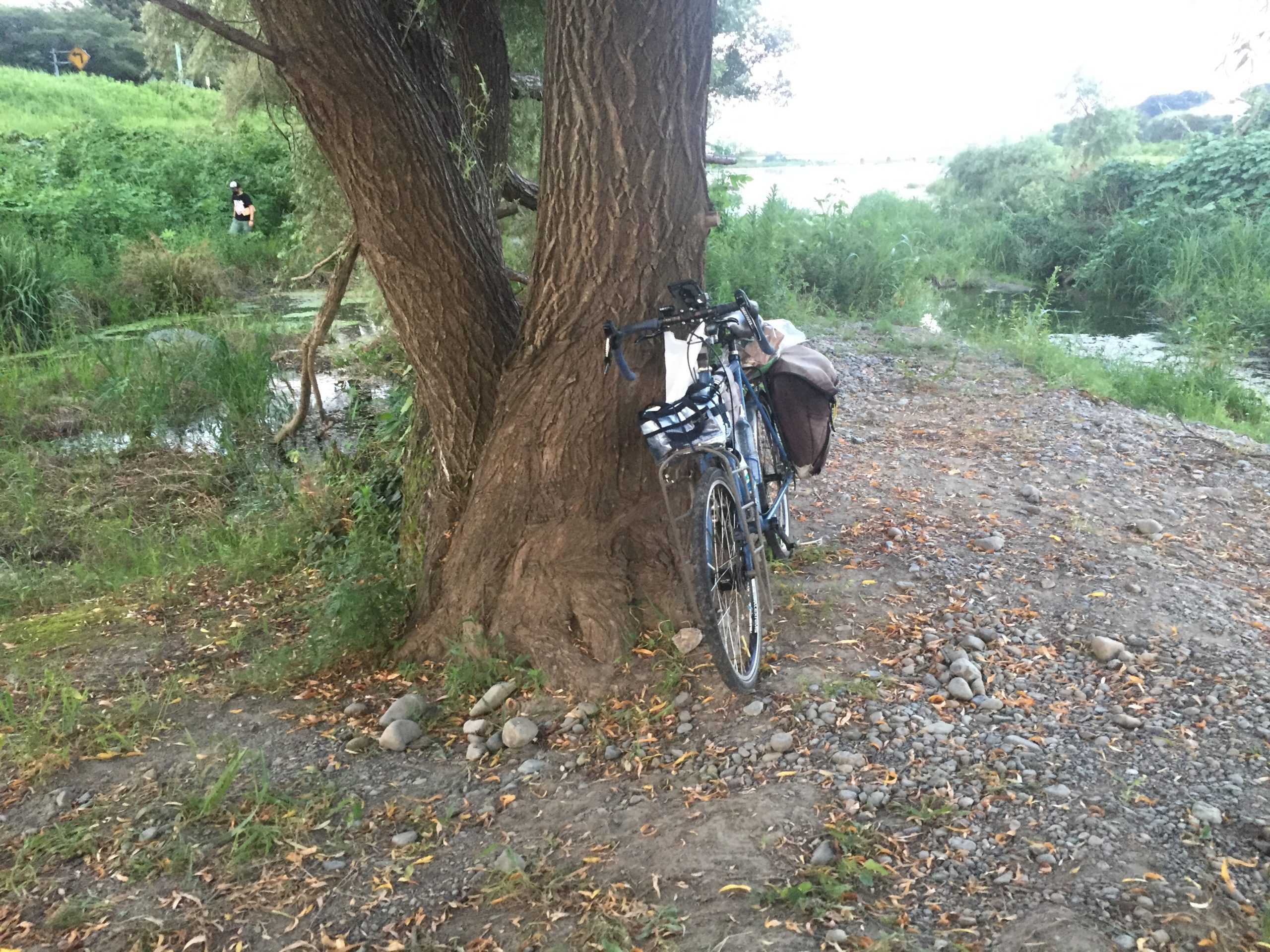
I packed up my gear and headed to the river for a bit of cycling and stealth camping. The city or maybe it was the prefectural government fenced off the river bank by Kyodo no Mori Park but I found a place upriver from where I usually camp. It was only about 8 km from home but it was far enough away to feel like a trip. Just far enough into nature to feel like I was out of the city even though it was usually just out of sight. This little trip offered a welcome respite from the cabin fever I was feeling.
During April and May we were encouraged and, in some cases, required to work from home. But from around June it was acceptable to return to the office up to 50% of the time. I still do part of my commute by bicycle but it is too far to go all the way by bicycle.
When I ride, I don’t wear a mask for a number of reasons. 1) In very hot weather, like a Japanese summer, it is very uncomfortable and potentially dangerous. Especially if you are exercising in any way. There is a risk of heat stroke or heat exhaustion. 2) In cold weather, it makes my glasses fog up and that, too, is dangerous when you are riding a bicycle. On the other hand, a mask keeps your face warm like a scarf or ski mask would. I have never a big fan of either of those pieces of cold weather gear. 3) And finally, I just don’t like wearing a mask. I feel more tensed up when I wear a mask. I find myself clenching my jaw more often. I don’t see that not wearing a mask when I ride is a problem. When you are riding a bicycle you naturally social distance from others. If you are not, it probably means you just had a collision with a pedestrian or vehicle. I hear that bicycles colliding with other road users is a bad thing so I try to avoid them. They can mess you up just as much as a virus infection. I do try to maintain my distance from other road users when I stop at intersections.
Hopefully, next year will be a better year for bicycle touring. I still want to take a trip around Mt. Fuji along the Olympic road race course.
Photo Gallery
Video
[yotuwp type=”videos” id=”98PqOd7q5Lc” ]
Home | Photo Gallery | Podcasts | Videos
]]>2019/12/21
I had fully a whole day to kill. My plane didn’t leave until shortly after midnight. I had several tasks I needed to accomplish and I was in the right neighborhood to get them all done easily.
Flat Again
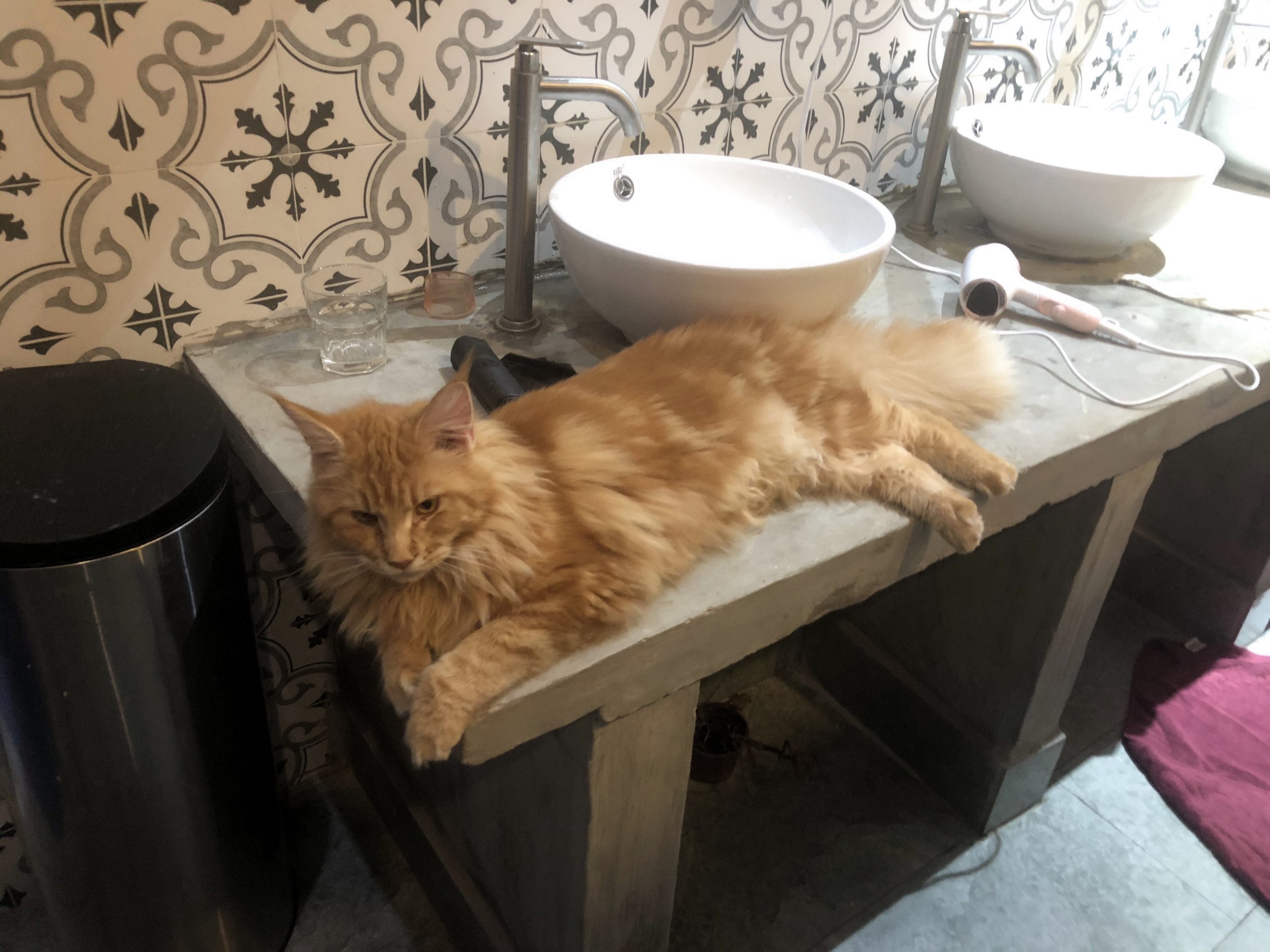
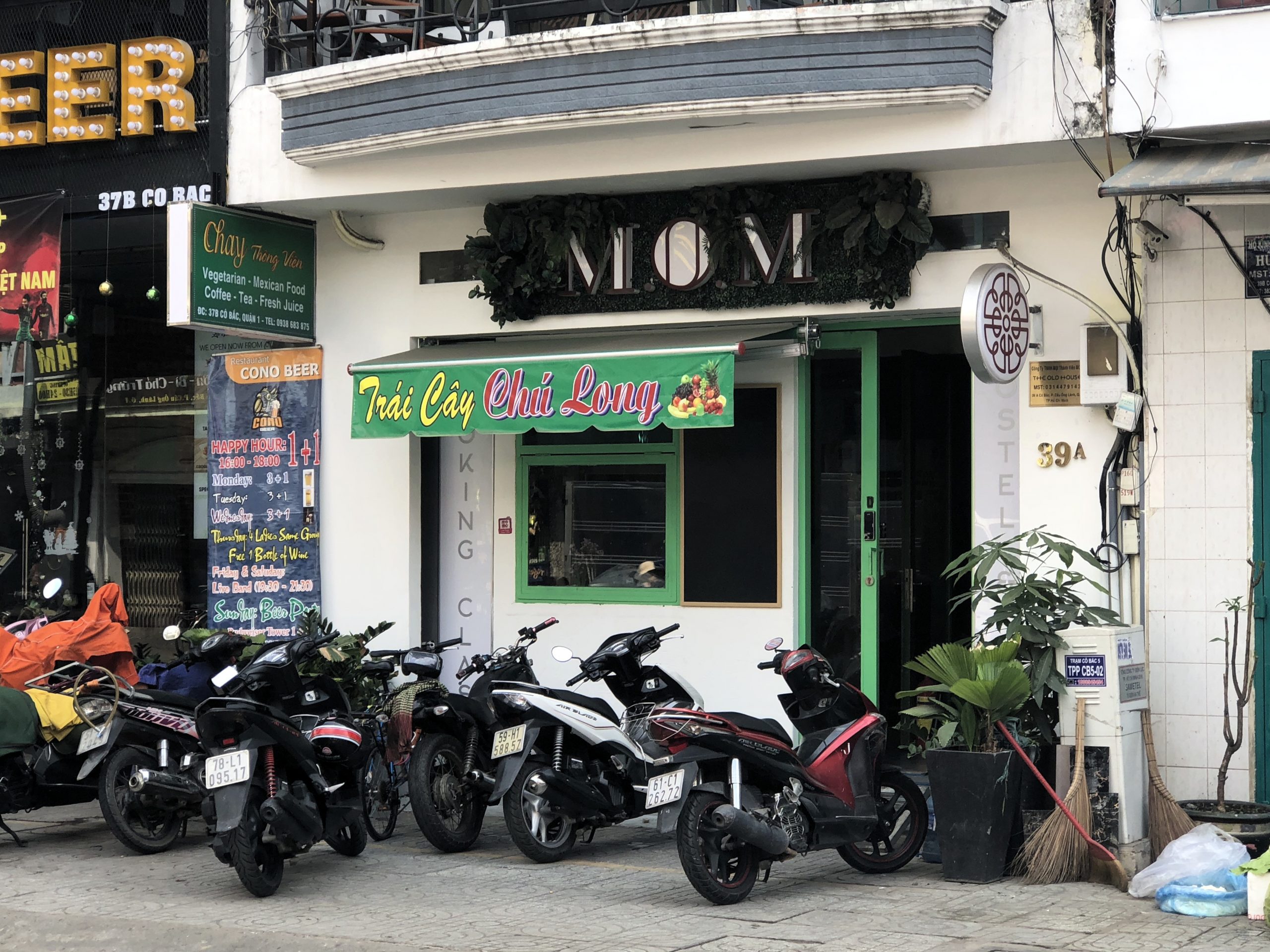
The first task was to see how badly I messed up my rim and tire by riding on a flat in Phnom Penh. After breakfast I attempted to fix the flat again. The tube was messed up but fortunately the rim was okay. One of hostel (hostel, not hostile, they were very friendly) cats looked on while I used the sink in the shared bathroom in the hostel to look for leaks. The patch on the original hole was leaking around the edges and I found two more holes and pulled a very fine wire out of my tube. It probably came from a blown out truck tire. I was doing some of this work out on the cluttered sidewalk in front of the M.O.M Hostel & Cafe. The guy from the motorcycle shop next door saw me breaking a sweat airing up the tire and offered to blow it up with his motorcycle air compressor. Nice of him to offer but by the time he found the right adapter for his compressor hose I could have finished the job at least twice.
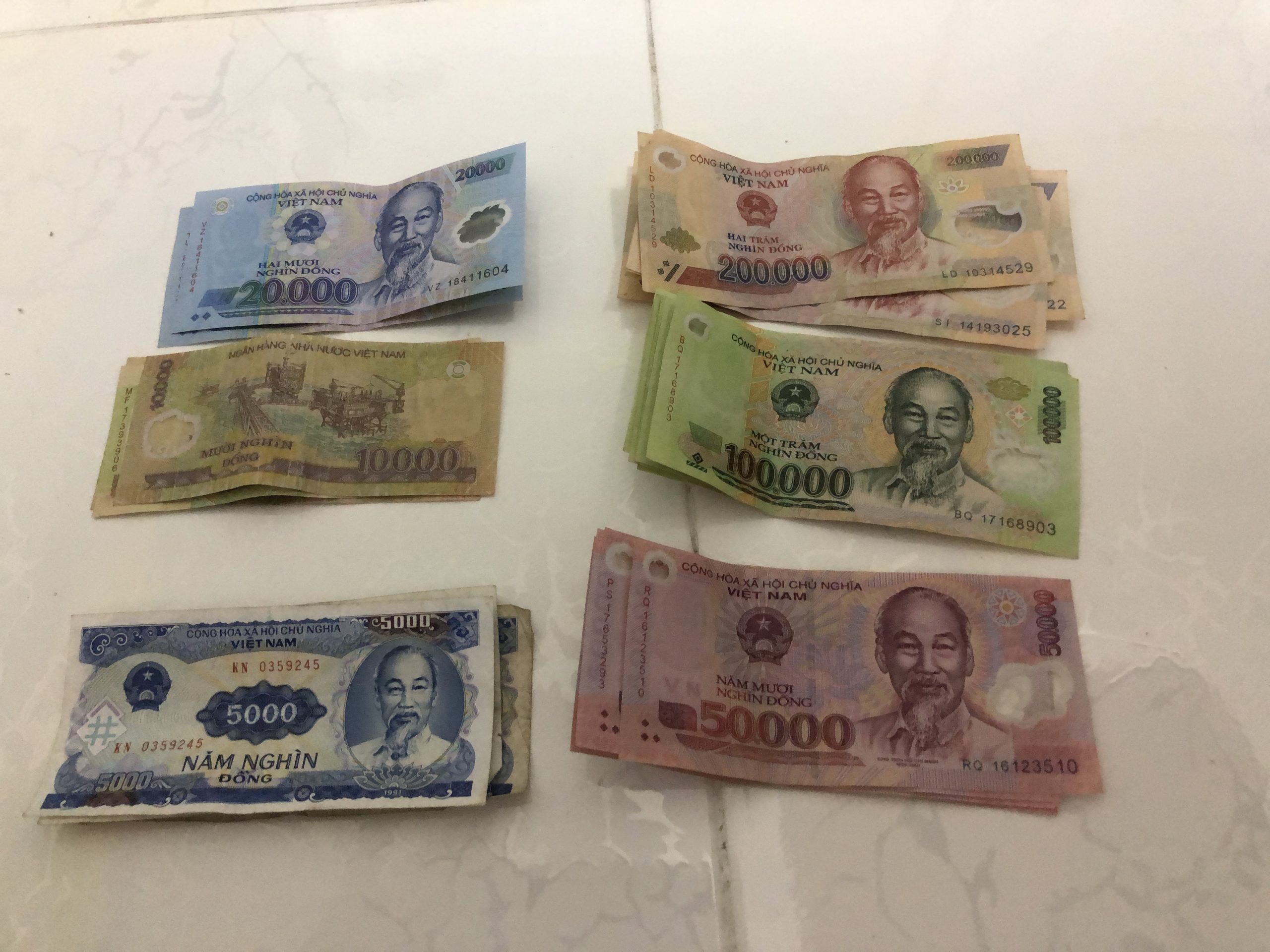
I left my bike locked up in front of the hotel while I ran my next errand a few blocks away. The next task was to change some more yen. The FX office was just a few blocks from the hostel. I changed some more yen to dong. To my great surprise I had less yen than I thought. I only had 3,000 yen. I thought that I still had at least one 10,000 yen note. I wonder if I accidentally used it to pay for something. It could happen given how many zeroes are in the local currencies of Vietnam and Cambodia. A 10,000 dong note and a 10,000 riel note have the same number of zeroes as a 10,000 yen note and they are more common. Anyway, If so, it is a sweet windfall for whoever received it. I also decided to make a cash withdrawal on my credit card. I had no problem using my credit card in Vietnam. Now I had enough walking around money for 1 day and enough to pay my bills.
When I got back it became clear that Velotta, the granny-geared goddess of bicycle riders, was balancing the karmic scales for the five days of good fortune that she showered upon me during my journey. The tire was flat again!
Box o’ Bike
The final, and perhaps, the most critical task was to get my bicycle ready to go on the airplane. That was easier than expected. Again, thanks to my guesthouse being so well located, I was less than a kilometer from an English speaking bike shop, Mr. Biker Saigon. I aired up my traitorous tire once again and said a little prayer to Rotunda, the trickster god of tires, that the air wouldn’t leak out before I reached the bike shop. I rolled up to the shop and asked for a box for my bicycle. He didn’t blink an eye at my request. For $10 dollars I got the box and packing service. Money well spent.
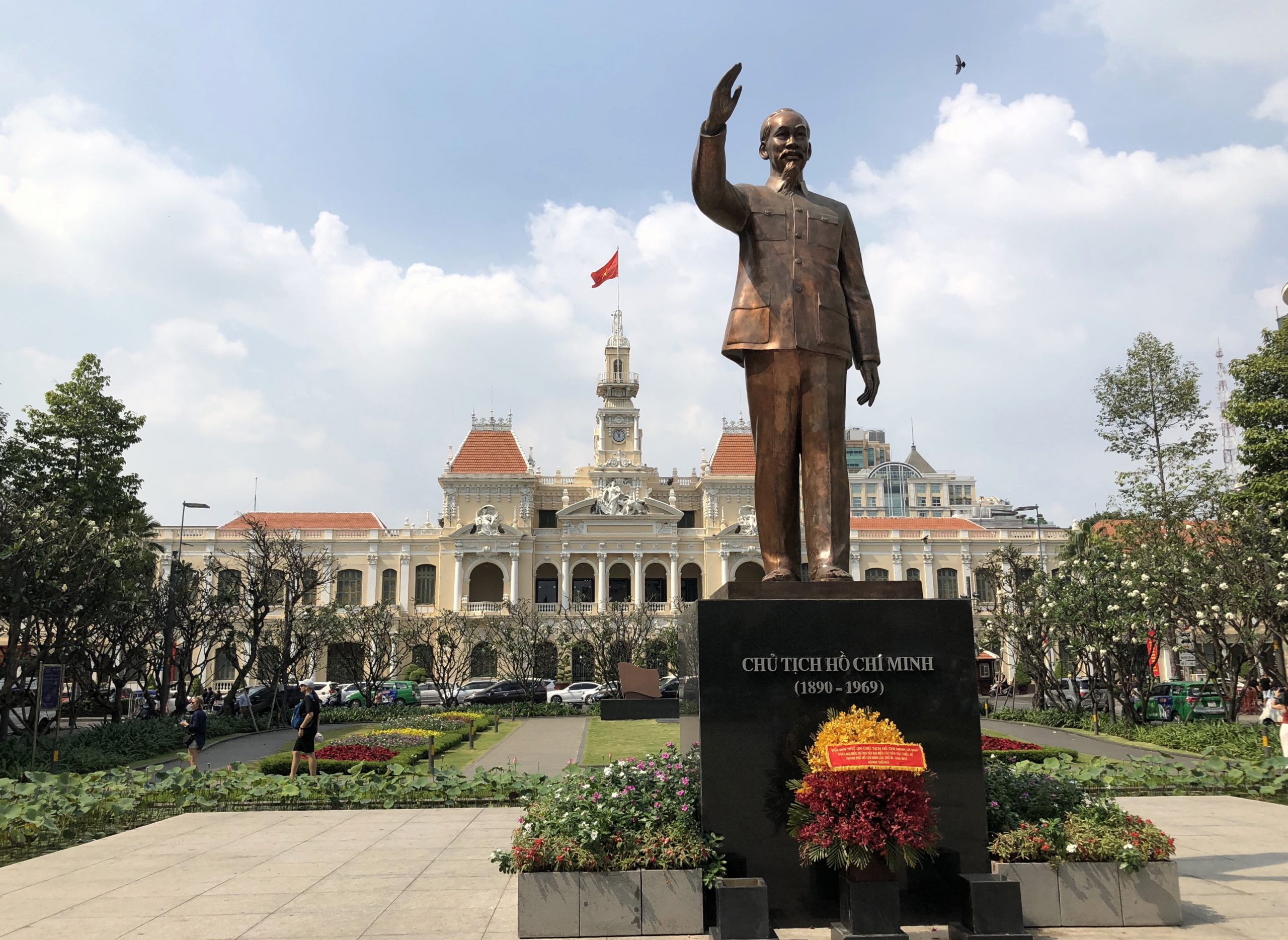
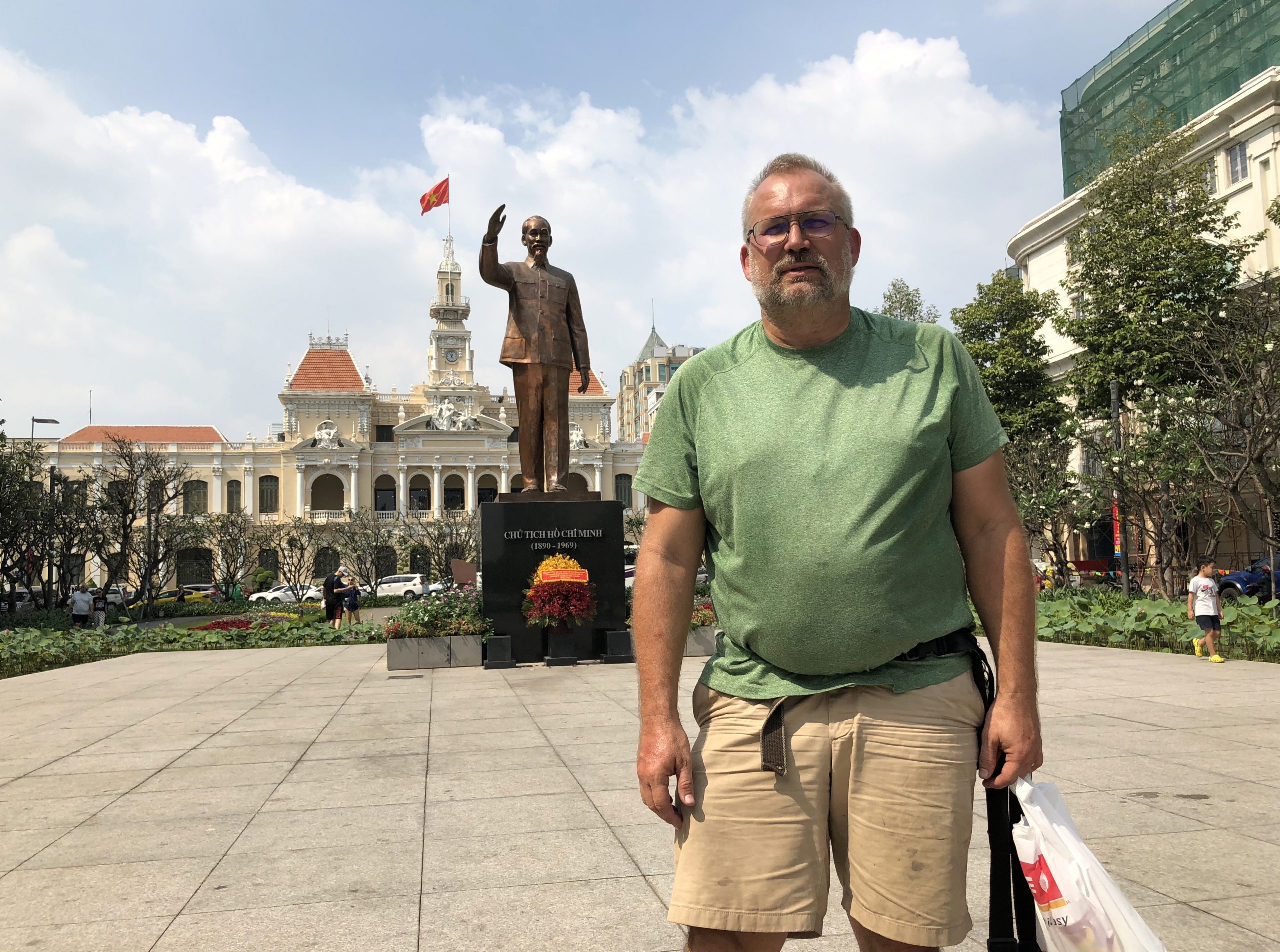
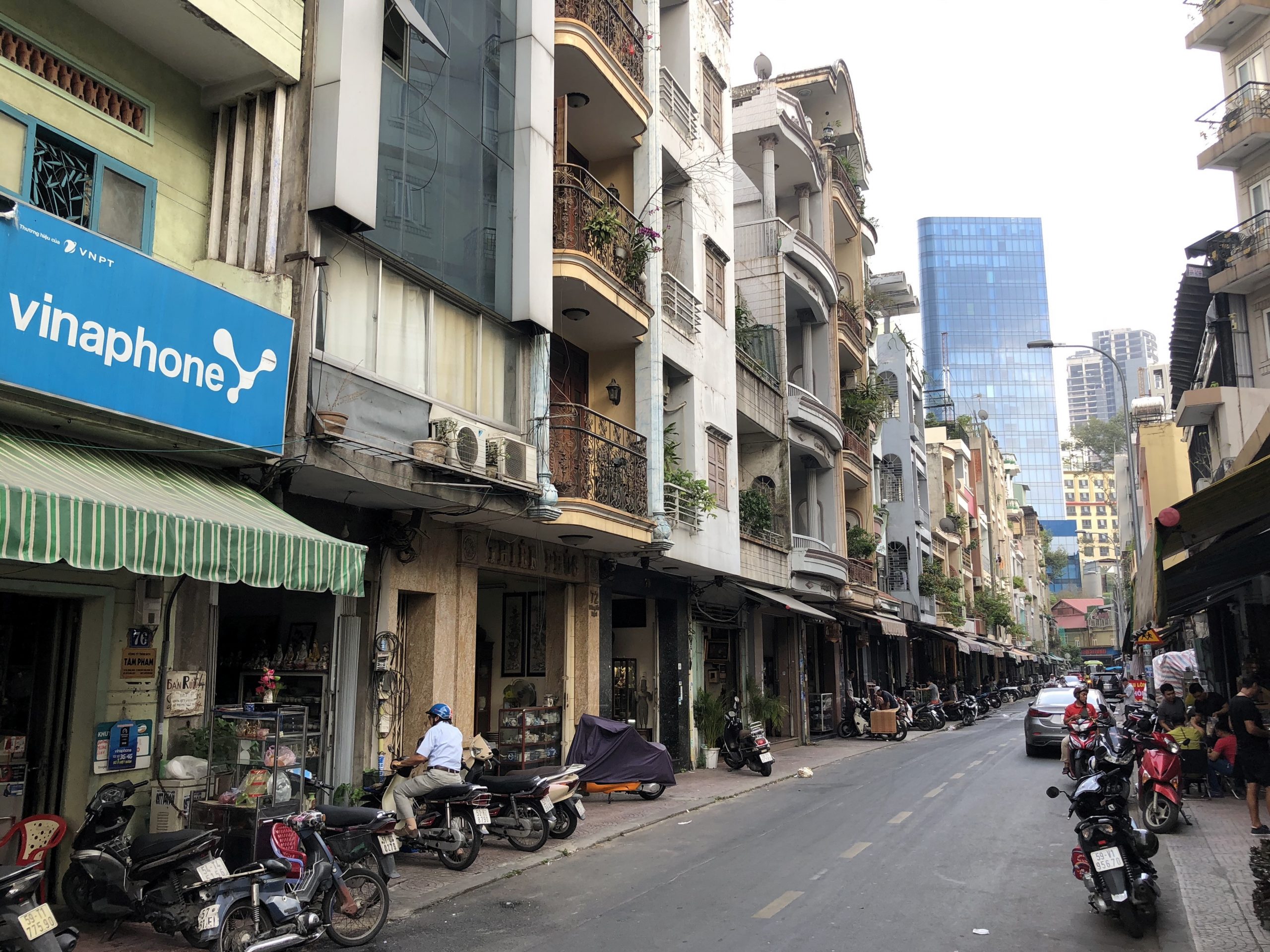
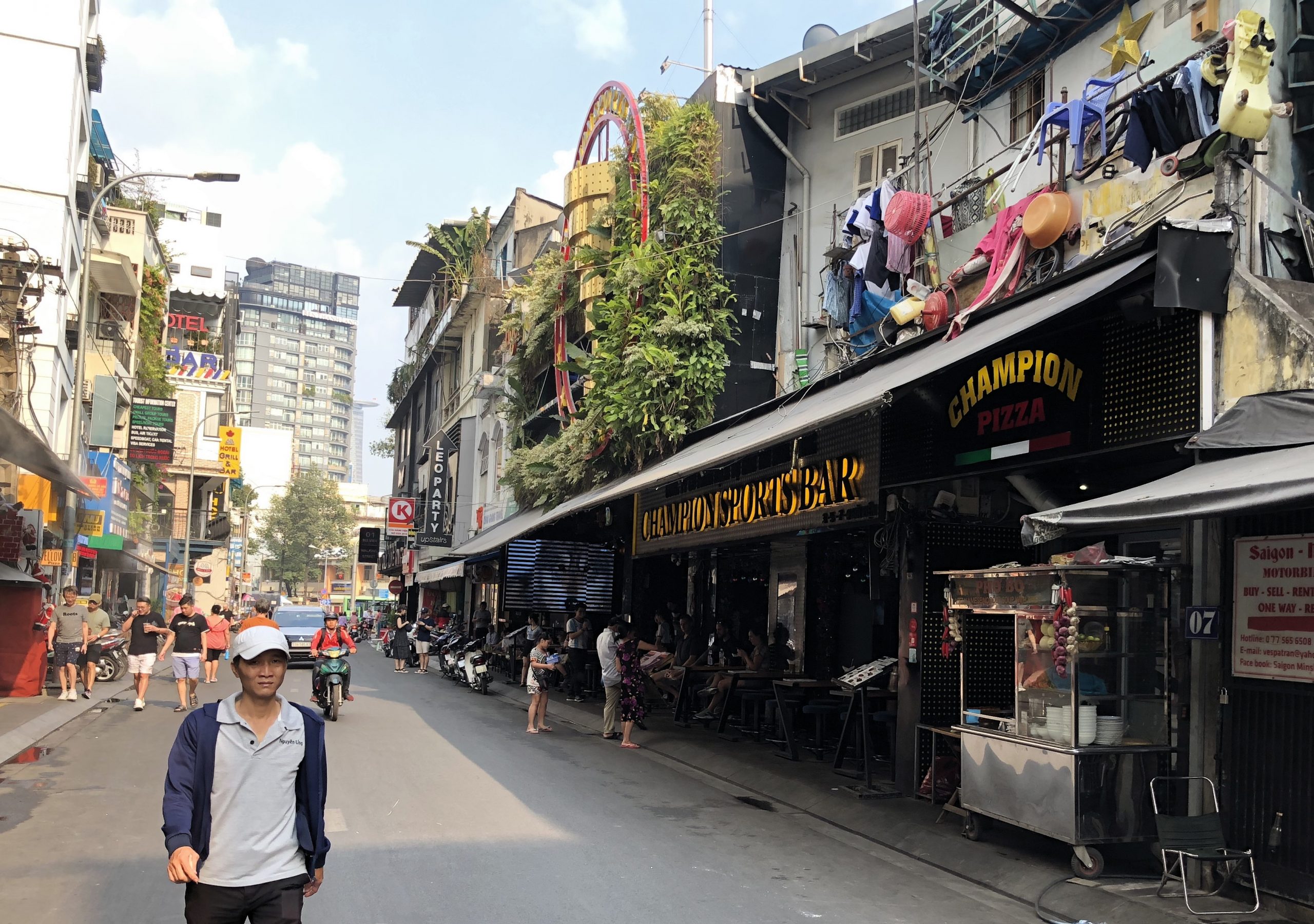
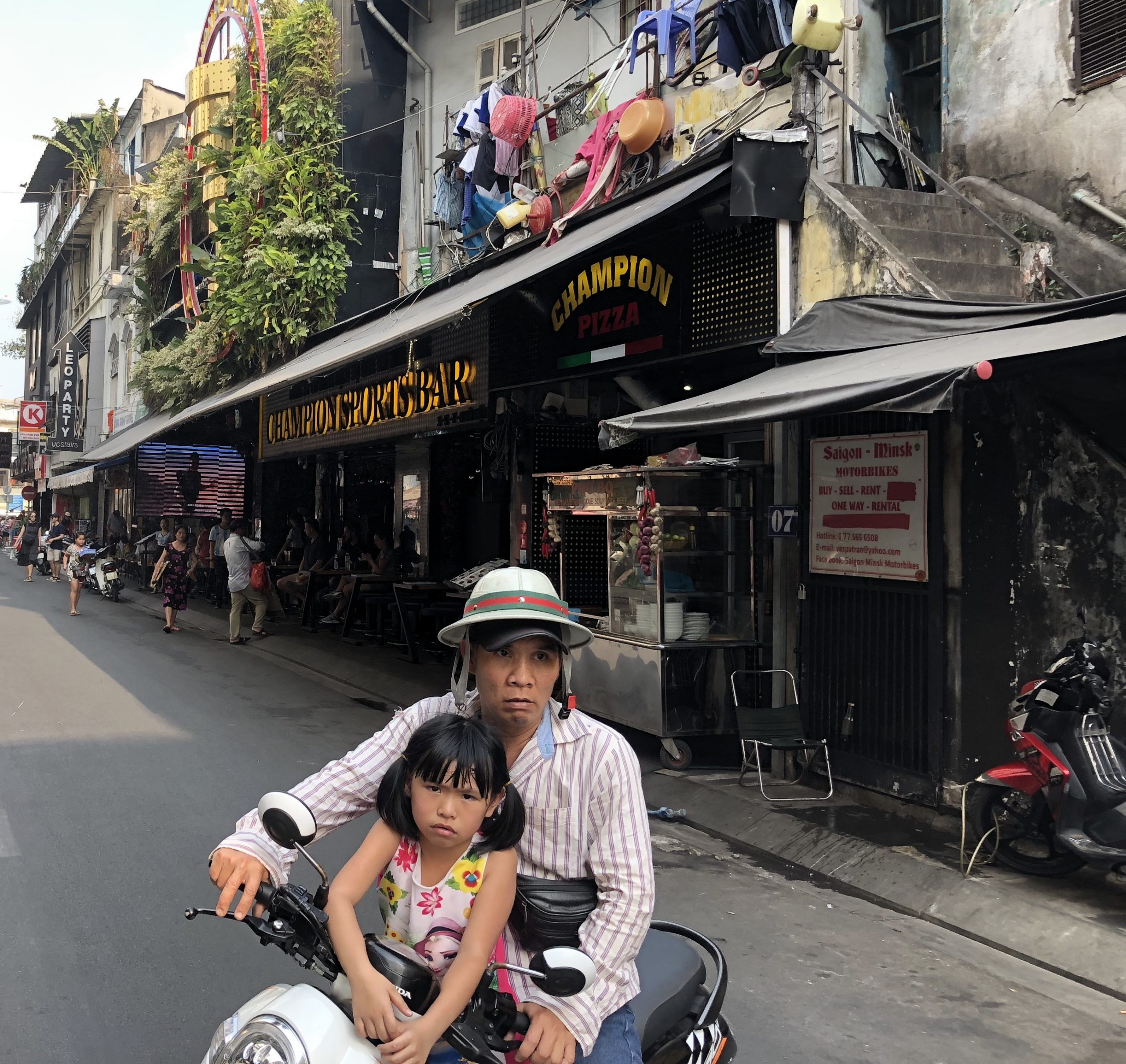
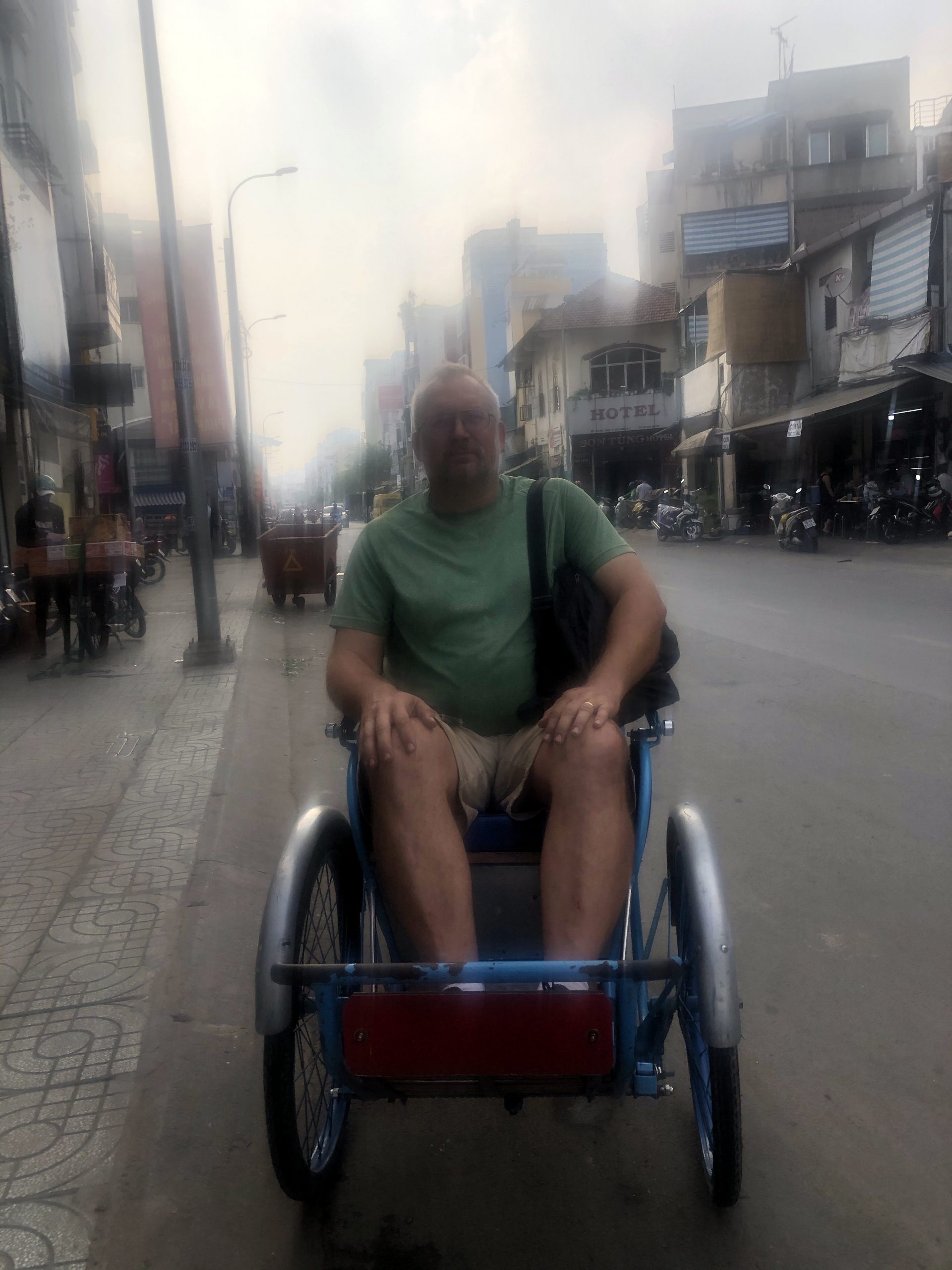
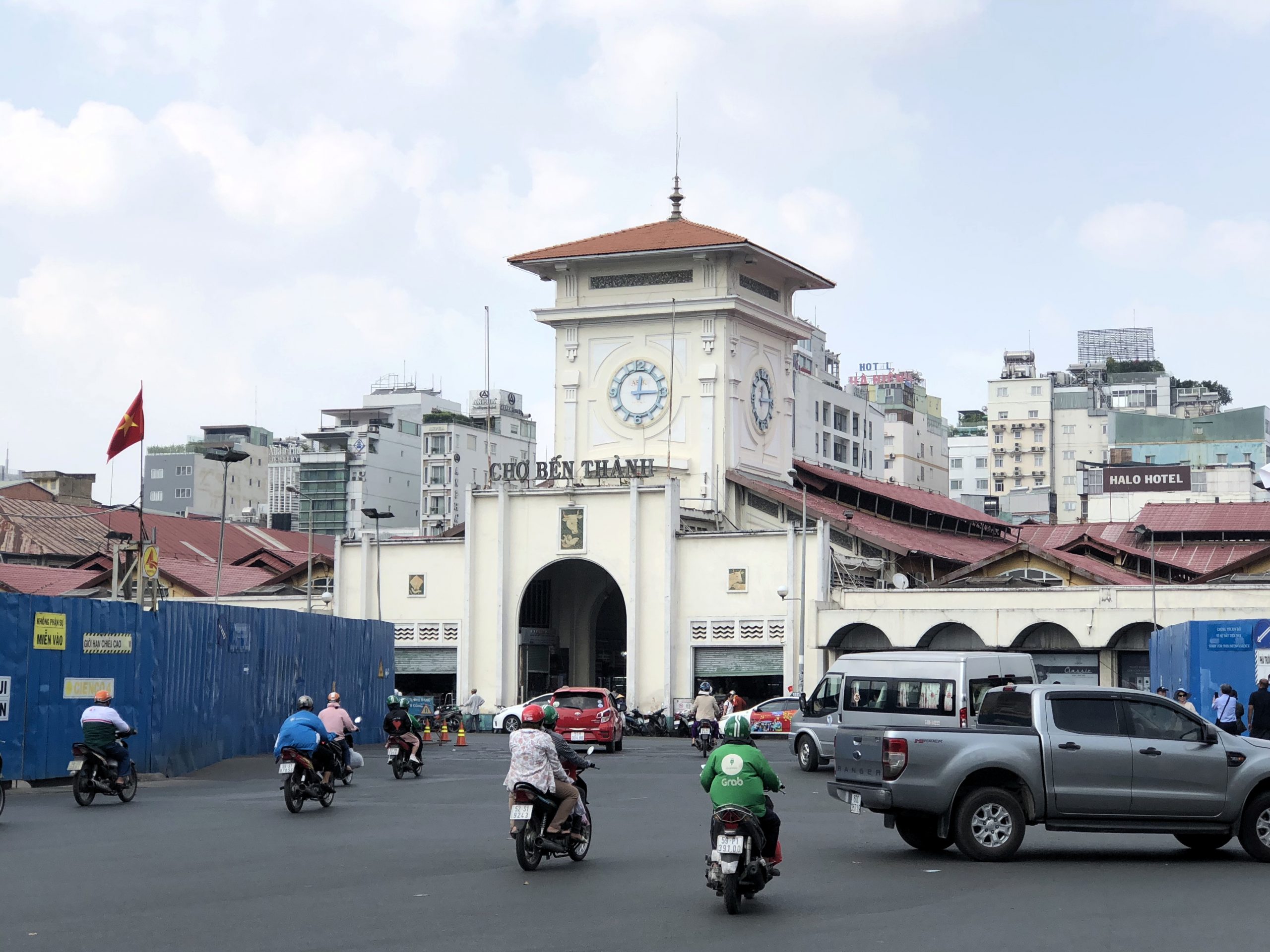
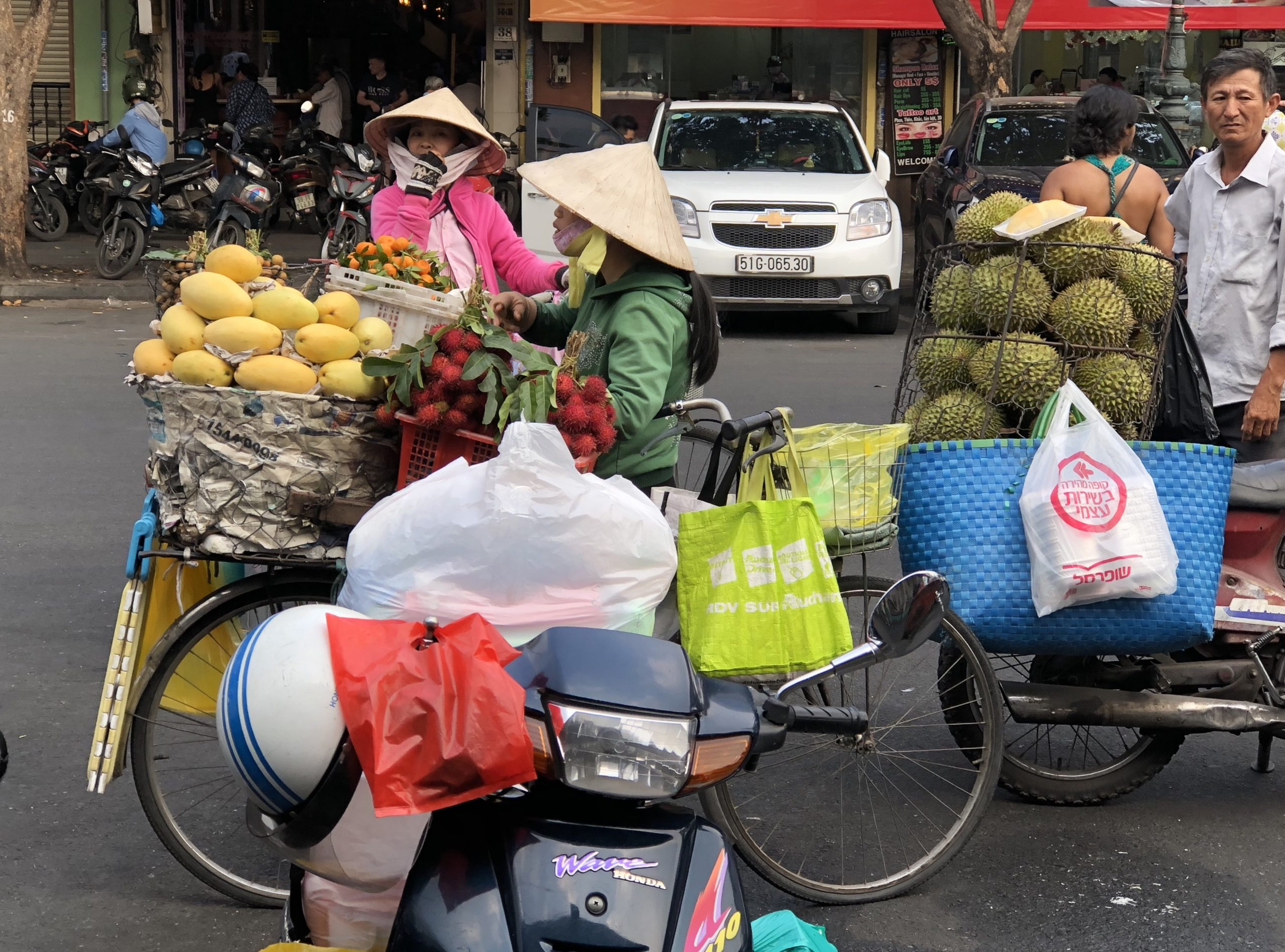
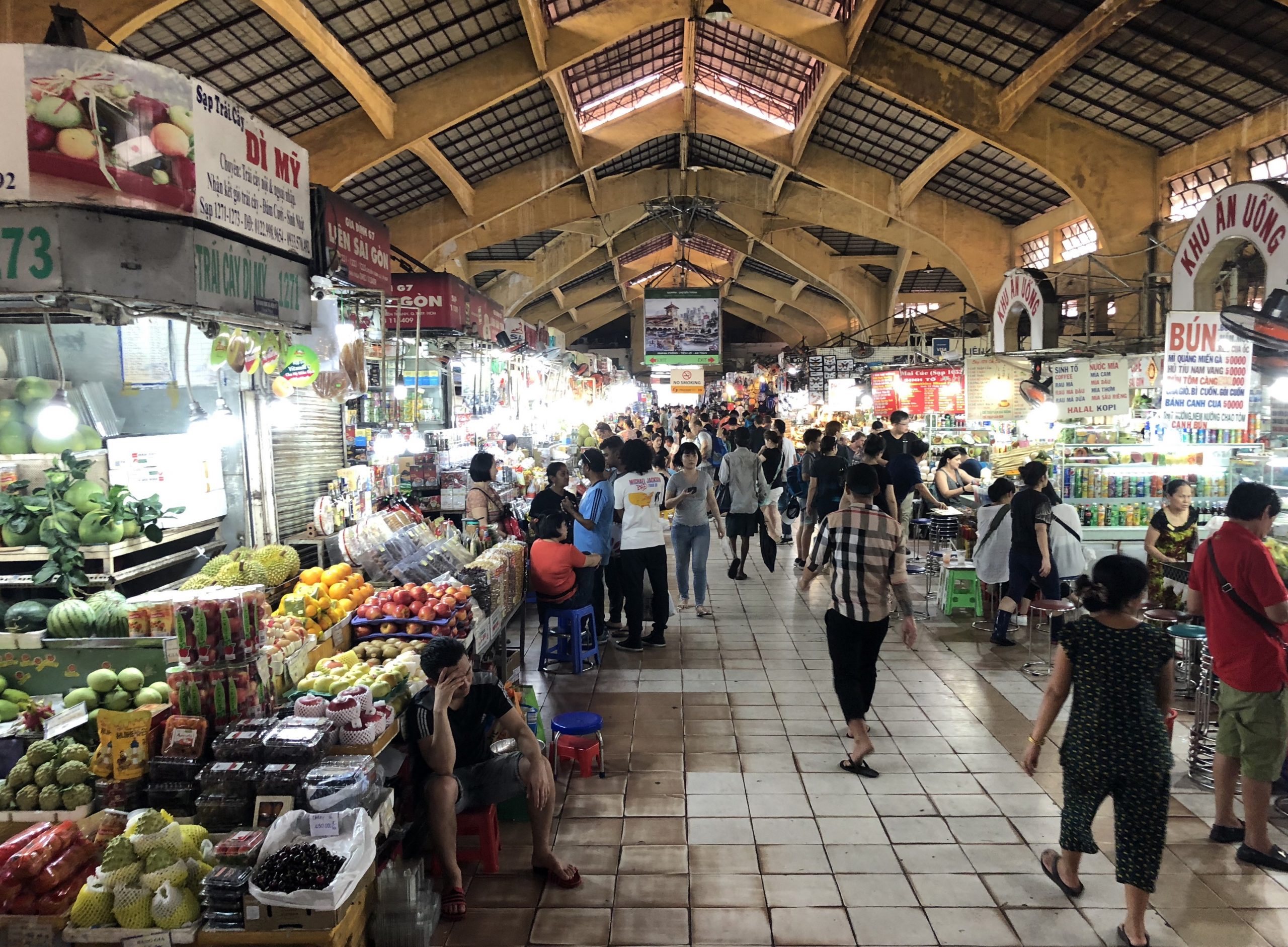
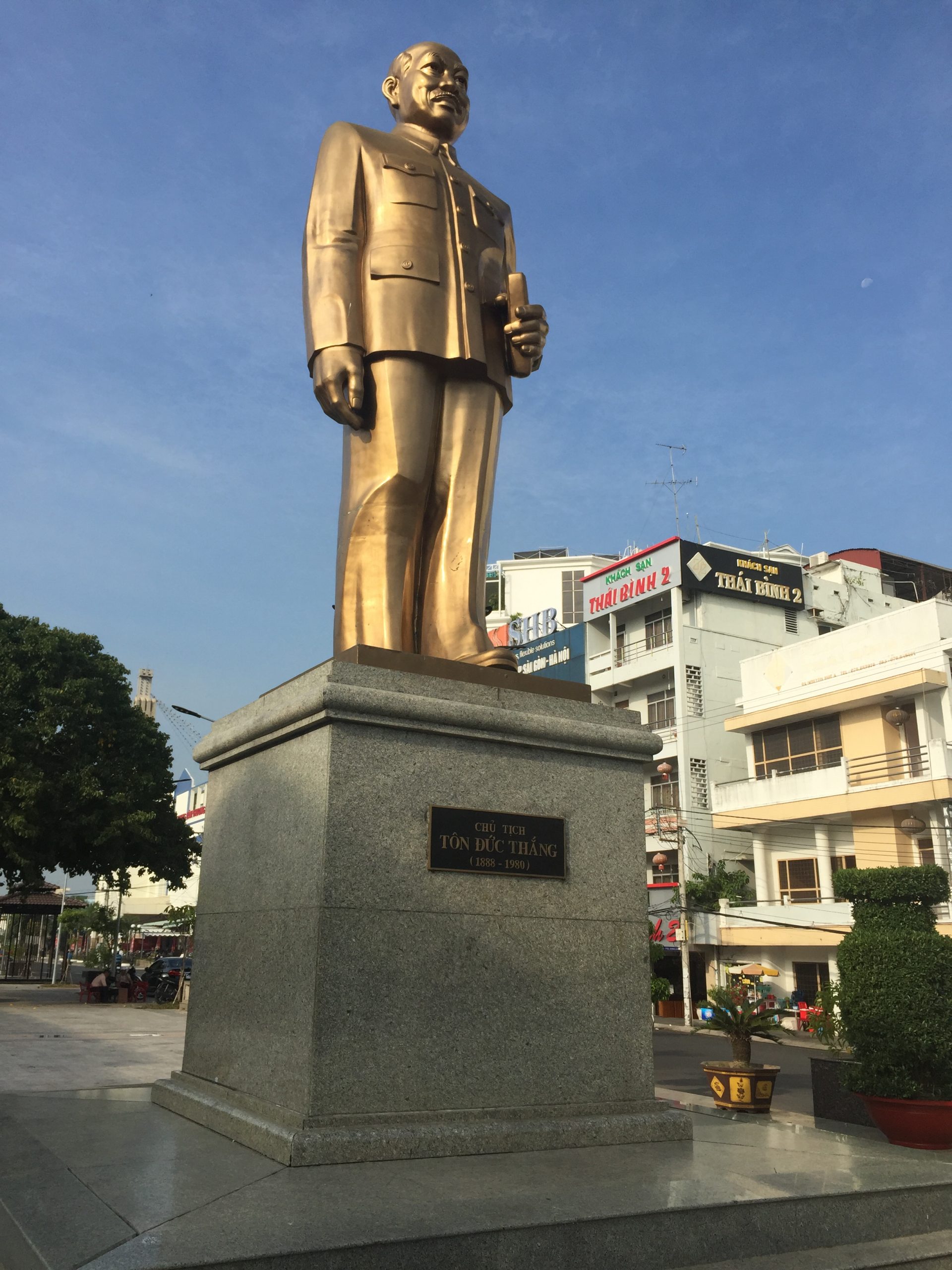
With the afternoon to kill before I had to return to the shop to pick up my boxed bike I set off to do some sightseeing, on foot. I found walking in District 1 of Saigon quite pleasant. Not because it was the cleanest city with the most pedestrian friendly infrastructure. I liked it because the streets were lively and colorful. There was nothing odd or out of place about a foreigner walking around. Also, I was in no hurry to get anywhere. I got some lunch. I went to the plaza and paid my regards to the golden statue of the great leader, Ho Chi Minh, found a geocache, and got a ride in a rickshaw.
I returned to the bike shop about an hour before it closed to pick up my box o’ bike. I am glad I got there early. There was a misunderstanding about when I needed it and when I arrived it still wasn’t done. A call from the attendant to the manager cleared everything up. The bike mechanic took about a half hour to dismantle my bike and very neatly wrap it in bubble wrap and pack it into my box. When all was done the mechanic called a Grab (Asian equivalent of Uber) car for me. It took about 45 minutes to get to the airport. My flight didn’t leave until midnight so I had hours to kill. In fact, I got to the airport before my check-in time. I rearranged my bags and found a dark corner to audit the inside of my eyelids for visual information leaks. I am happy to report no findings.
Since, my luggage check-in experience at Narita was so expensive I didn’t pack anything else in my box. I brought my panniers on as carryon luggage. This backfired on me a little bit. My ticket had restrictions on carry luggage as well. When I checked in the woman working at the check-in counter warned me that they may weigh my bags at the gate so I should rearrange my belongings to somehow make them lighter. Perhaps she meant to say throw something out to lighten the load. Anyway this was ridiculous advice and I didn’t believe that anyone would weigh my bags at the gate. I was wrong about weighing bags at the gate. Sure enough there was a scale at the gate counter. It seemed like they were weighing bags at random so I was hoping I wouldn’t be picked. I was picked. They were very zealous about the weigh-in. Not only did they weigh my two panniers which were full to the brim but they also put my waist pouch on the scale. I was over the limit. They made me check the bags and pay a fee. Even with the fee to check in one pannier it still was less than if I put everything into the bike box.
Suspicious Box
Despite sleeping most of the way back I was still very tired when I arrived in Narita. I bought a ticket for the limousine bus to Tachikawa. I had about an hour to wait for the bus. I put the cart that all my luggage was on as near to some benches in the arrivals lobby as I could and then sat down to wait for the bus. I dropped off to sleep. While I was paying a brief visit to Dreamland all the other travelers who were also waiting on the benches and whose luggage was preventing me from putting my cart nearer to the bench left, leaving my cart alone in the middle of the thoroughfare. My lonely luggage captured the attention of the airport police. I returned from Dreamland to find an officer eyeing my luggage. I hopped up immediately and informed him that the bags were mine. When he asked me where I was I told him I fell asleep on the bench just a few meters away while waiting for the bus. Before I knew it Officer Friendly was joined by two more officers. I was surrounded by uniforms. I told my story again and showed them my gaijin card and my bus ticket. They determined that I and my big bicycle box were not a threat. I was free to go. I decided that it was time to leave the arrivals lobby. I removed myself and my non-threatening big bicycle box to the bus stop. Thus was I welcomed back to Japan.
Photo Gallery
Video
[yotuwp type=”videos” id=”zKqTaKkIprg” ]
Home | Photo Gallery | Podcasts | Videos
]]>2019/12/20
The Plan at Breakfast
The riding is over. I am preparing to leave Phnom Penh. I’m eating breakfast at the restaurant in the hotel and the plan for today is to go see the genocide museum maybe do a little shopping at the Russian market and catch a bus out of town to Ho Chi Minh City.
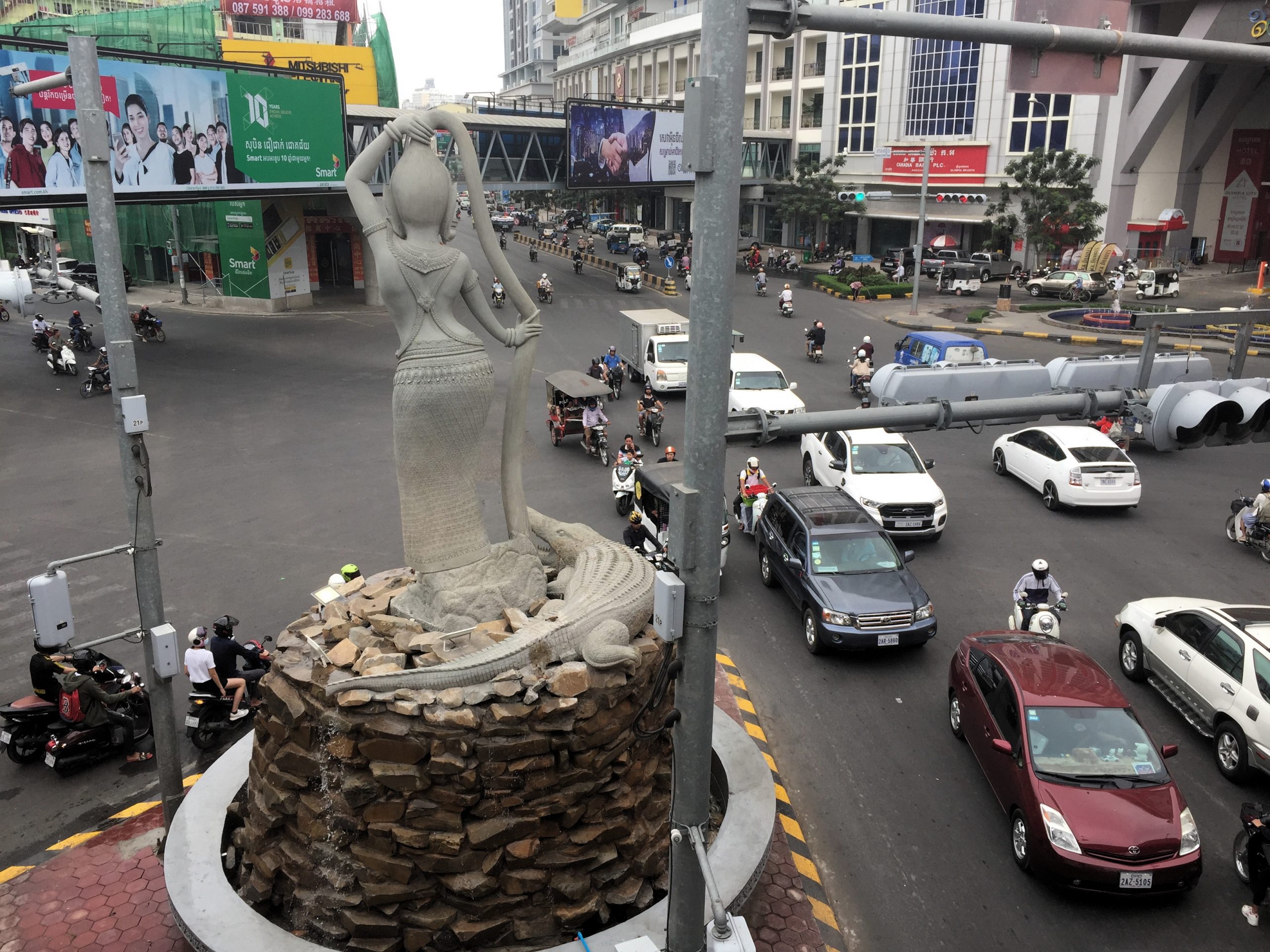
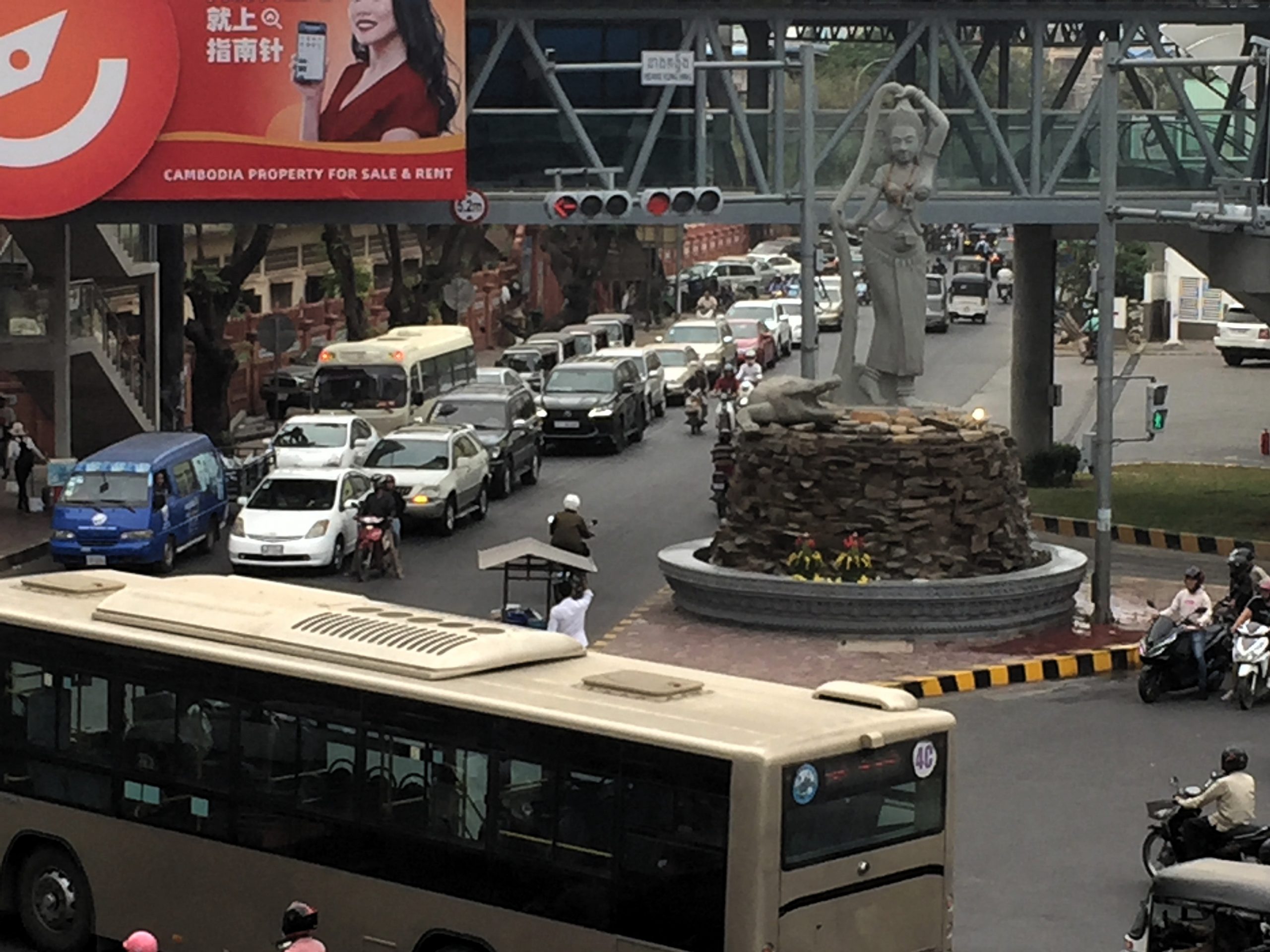
Phnom Penh has the feel of a city that’s desperately trying to be modern. In many ways it’s similar to Tokyo; big buildings, lots of traffic, office ladies dress to the nines. But behind the big buildings are the street vendors, the trash and the poverty. It is clear that the U. S. dollar is a highly coveted commodity here. Many restaurants post prices in both dollars and riel. I don’t know which would give you a better deal. When you change money you lose a little bit of value. I haven’t been here long enough to know whether the dollar price is better than the riel price. There is always going to be a bit of rounding going on as there are no really small denominations in riel and nobody wants to deal with pennies, nickels, and dimes. I exchanged 400,000 Vietnamese Dong yesterday at the front desk here and they really gave me a bad deal. I realized it right away but there wasn’t much I could do about it. As soon as I had an Internet connection I confirmed that I lost 10 USD in value on a relatively small transaction. I felt they really didn’t want to exchange VND. They are really after USD. Perhaps, in the long run, it doesn’t matter, but I’m trying to keep this trip under budget. It also influences my overall impressions of the establishment’s honesty. I will mention this in my review. This place really could be nice with some more effort and pride. Given the Cambodian economy, 100,000 yen could make the place quite homey. 1,000,000 yen could make it a 5 star establishment. Of course, 100,000 yen is probably half a year’s salary for the average man in Cambodia. Perhaps there is a business opportunity for a careful foreign investor. Anyway, if I ever come to Phnom Penh I won’t be staying here again. There isn’t even a lake anymore. The government leased the land to a developer who filled the lake in and built buildings in its place.
When the Plan Falls Apart
What a crazy day! It started out okay but it pretty much went off the rails as soon as I checked out of the hostel. I stopped to chat with two other travelers who lounging in front of a neighboring hostel. We were talking about my bike and I was bragging how I had ridden it for 5 days without flats or mishaps when less than 30 seconds after leaving the gentlemen I noticed my back tire was low on air. I pulled over and aired up the tire. A few blocks later it was low again. I knew I had a flat. I stopped in front of the Science University and began to fix my flat. While I was working on it a guard came over to check me out. When it was clear to him that I was no kind of threat he smiled at me and disappeared. Flat fixed, I navigated my way to Tuol Sleng Genocide Museum. I payed a thousand KHR to officially park my bicycle. 24¢ to park. Not bad. Unfortunately, I didn’t have enough riel or dollars so I decided to leave my bike safely parked at the museum and walk to the FX shop. I soon realized it was farther than I anticipated. There was a tuk tuk driver across the street. A great chance to go for a tuk tuk ride. It cost me 6,000 KHR to go close to my destination. I had pointed on the map to where I wanted to go. I think that because the Olympic Stadium dominated the map it distracted the driver from the pin drop on the FX shop. He didn’t take me all the way because I wasn’t clear enough about where I wanted to go when I pointed on the map. The FX office was near the Olympic Stadium which is a major landmark. He assumed I wanted to go there. No problem. It was now close enough to walk.
I exchanged what I thought was a fair amount of Vietnamese Dong. The clerk handed me about 30 USD and few small riel notes. My first thought was to ask for riel only but it occurred to me that almost everybody prefers to get dollars over riel in Phnom Penh so I shrugged and excepted my greenbacks.
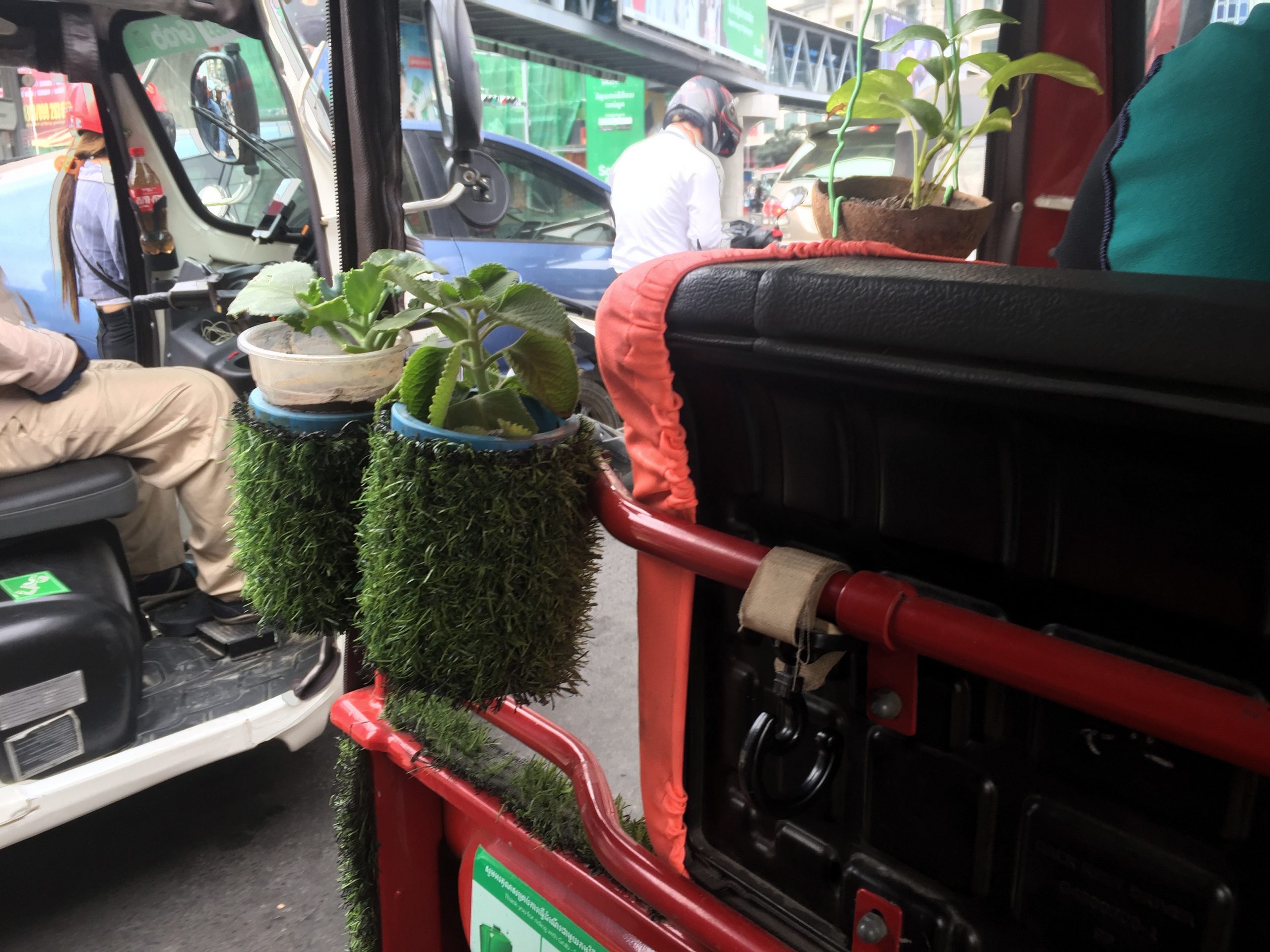
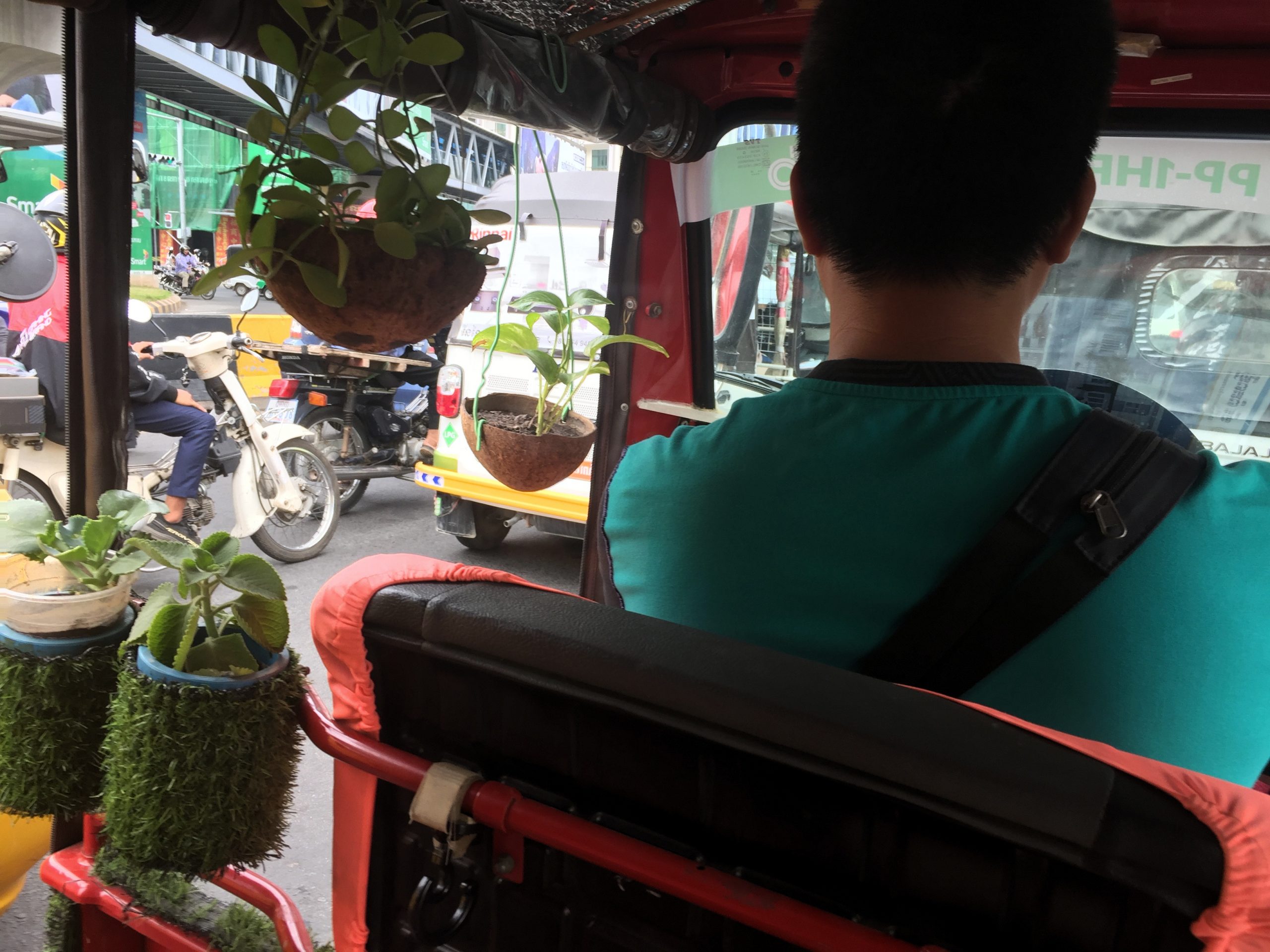
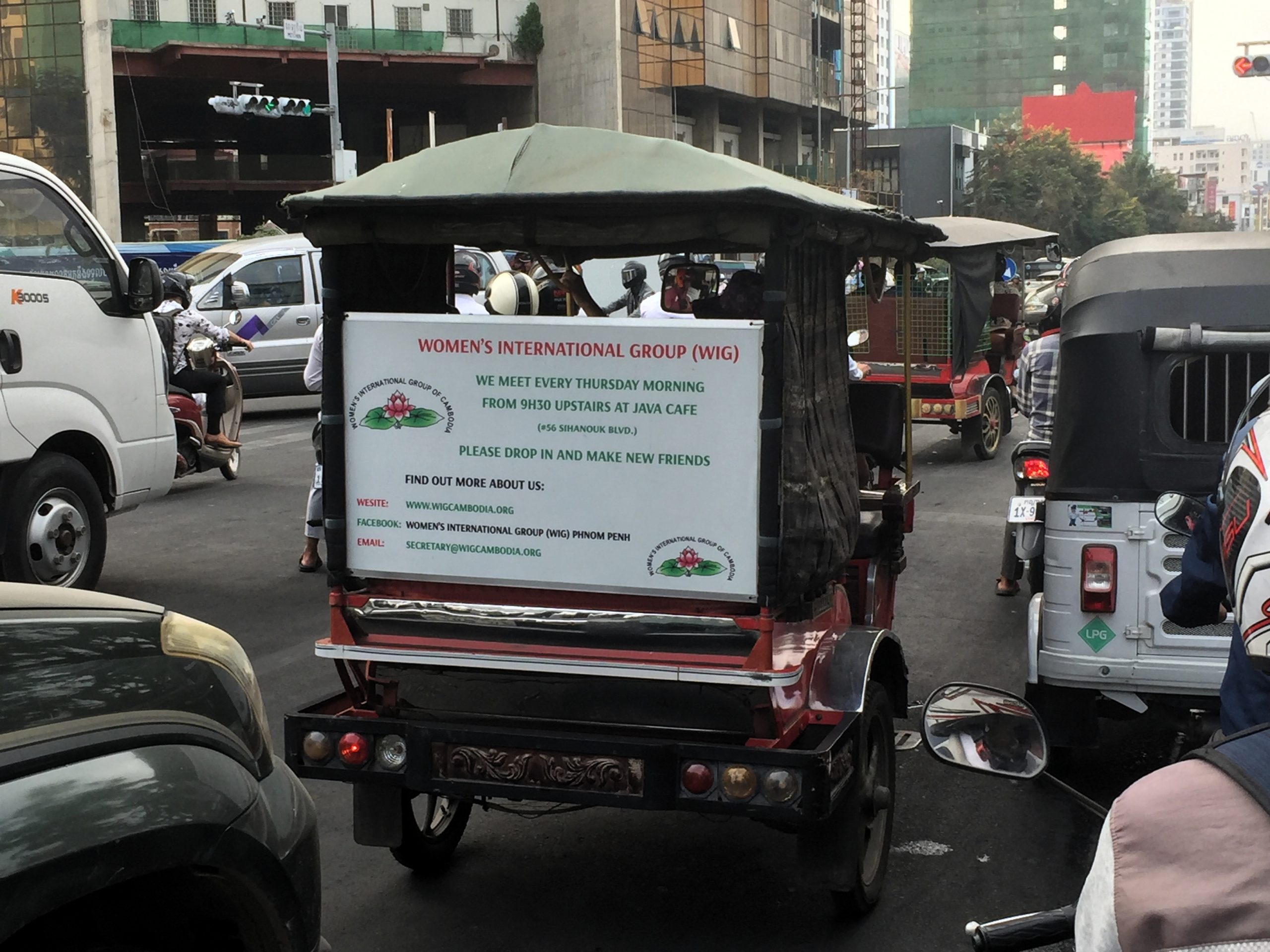
Money in hand, I flagged another tuk tuk. I picked a red one that was upholstered completely with astro turf and potted plants hanging in the windows. A real green design. I told him where I wanted to go repeating it several times. He quoted me a price of 8,000 khr and away we went. I thought I made myself clear about where I wanted to go. The Genocide Museum. Somehow the driver thought I meant some other museum it seems. After a while it felt like it was taking too long to get there so I checked the map and, sure enough, we were going on a tangent towards the palace. I told the driver he was going in the wrong direction. He did an amazingly tight u-turn. (Those tuk tuks can turn on a dime!) I suppose he wasn’t happy about the extra distance but it was his mistake. He didn’t charge me anymore than he quoted so I guess he was basically an honest guy.
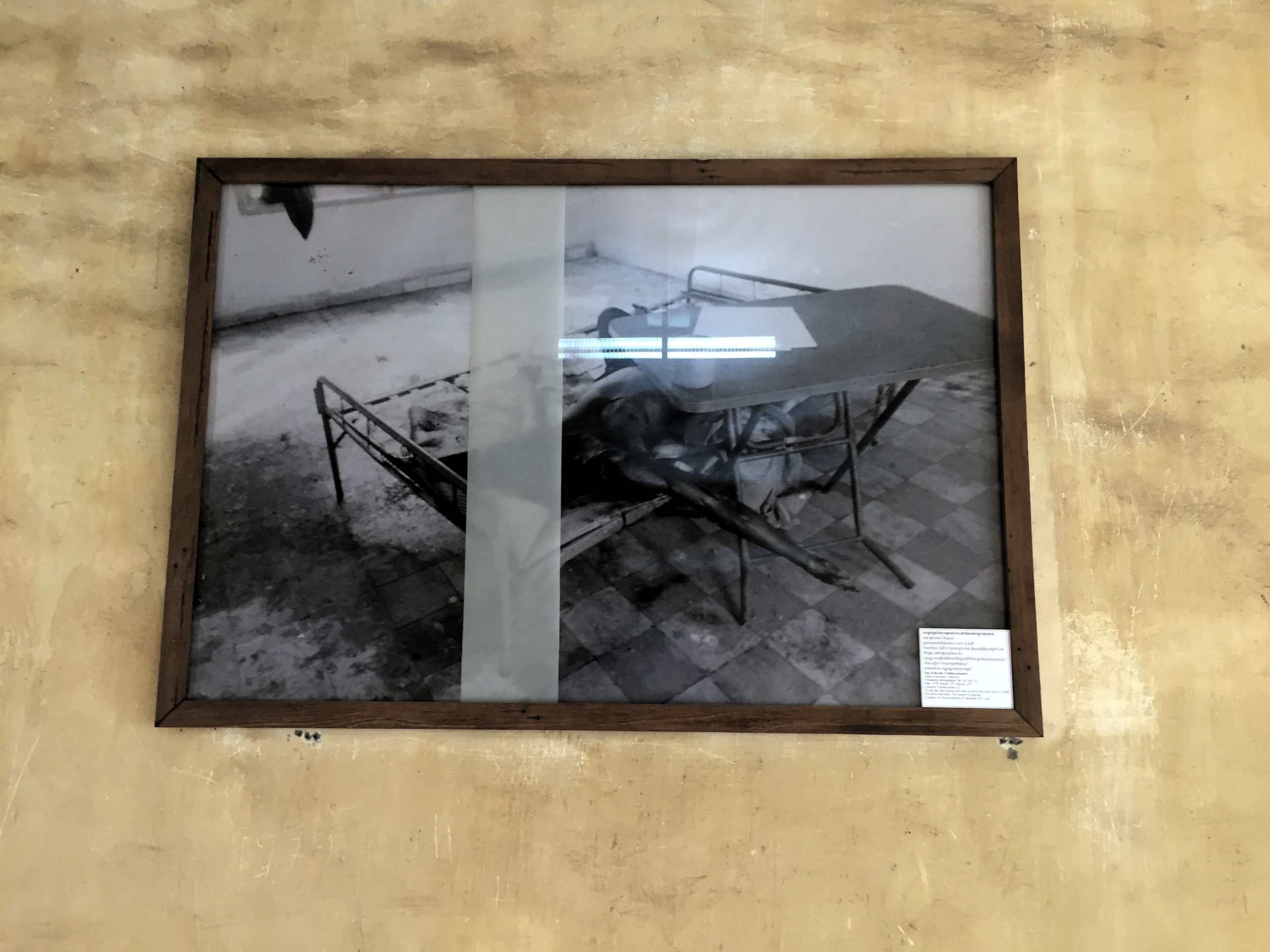
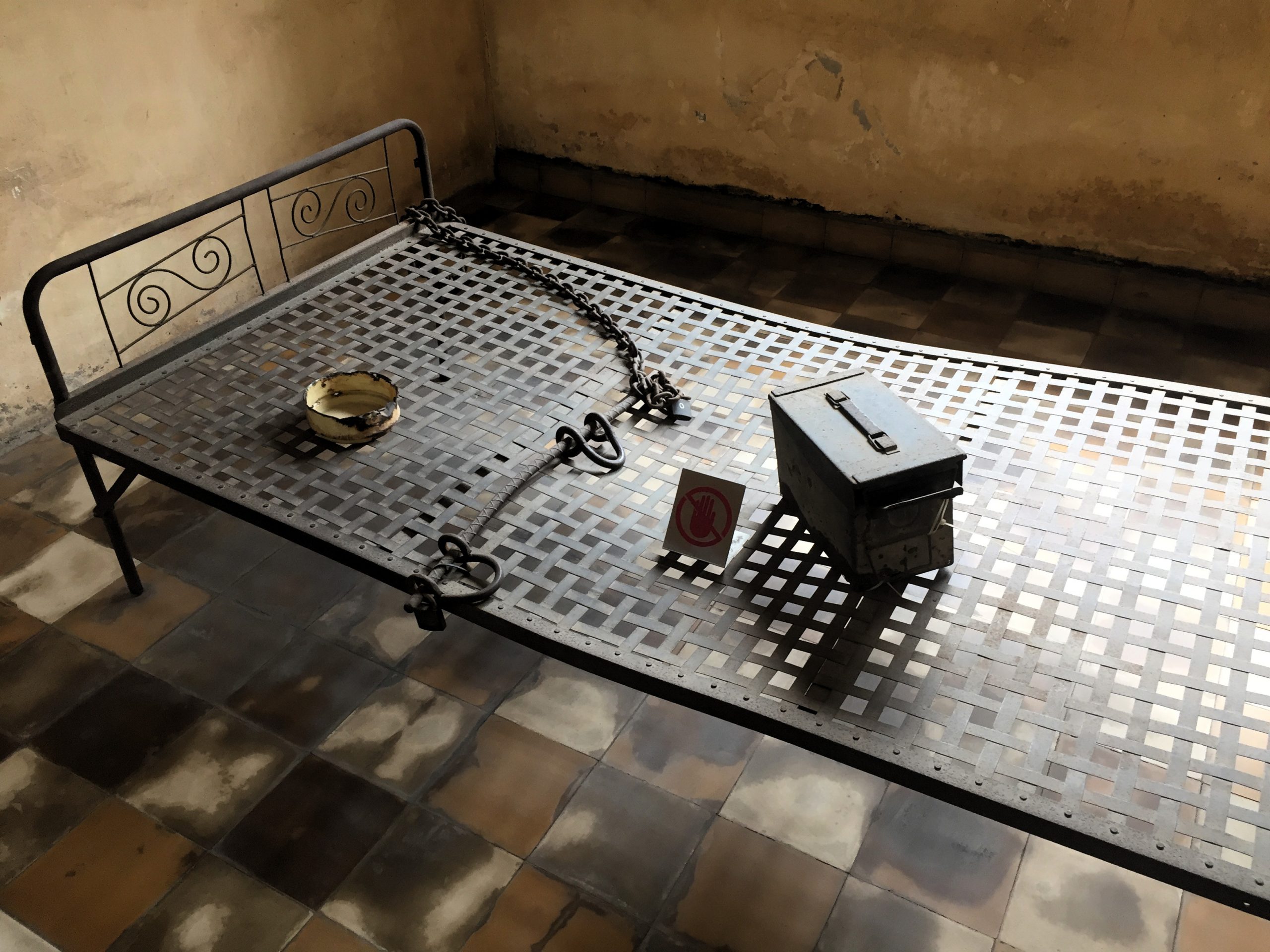
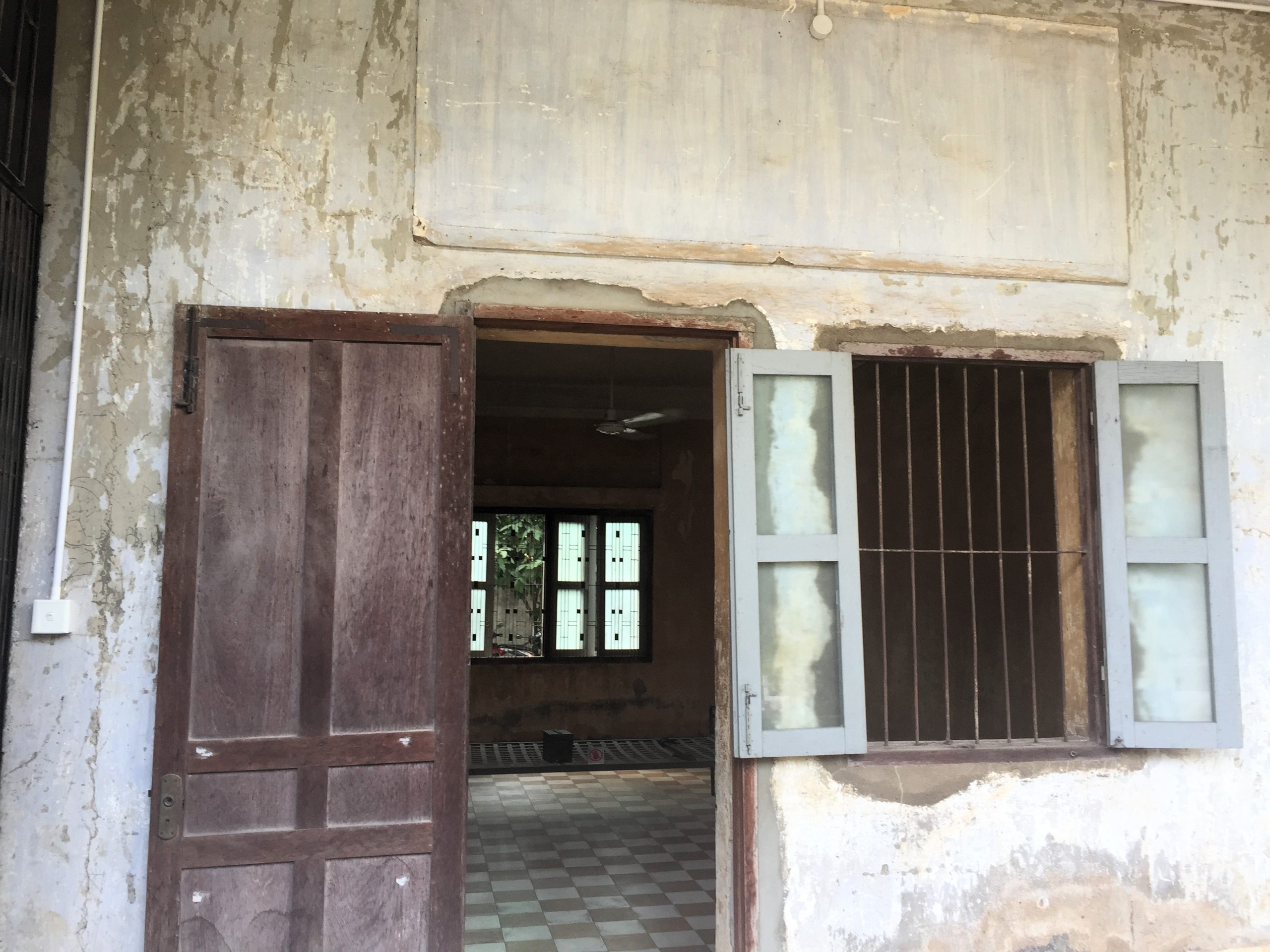
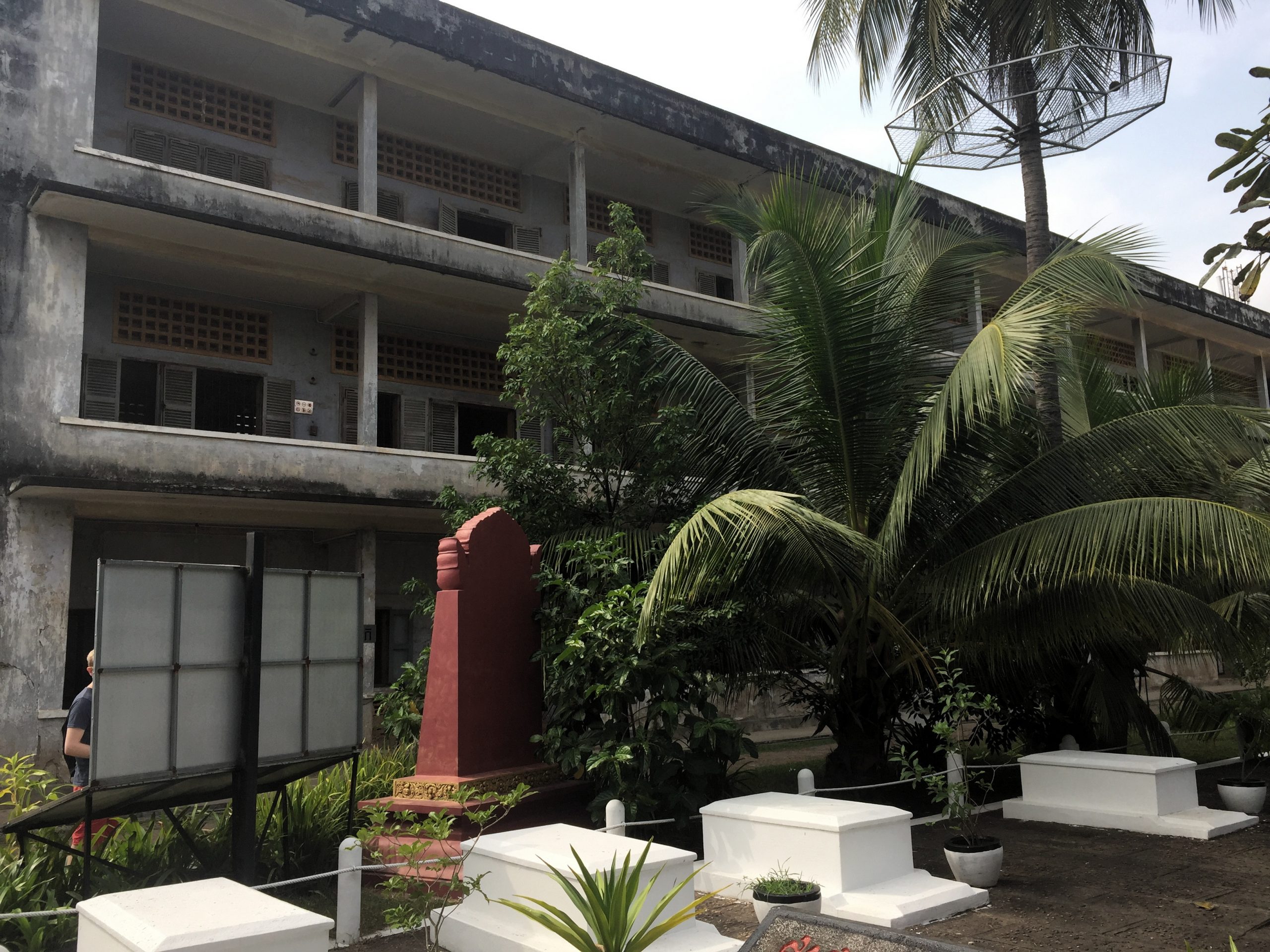
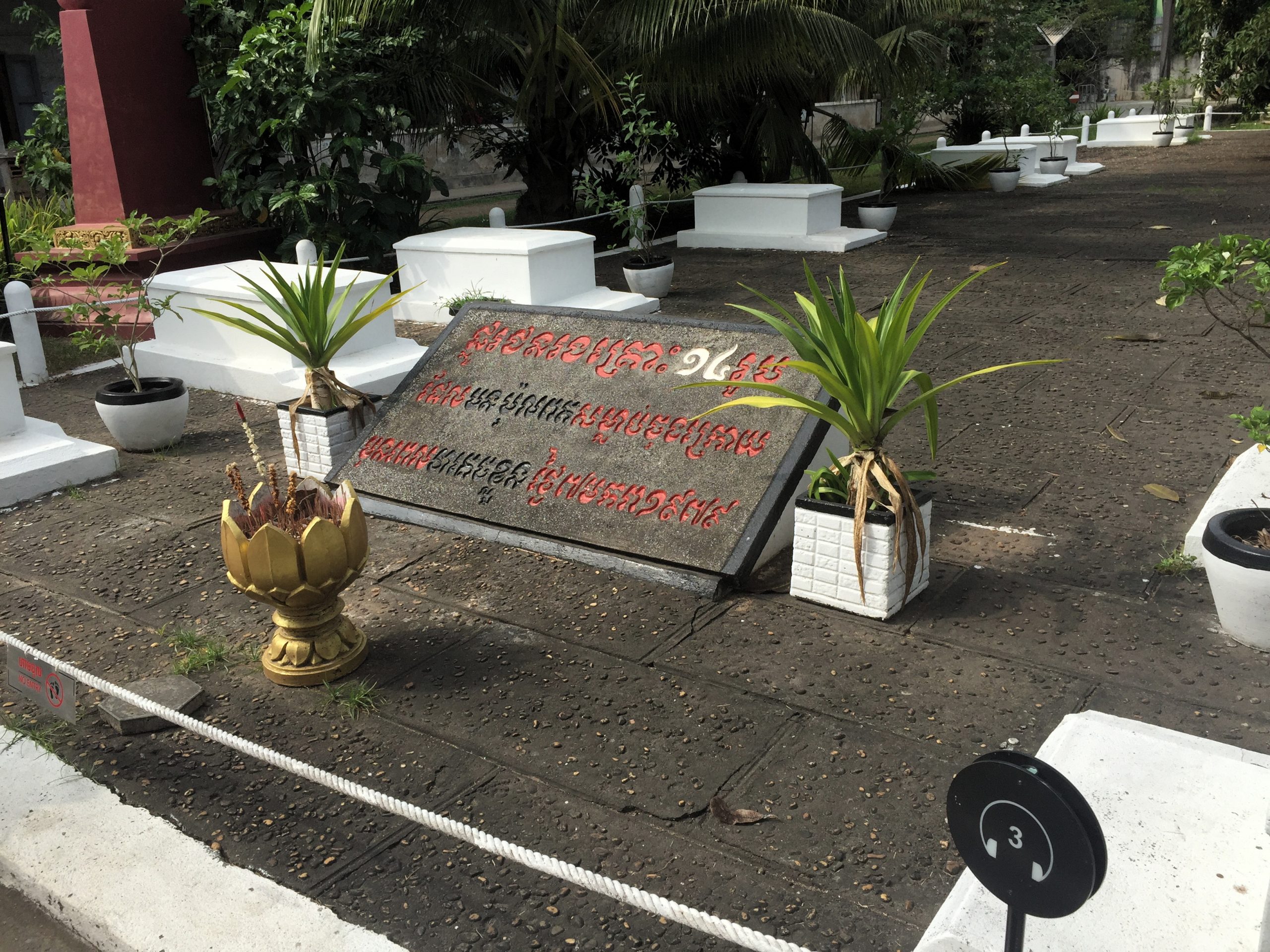
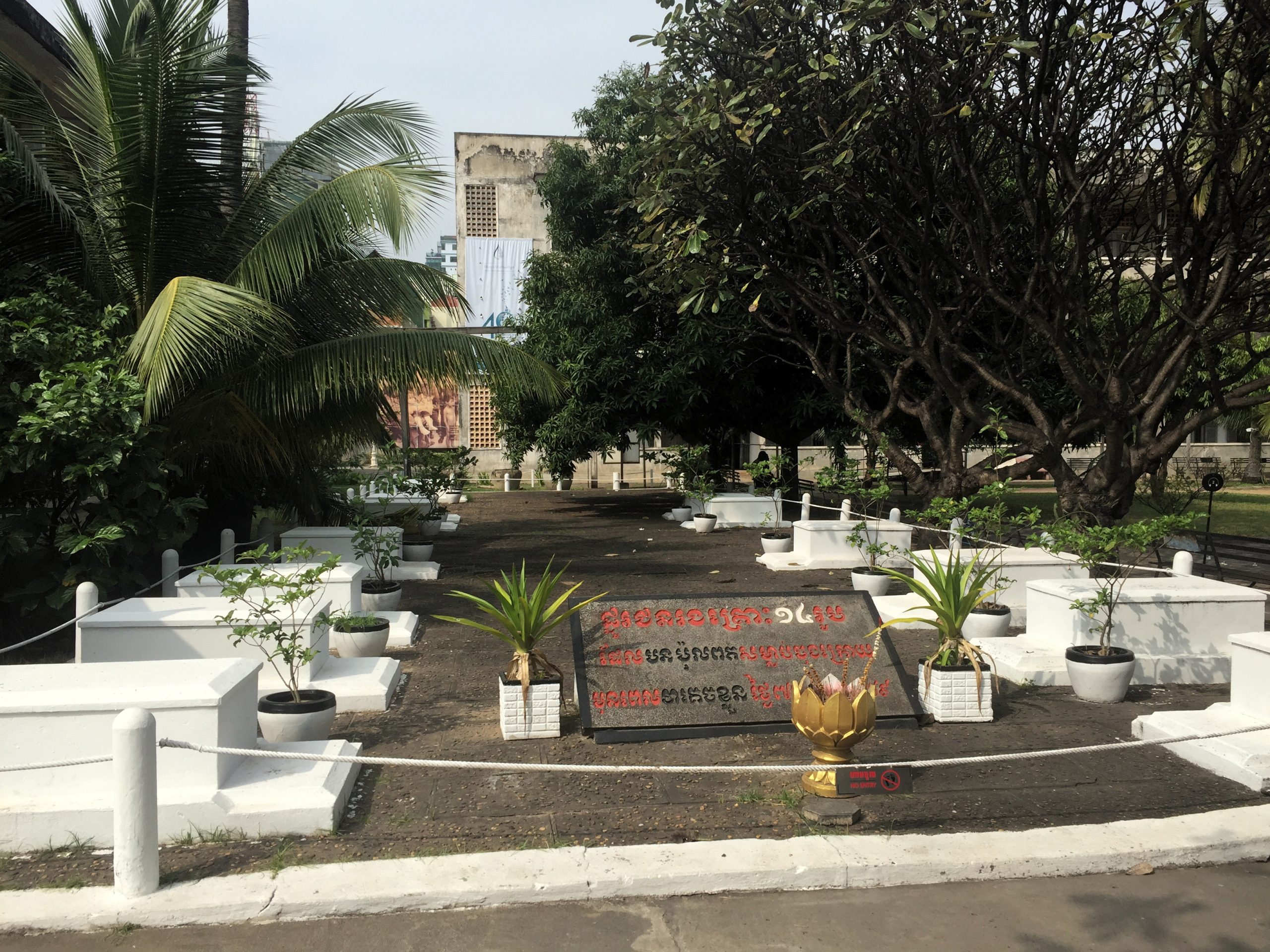
The Tuol Selong Genocide Museum
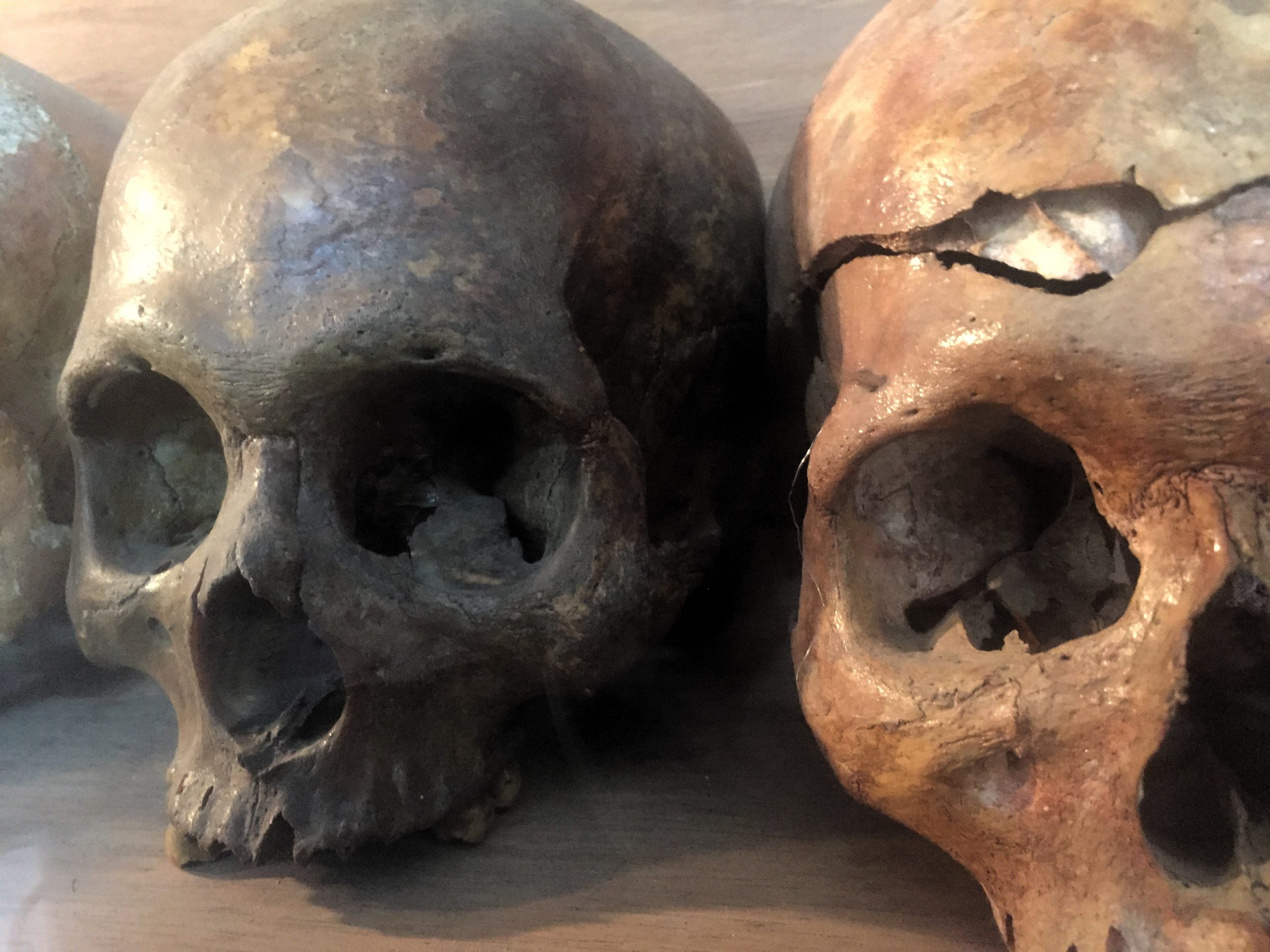
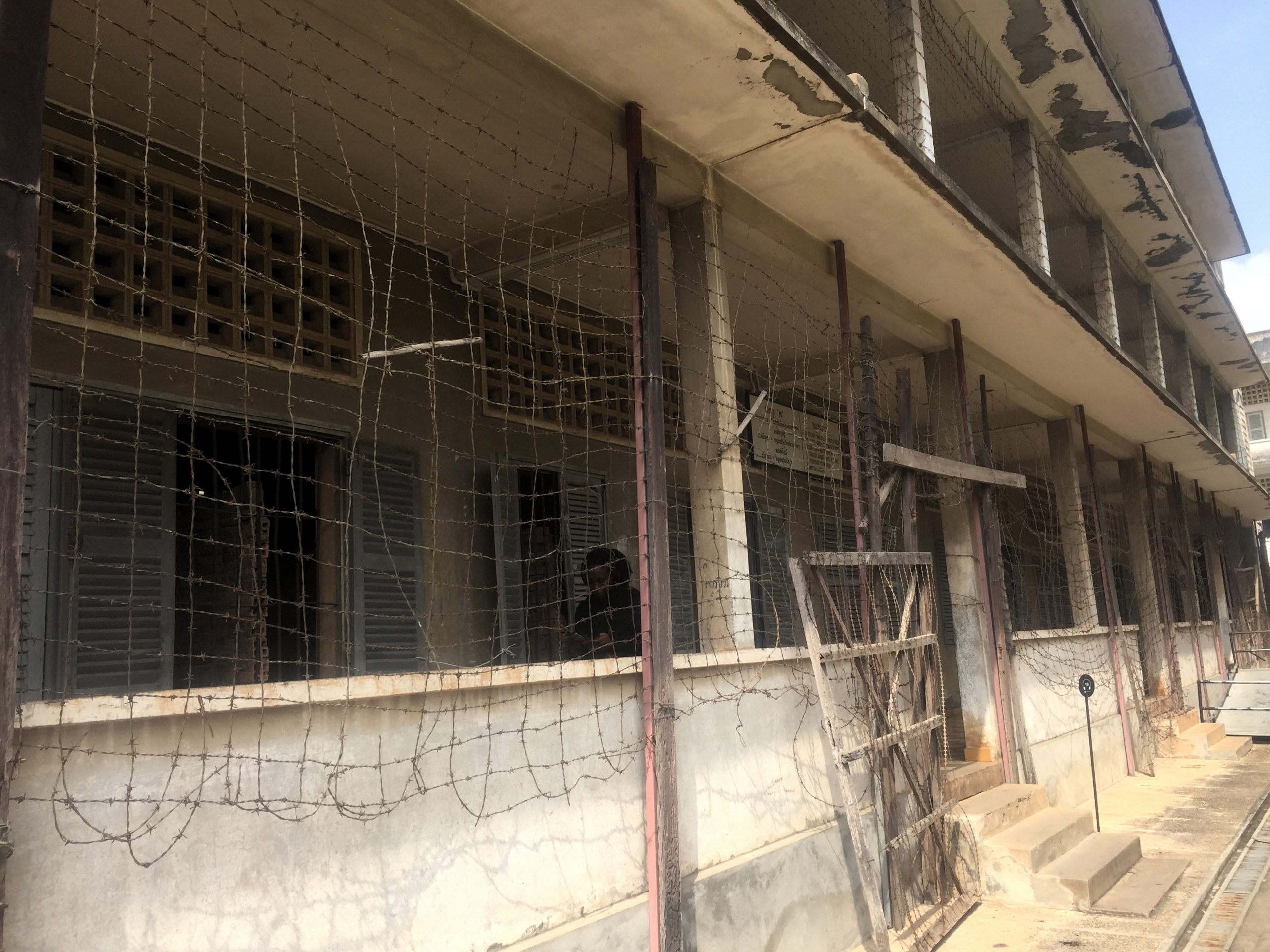
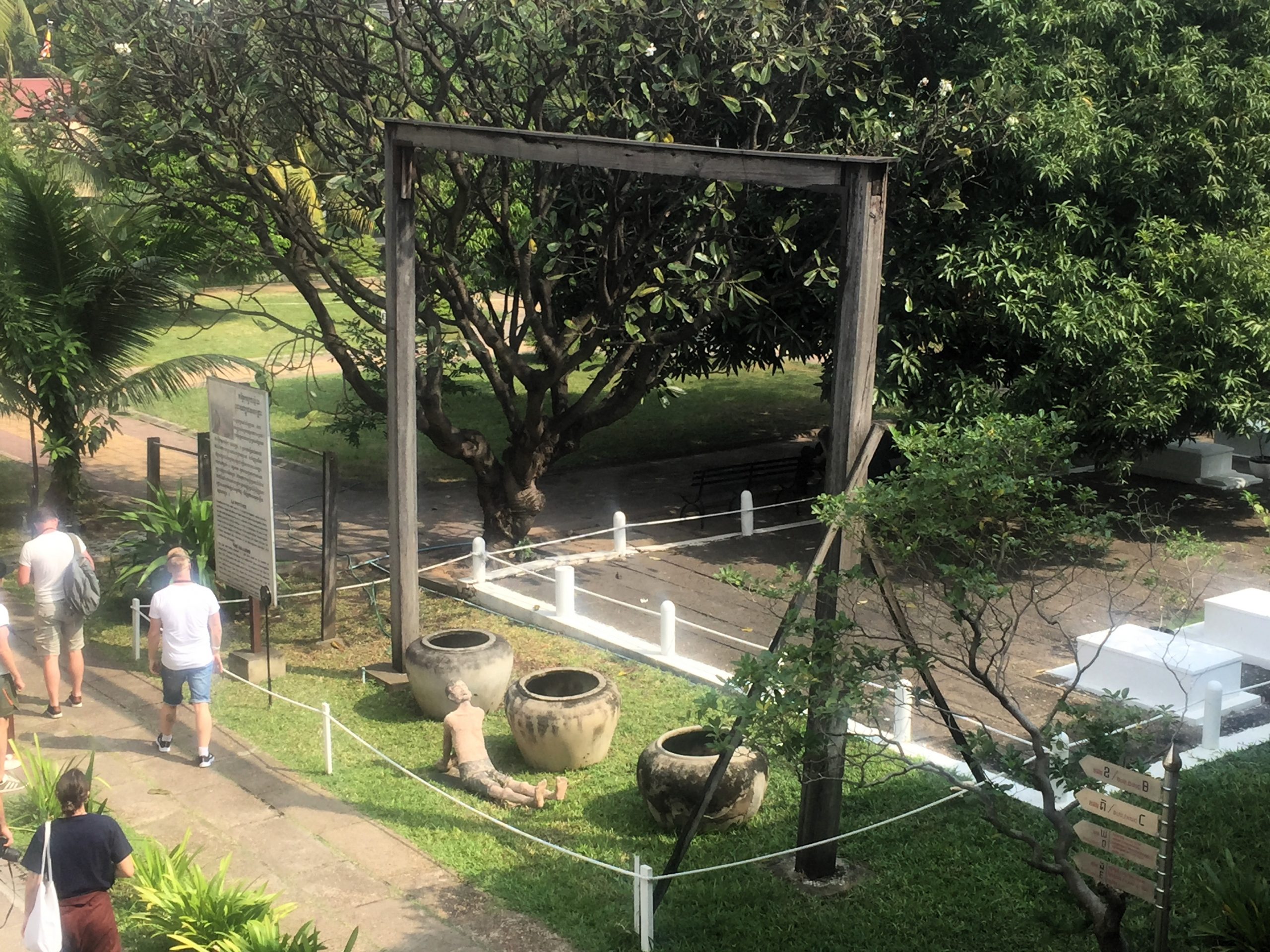
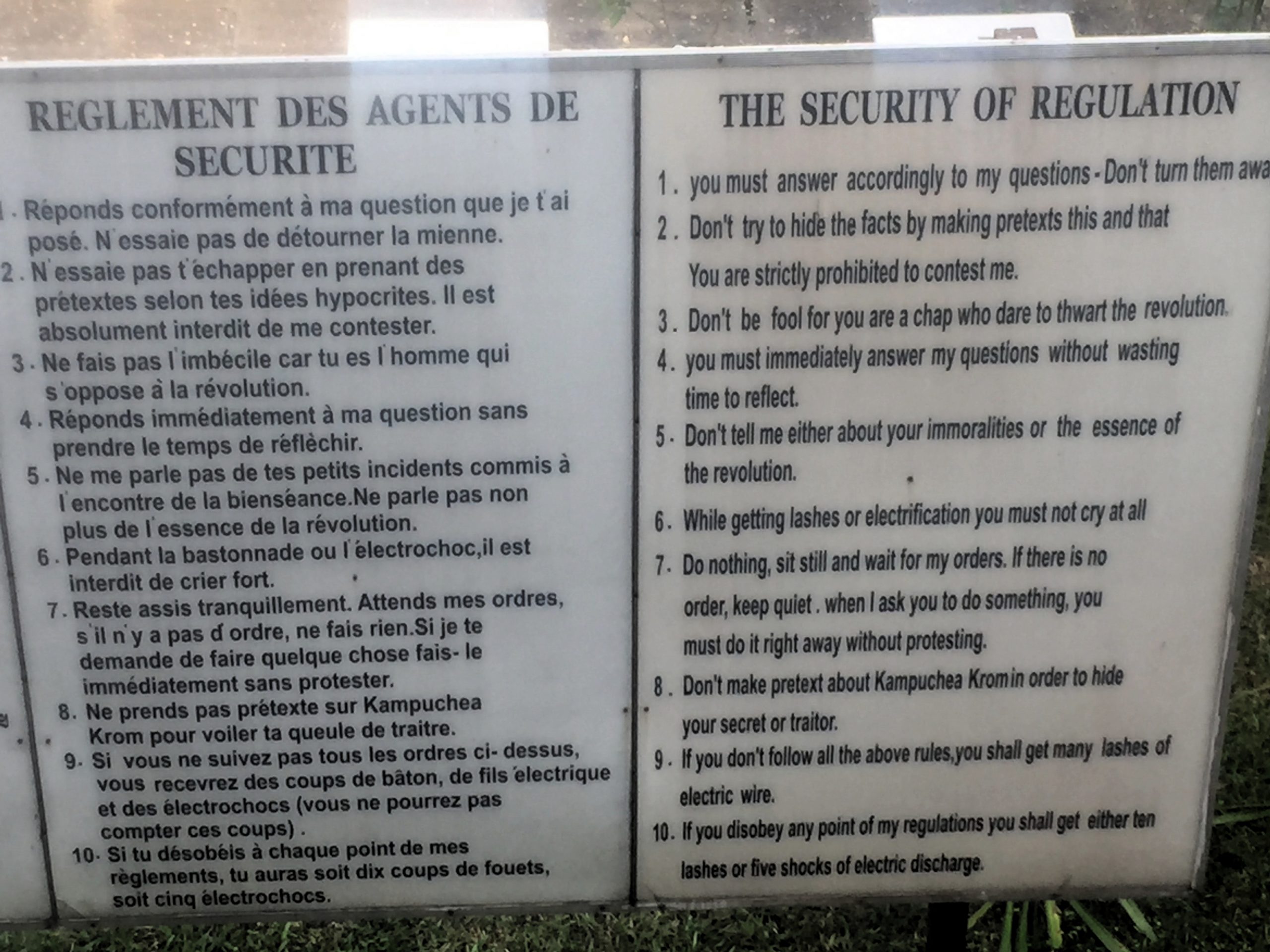
The Genocide Museum is a horrible place that everyone should visit. It is like the Genbaku Dome in Hiroshima or the Nagasaki Atomic Bomb Memorial. It is a reminder how atrocious humans can be to each other. While it is not stated outright a little connect-the-dots leads one to understand the United States’ complicity in the tragedy. I will not go into details here. One should experience for themselves or at least do their own research. Start with these links.
| Official Web Site: https://tuolsleng.gov.kh/en/ Tuol Sleng Photographs: http://www.tuolsleng.com/ The Killing Fields Museum of Cambodia: http://www.killingfieldsmuseum.com/s21-victims.html Wikipedia: https://en.wikipedia.org/wiki/Tuol_Sleng_Genocide_Museum |
Unfixable Flat
I stayed later than I planned at the museum. I had planned to go the Russian Market to get some souvenirs. It was too late. I wanted to leave town by 1 pm so I could get to Ho Chi Minh City at a reasonable hour. According to various web sites the trip would take 6-7 hours. No time for souvenir shopping. I decided to go to the bus terminal. Despite patching my tire, when I came out of the museum it was flat again. I pumped it up hoping it would last long enough to get to the bus terminal that I thought wasn’t very far away. It didn’t hold. Cycling on the streets of PP is challenging enough but I find it preferable to pushing a bike through the chaotic crowds of tuk tuks, food carts, delivery motorcycles, street venders and other users. I stopped at a sandwich shop and ordered a sandwich for 1 dollar which I took “to go”. I put air in the tire a got another few blocks on me way before I was back to pushing it again. I really wanted to fix the tire again but the streets were too crowded and I was still hoping to get on a bus by 1. The bus agent was in the middle of Orresy Market and very hard to find. Looking around the ticket office I realized it could not possibly be the bus depot. It was just too crowded and too chaotic. The ticket seller confirmed this. I tried to pay for my ticket with my credit cards to conserve my dwindling dollars and riel but the charge was denied. I paid $12 from my dwindling supply of USD. It was 12:20 and the bus left at 2:00. Not the worst result. All the online sources put the bus ride at 6-7 hours. That would mean getting to Ho Chi Minh City at 8 o’clickish. Acceptable.
Unfortunately, the terminal was farther away than I expected. It was back towards where my hotel was and further north still. Peddling a bicycle, maybe 20 minutes or so away. Pushing a bicycle – a lot longer. There was nothing else for it but to set out. I aired up the tire once again and set off. I thought If I put air in the tire every few blocks I could make it in time. The air was leaking out faster and faster. I had to push it or fix it.
I finally got through the market which was crowded and chaotic. I was pushing as fast as I could. It became clear to me that I wasn’t going to make it by two walking. I came upon a Hindu temple and pulled out of the noise and bustle into the calm. I would take the 15 to 20 minutes needed to fix the flat again and even have time to eat my lunch afterwards.
I pulled out my tools and took off my panniers, because of course it was the back wheel. Took off the wheel, levered off the tire and pulled out the tube. The patch I put on earlier in the morning had been obliterated. All that remained was a square of adhesive. I had used a self-adhering patch I got from Cycle Mode last month. I thought it would be okay temporarily. It just didn’t hold up. Okay. Lesson learned; don’t be lazy, put on a real patch. I did so. I put the whole thing back together. Fine. Now there is time to eat my lunch. While I was working on the bike an older monk came by. He said something to me which I didn’t understand. I said something to him that he didn’t understand. We smiled at each other and he went on his way. A good but, for all practical purposes, meaningless interaction.
Belly full. It was time to go. Oh no. The tire was flat again. Argh! Now there was no time to open up that can of worms again. I made another sub-optimal decision. Just ride it with a flat and damn it all with the damage it will do to my tube, tire and rim. Not to mention my soul each time I hit a bump, and there were many. I covered the distance but time was bleeding away.
I didn’t have a properly functioning map. Without cell service I couldn’t search for anything except when I could connect to Wi-Fi like at the sandwich shop. As I got near the bus terminal I started to look for buses. I know, a no-brainer, right. Bus terminal = buses. I couldn’t see any buses or anything that looked terminalish. I stopped to ask for directions at a local shop. I managed to make myself understood somehow. The woman pointed me back the way I came. Okay I passed it up somehow. I went a few hundred meters and asked again. I was pointed in the opposite direction. By this time I am starting to panic. Time is leaking away. I turned around again. No sign of a bus terminal. Did the Mekong Express Bus Terminal fall into another dimension? Like the Emperor’s new clothes is it only visible to party members in good standing? Was I suffering from bus blindness? I finally found it. The buses were all in the back, out of sight from the road. Logical but not what I expected.
I had made it in time with 20 minutes to spare. I was reassured that I would be able to put the bicycle in the cargo compartment but it would cost $10. Fine, an acceptable expense. One problem, no combination of riel and dollars in my wallet came to $10 and my credit card was denied again. There was a hairy faced occidental foreigner and his family sitting nearby. In the worse case scenario I could ask him to exchange some dong for me – maybe. Fortunately, I was able to pay in dong at a fair rate. Whew. 5 minutes to 2. Mission accomplished. But no bus. After all that, it left an hour late.
Long Bus Ride and a Border Scam
If I had known, I could have tried to fix my tire again. If it is even repairable after all the abuse I gave it riding on it flat. I was glad to be on the bus with an E.T.A. of 9 pm. Still acceptable. I settled in for a long ride as the bus crawled through the city. I made the acquaintance of an Australian man traveling with his family; mom, dad (the same hairy faced chap in the terminal waiting room Ithat considered borrowing or buying currency from) and his four kids. From him I learned why my credit card was rejected. The settlement company used by most businesses in this part of the world is Chinese and Visa and Mastercard just deny authorization as a matter of course. We swapped stories of our travels in Asia.
As the bus rolled through the benighted countryside, back along the road I had come on the day before the sun set and we were still on the Cambodian side of the border. It became clear to me that I was going to arrive in Ho Chi Minh later than I expected. I wanted to notify my hotel but wouldn’t have cellular service until I got back to Vietnam. Meanwhile, the bus attendant , a stockily built fellow, came down the aisle checking all of our passports to make sure we had a proper visa (something that was already checked when we bought our tickets). He informed us that we would not have to pay anything on the Cambodian side to exit the country but there might be a 1 or 2 dollar charge on the Vietnamese side of the border for the entrance stamp.
After a rest stop another, skinnier bus attendant came through the bus checking our passports again telling us the same story. Finally, skinny bus attendant guy came through again repeating the process. I was still baffled and skeptical. After all, I didn’t have to pay any fee when I arrived at the Ho Chi Minh Airport. I didn’t pay anything extra when I was leaving Vietnam. I saw the list of fees at the land border crossing and I don’t remember there being a charge listed for any kind of entry fee other than the official visa fees.
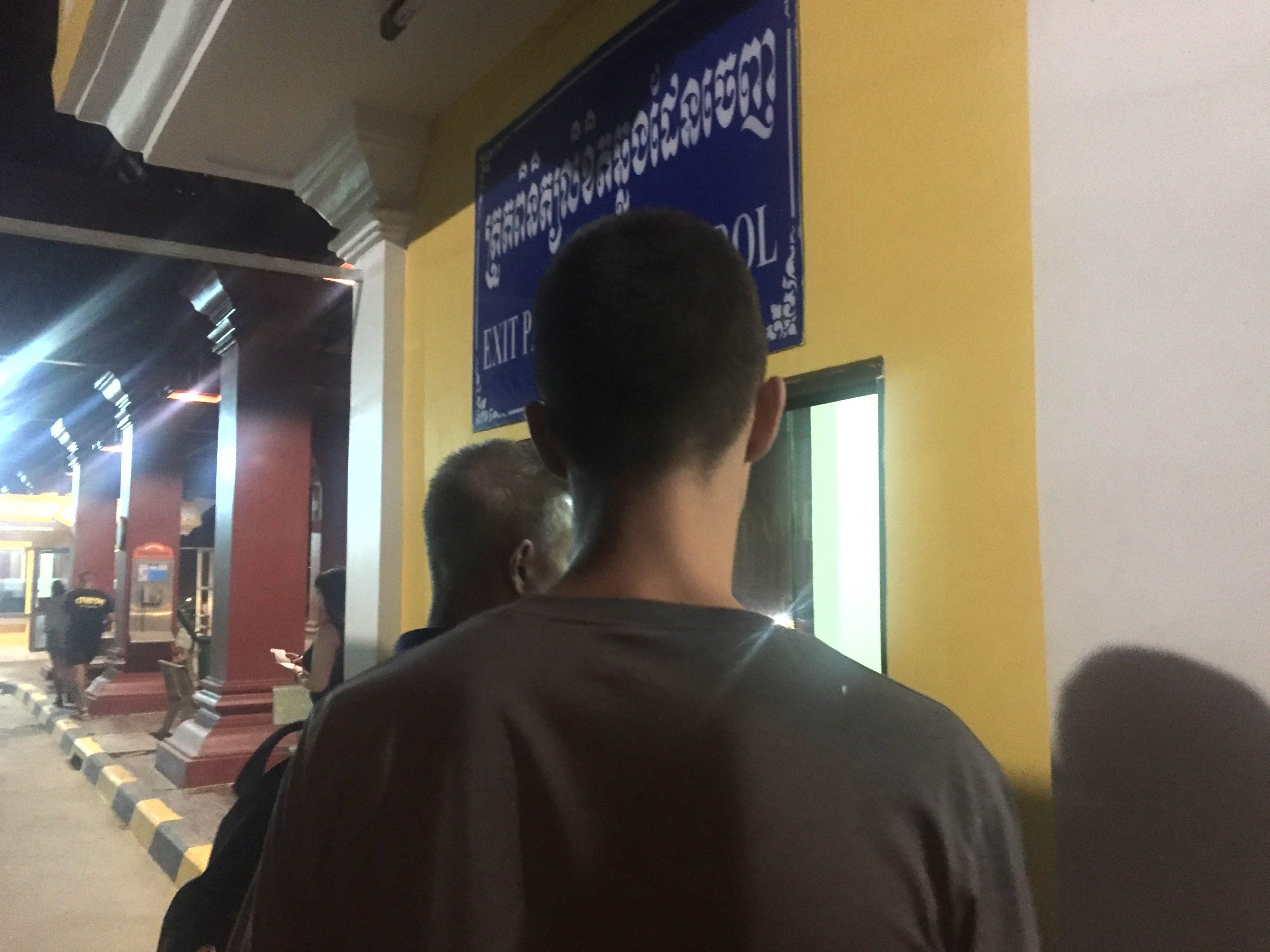
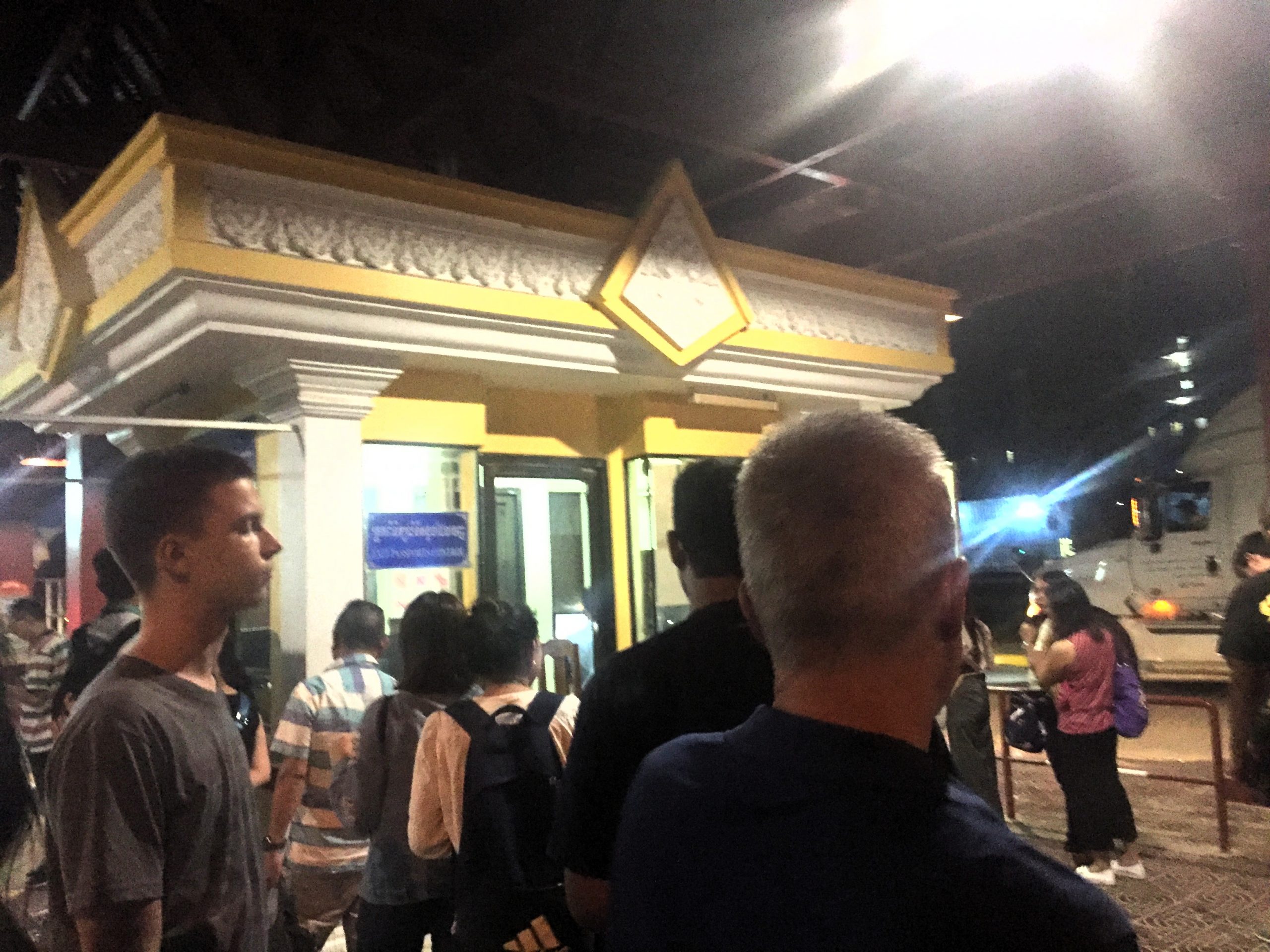
We finally got to the border somewhere around 9 pm. The Cambodian border officer stamped our passports. There was even a sign posted that clearly stated that no payment was needed. So far the story held up. Next, on to the Vietnamese checkpoint. At the Vietnam checkpoint we had to unload our luggage to go through customs. So I followed the other passengers pushing my dirty and wounded Mini-V through the border station, the bus attendant once again informed all of us waiting in line that we would need to pay a dollar to get our exit stamp. Well, I was fresh out of dollars. I asked if I could pay in dong. The attendant told me 30,000. I wasn’t sure how much a dollar was in dong but I was sure his math was wrong. I handed the attendant my passport without any money in it. He was trying to get us processed in one batch. I think he was just adding to the confusion.
After the passports were stamped Mr. Skinny would call our name and give us back our passport. When I got my passport back there was no stamp. The stamp “fee” was unavoidable. I wasn’t going to get screwed again with some ballpark exchange rate math so I pulled out my phone (I finally had cel service again.) and looked up the rate. 1 red blooded American dollar equals 23,000 dong and change. You better believe I was rounding down this time. I put 23,000 dong in my passport and put it back on the officer’s counter. I felt if anyone would accept a bribe in dong it was a hardworking, honest Vietnamese border officer. In a few minutes the bus attendant called my name again. My passport was lighter by 23,000 dong but adorned with a beautiful re-entry stamp. I think I could have gotten by with just 20,000 VND. Any amount to grease the uncertain good will between nations is worth it, right?. What a scam! Think about, a busload of about 30 travelers times how many buses. Each passenger being charged a dollar or two extra. Given the Vietnamese economy, a tidy little profrit that.
We finally rolled into Ho Chi Minh a little after 11 pm. A trip of 8 plus hours. It was only a few blocks to my hotel. At least, I planned this part out well. I pushed Mini-V through the late night revelers to my Hostel. M.O.M. Hostel & Cafe. A funny name but a nice place. Unfortunately, it was way past check-in time. Fortunately, a short e-mail message to the front desk unlocked the door before I had time to come up with a plan B. Unlike some of the other places I stayed in the room was prepay. I didn’t have enough dong now thanks to my donation to the border guards of Vietnam auxiliary fund. The clerk took my passport as insurance until I could exchange more cash the following day. The room cost about 5 dollars and I was about a dollar short.
Lessons Learned
1. Be more precise when giving directions to tuk tuk drivers.
2. Carry pencil and paper with you to write down prices and place names. It helps to avoid confusion.
3. Don’t change money at the front desk of backpacker hotels. They tend to use prodigious rounding skills to give themselves favorable rates.
Photo Gallery
Video
[yotuwp type=”videos” id=”zKqTaKkIprg” ]
Home | Photo Gallery | Podcasts | Videos
]]>2019/12/019
It was my last day of cycling. I was just a day’s ride from my final destination in the Mekong River Valley, Phnom Penh, the capitol of Cambodia.
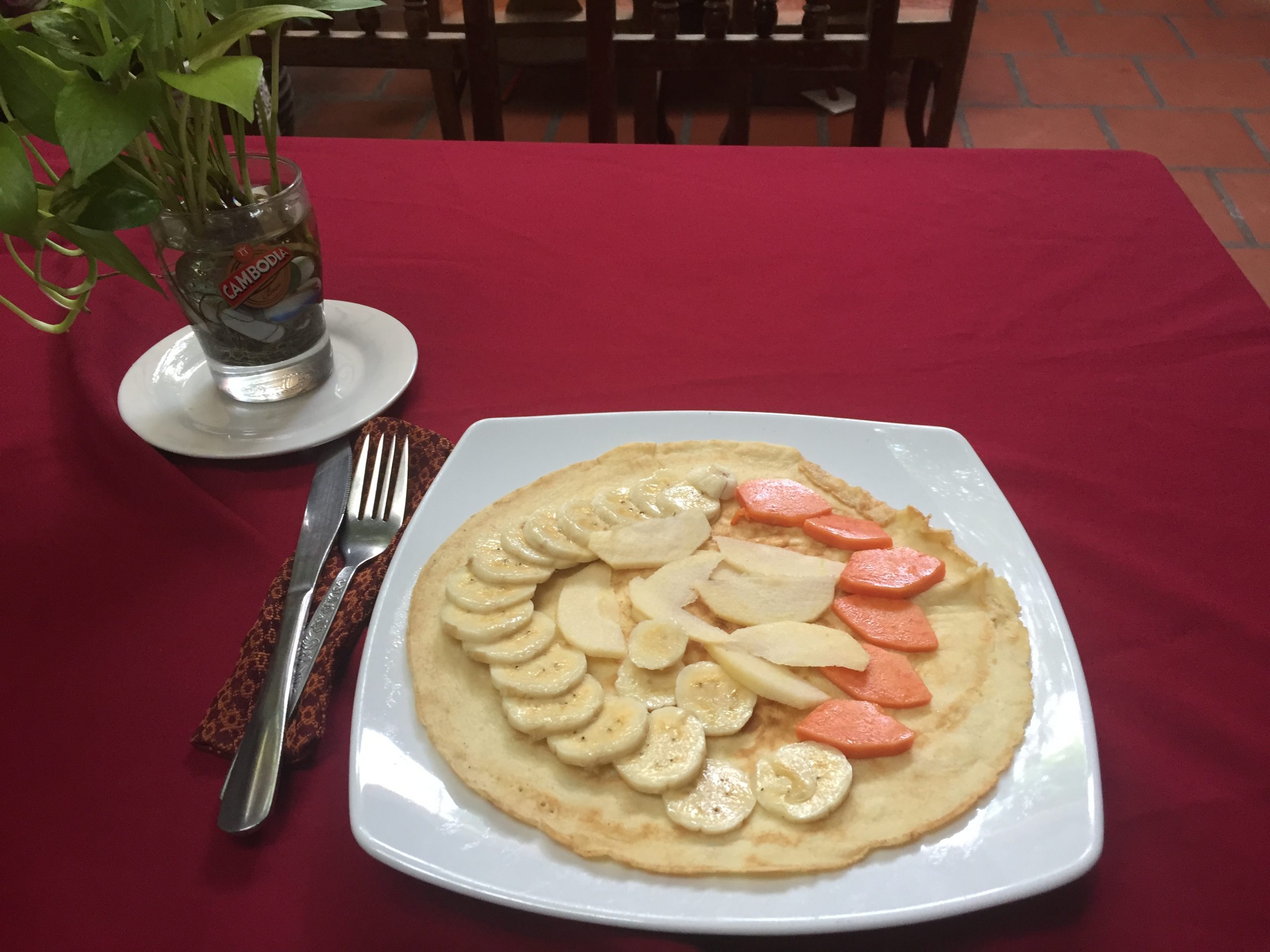
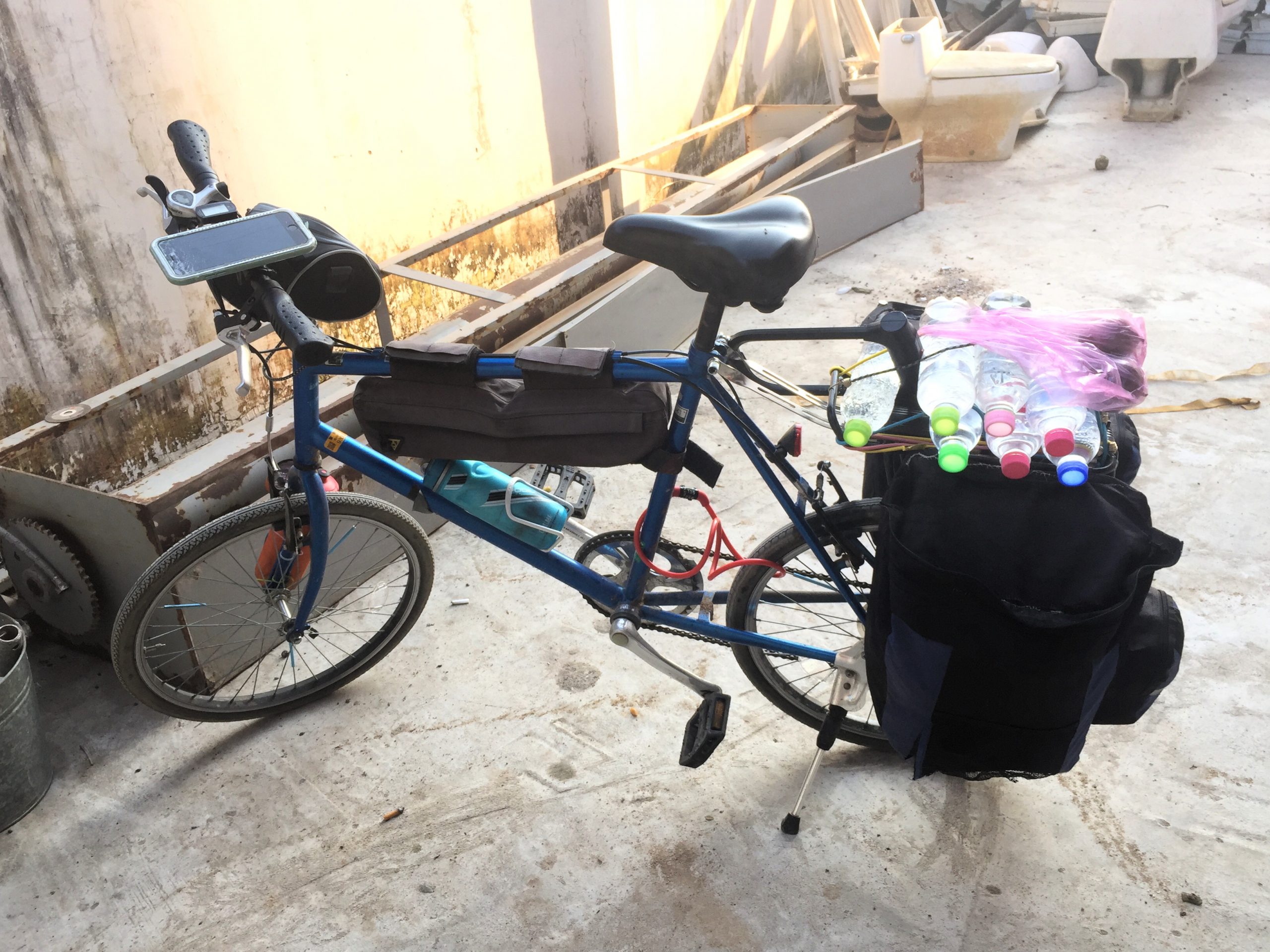
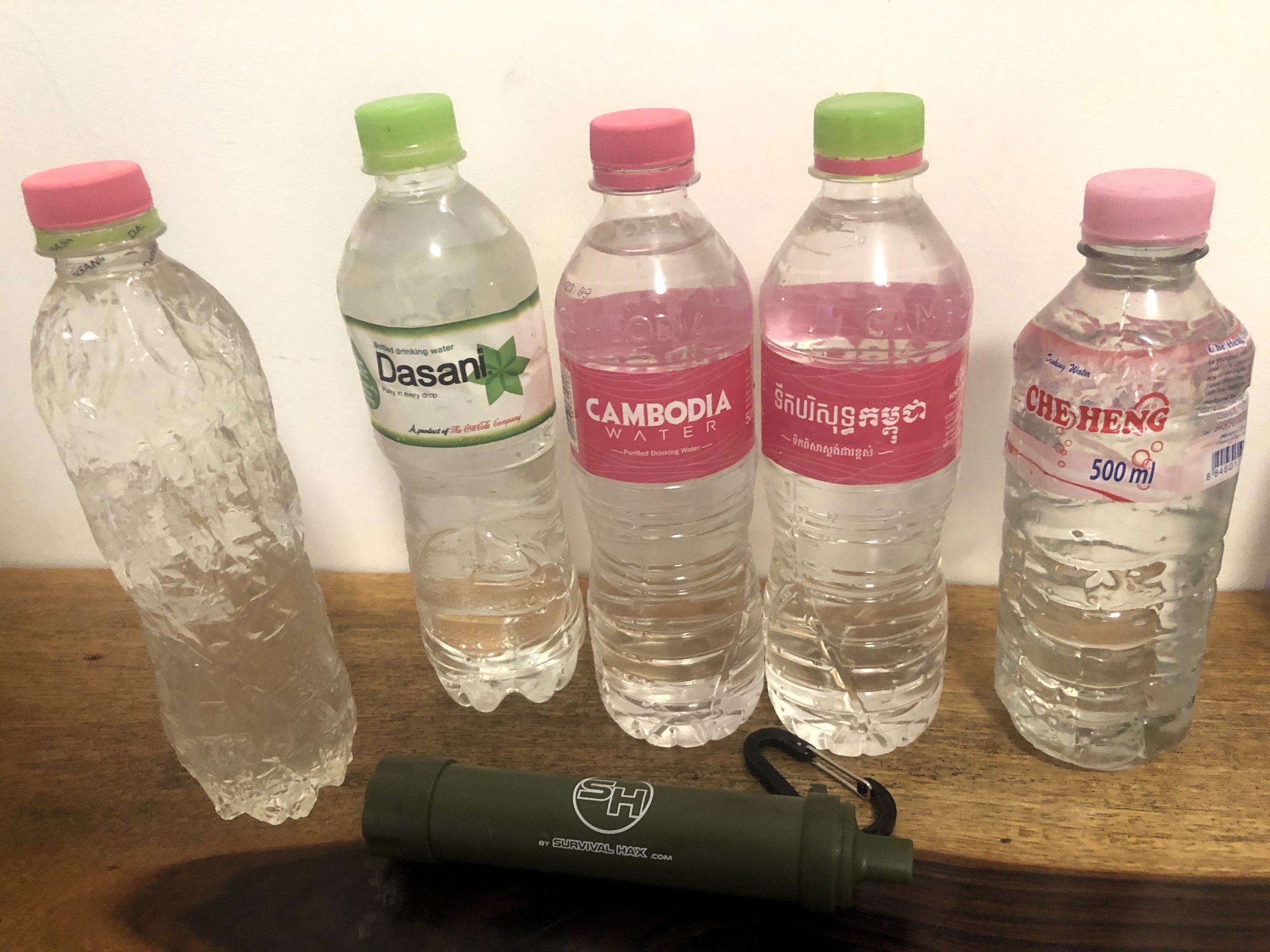
I ate my croco-sant and 2 of my mystery fruit for breakfast. (Check out the video to learn more about croco-sant and mystery fruit. No spoilers here.) I planned to exchange some more dong for riel at the front desk when I checked out. Unfortunately, the man at the front desk was not the same as the young fellow from the previous afternoon. He didn’t seem to understand English but he was able to say enough that I understood that he would not change any money. So once again I was pedaling through a foreign country with almost no useable cash in my pocket. On the bright side I still had two mystery fruit and a lot of water. I filled up every bottle I could find with filtered water. Altogether I think I was carrying about 5 or 6 liters of water. The bottles were piled up on my rack and tied down with bungee chords. There were so many in my precarious pile that occasionally one would fall off when I hit a bump. I am pretty sure that at least one bottle went missing in action during the morning.
My route took me back over the big yellow bridge again. Fresh from a good nights sleep it was a lot easier climb than the night before. On the other side I pointed my handle bars to the north. This section of the road was equivalent to the day I spent riding on National Highway 91 except now I was on the famous Asian Highway 1 That connects Thailand, Cambodia and Vietnam. I noticed fewer bicycles, more cars, ambulances, motorcycles pulling big trailers loaded with good and materials and lots of tuk tuks.
Tuk Tuks
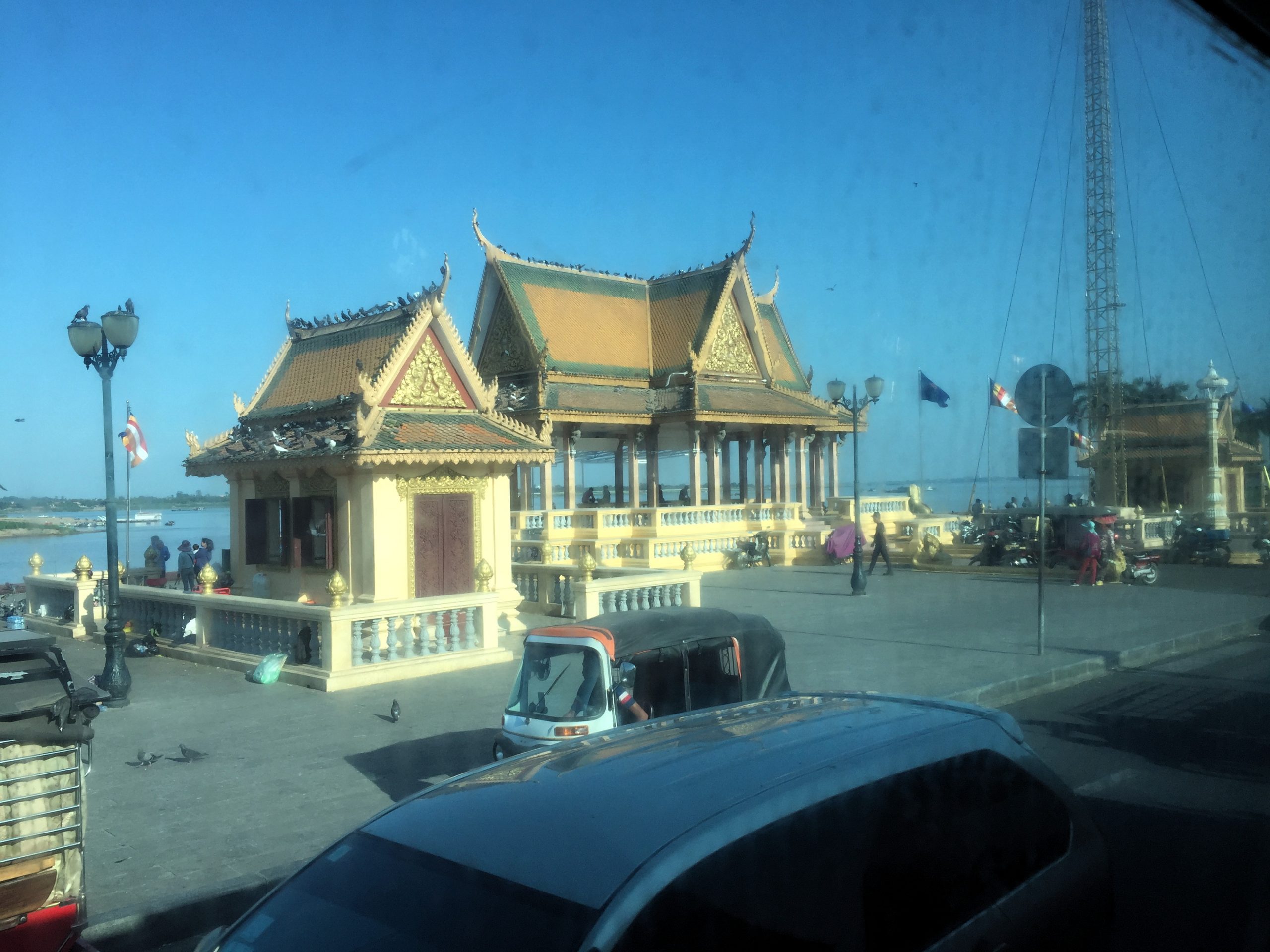
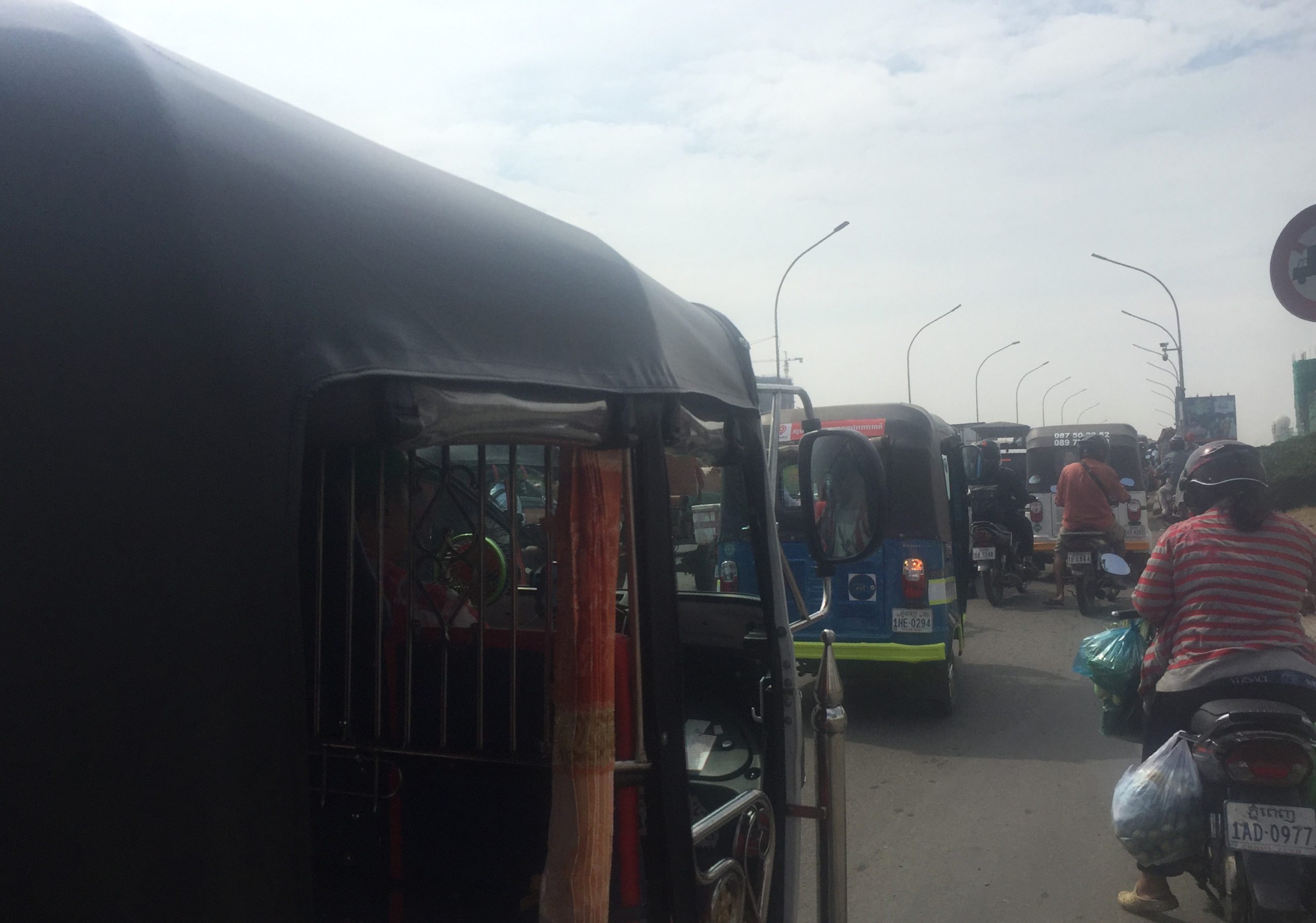
Tuk tuks are cute little 3 person, 3 wheeled vehicles that are used as taxis and are ubiquitous in Phnom Penh and the surrounding towns. Even the name is fun to say. Try it! Tuk tuk. Tuk tuk. See what I mean the most fun you can have with your lips by yourself. When I first considered traveling to Cambodia I saw pictures of tuk tuks and fell in love with them instantly. I was wondering if I would get a chance to ride in one. It didn’t seem likely as I brought my own transportation with me. As the morning wore on I lightened my load by wetting my whistle from my stock of water.
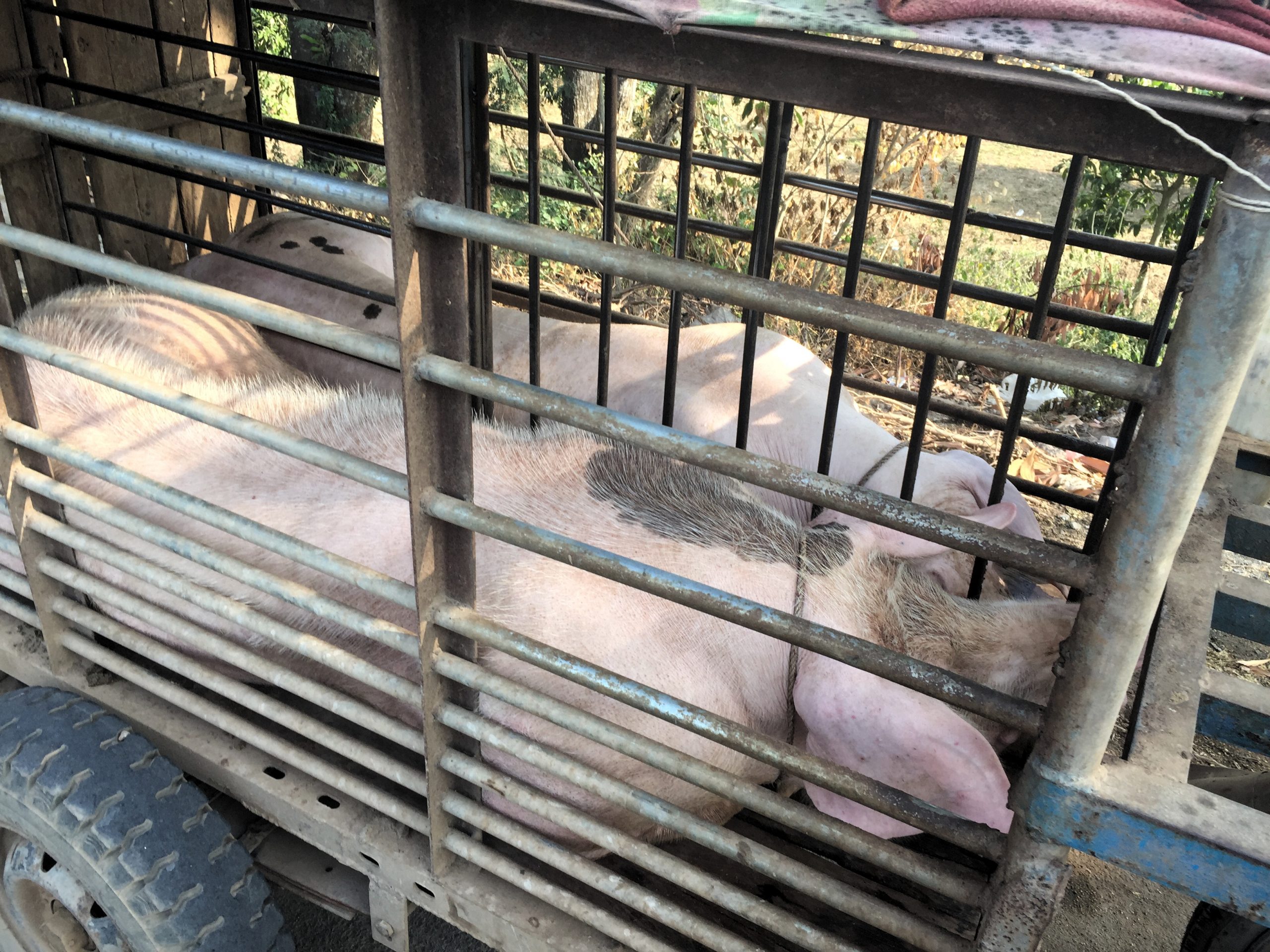
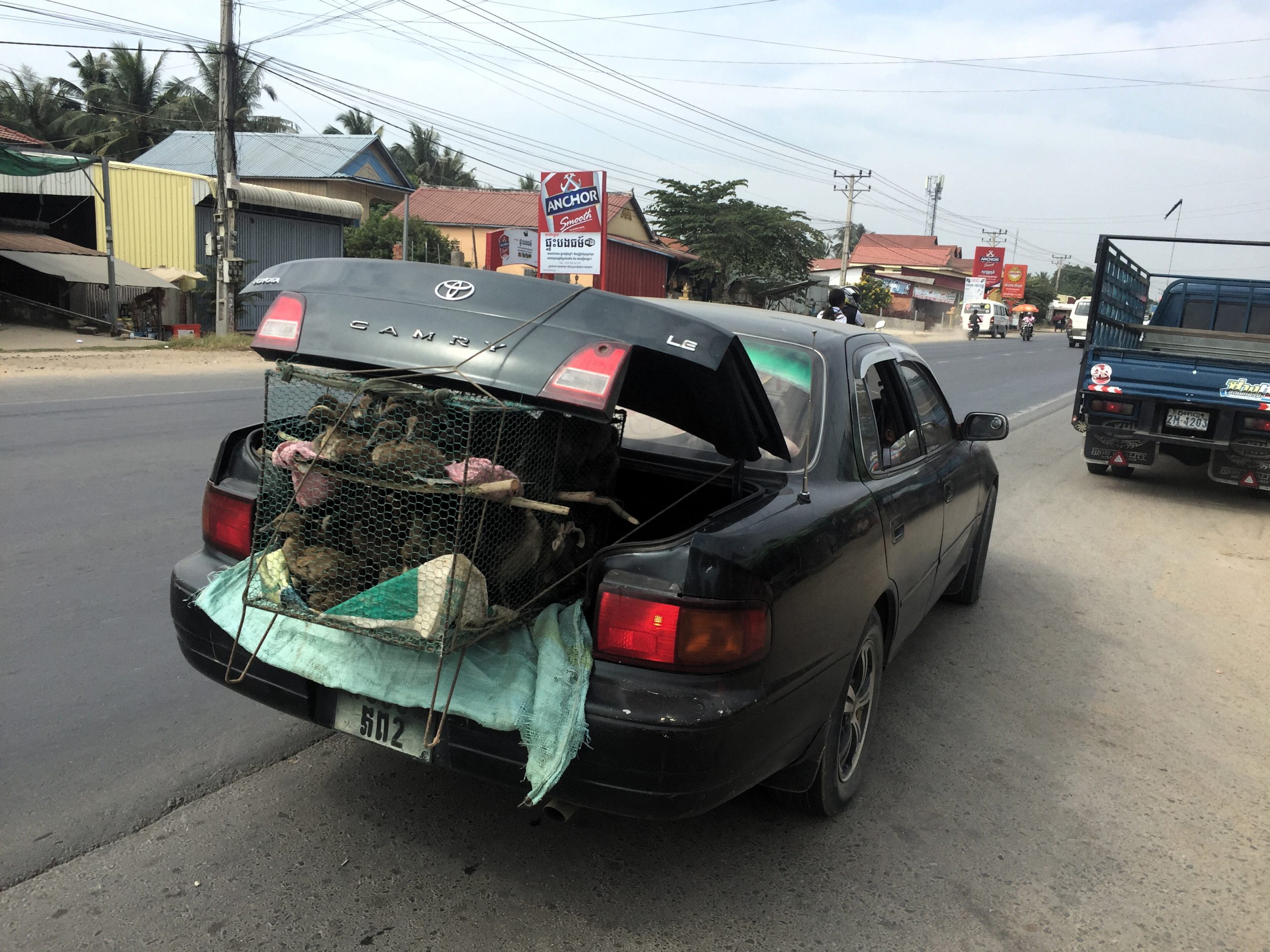
I’m going to say it straight out. The most interesting thing I saw on the road that day was not tuk tuks. It was two pigs and some cattle. In Cambodia a common way to haul goods is on a flatbed trailer pulled by a small motorcycle (maybe only about 100cc or 150cc). The trailers are 3 or 4 times longer than the motorcycle in some cases. I passed by a motorcycle with an unexpected cargo. (By this time I don’t know why any kind of vehicle with a load would surprise me but this one did.) I passed a motorcycle and trailer parked alongside the road. The motorcycle was pulling a trailer with a big cage on the trailer. As I passed by I looked down and saw two enormous hogs in the trailer. They were laying down with barely enough room to standup. At first I thought the hogs were dead but when I doubled back to get a better look I could see that they were awake. I don’t know if they were drugged or sleepy or just a very placid pigs. I think they probably weren’t drugged because the hogs were way too big to get in the cage if they weren’t alert enough to walk into the cage under their own power. The unexpected doesn’t end there. As I looked up I saw a woman and a little girl trying to lead two cows and a calf across the busy road. Now Cambodian cows are not old Macdonald’s rotund, sloe-eyed gentle dairy cows. Cambodian cows are tall, slender legged, you could even say svelte, humpbacked behemoths. The woman held rope halters for all three beasts and directed them with her voice and a judicious tugs on the rope while the little girl walked along side with a thin stick. I don’t know if she used the stick to motivate the cows or if she had just picked it up for fun as children around the world will do. It is a universal law that if a child sees a stick on the ground they will pick it up and swing it around when their parents are not looking. (How do I, as an adult know this, you ask? Because of the other universal law that says all parents have eyes in back of their head until their children are old enough to move out of the house.) The calf was taller than the girl and the two full-grown cows were taller than her mother but somehow the woman got herd and offspring across the road safely.
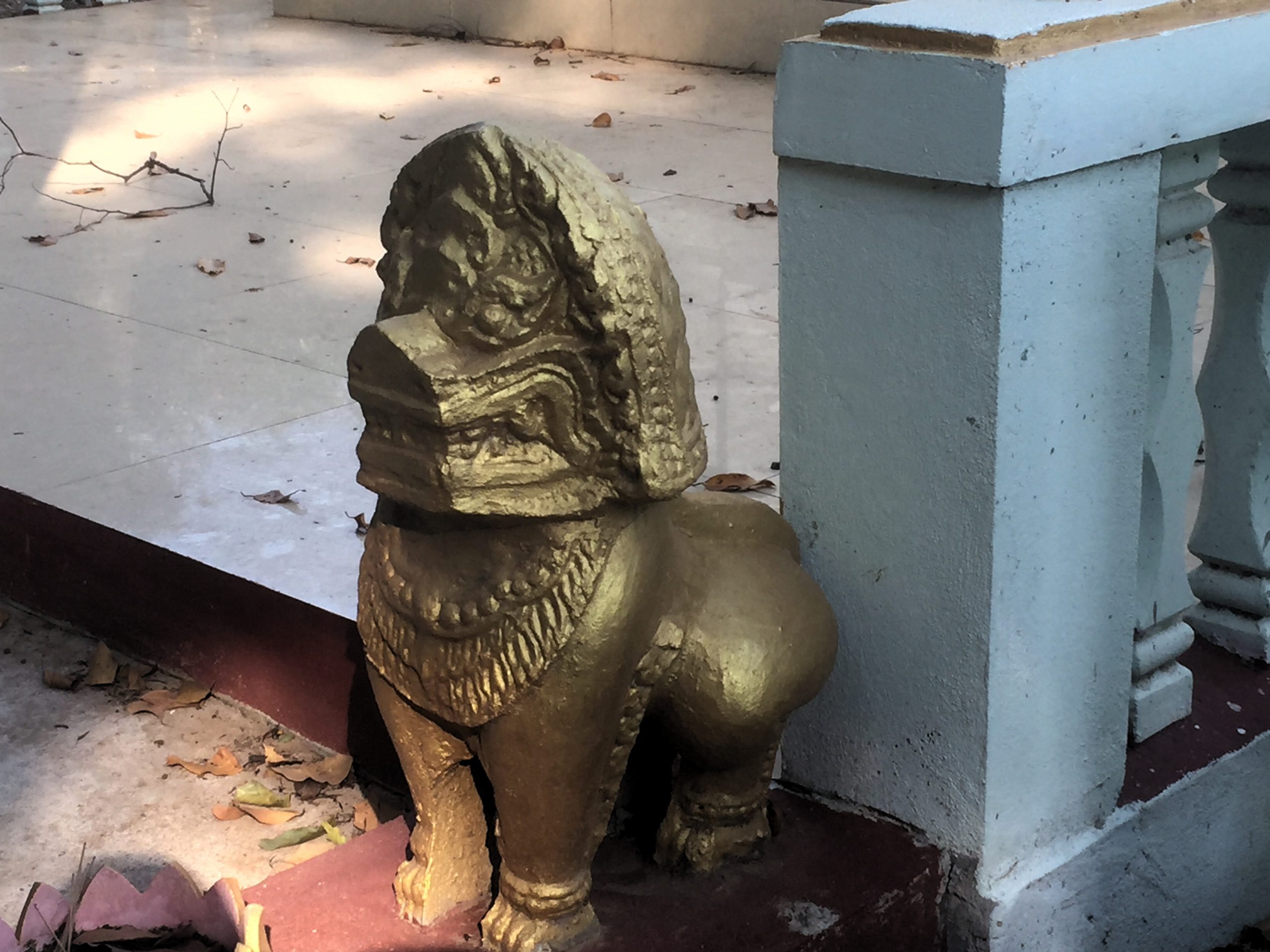
By the time 11 am rolled around I felt like I was making good enough progress to take my lunch break. I learned the day before that Buddhist temples are a good place to take a break. They are generally quiet places. That is not to say they are somber places. Buddhism in Cambodia looks very different from Buddhism in Japan. Besides the obvious differences in architecture and the use of color (Cambodian temples are very colorful. Some might even call them gaudy.) To my mostly uninformed mind Buddhism in Cambodia seems more like a living religion where in Japan Buddhism is respected for its historical and cultural value but it is not a thing Japanese people believe in. I think some of the differences are sectarian. I am sure the general precepts are the same but the feel is different.
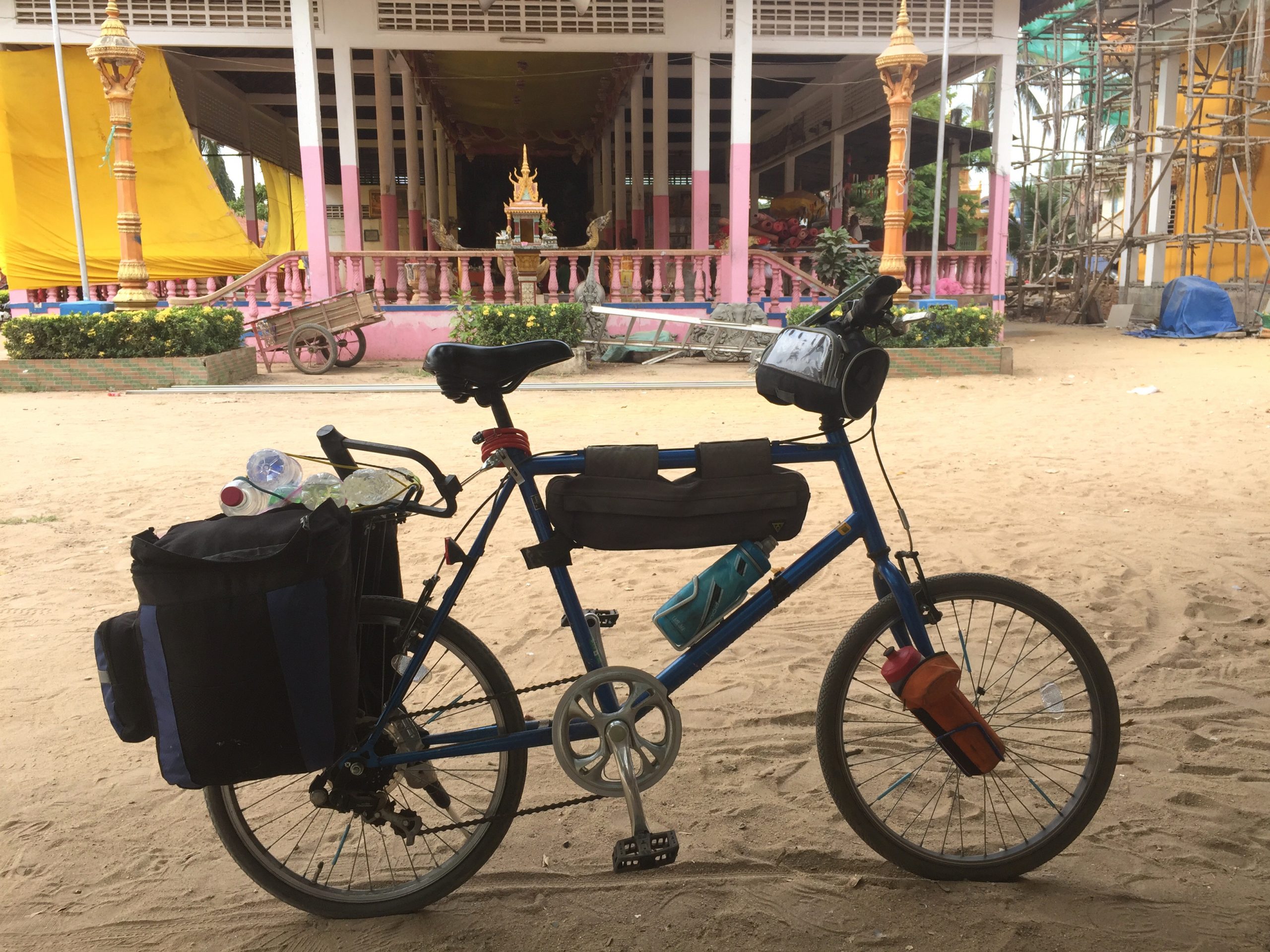
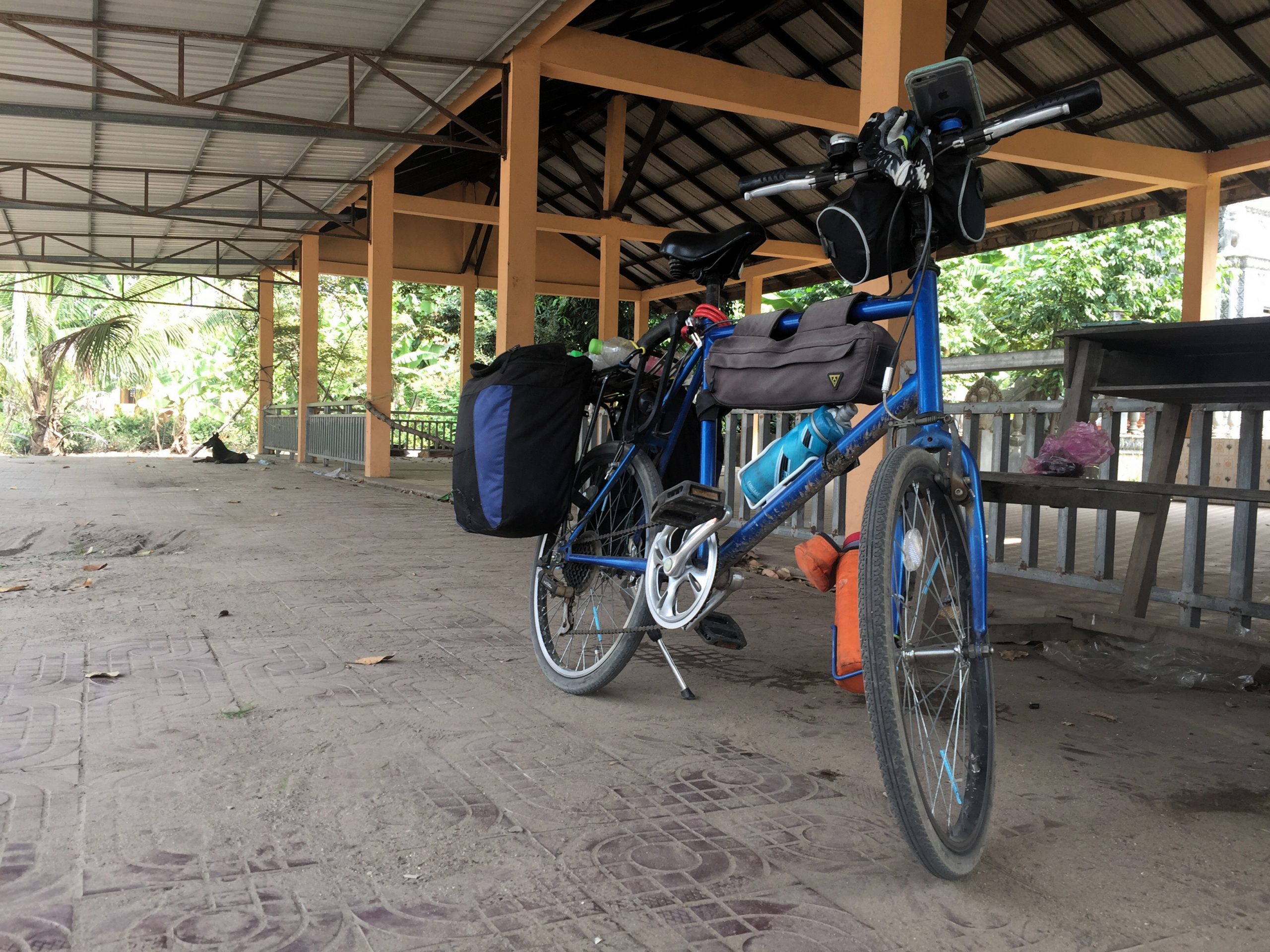
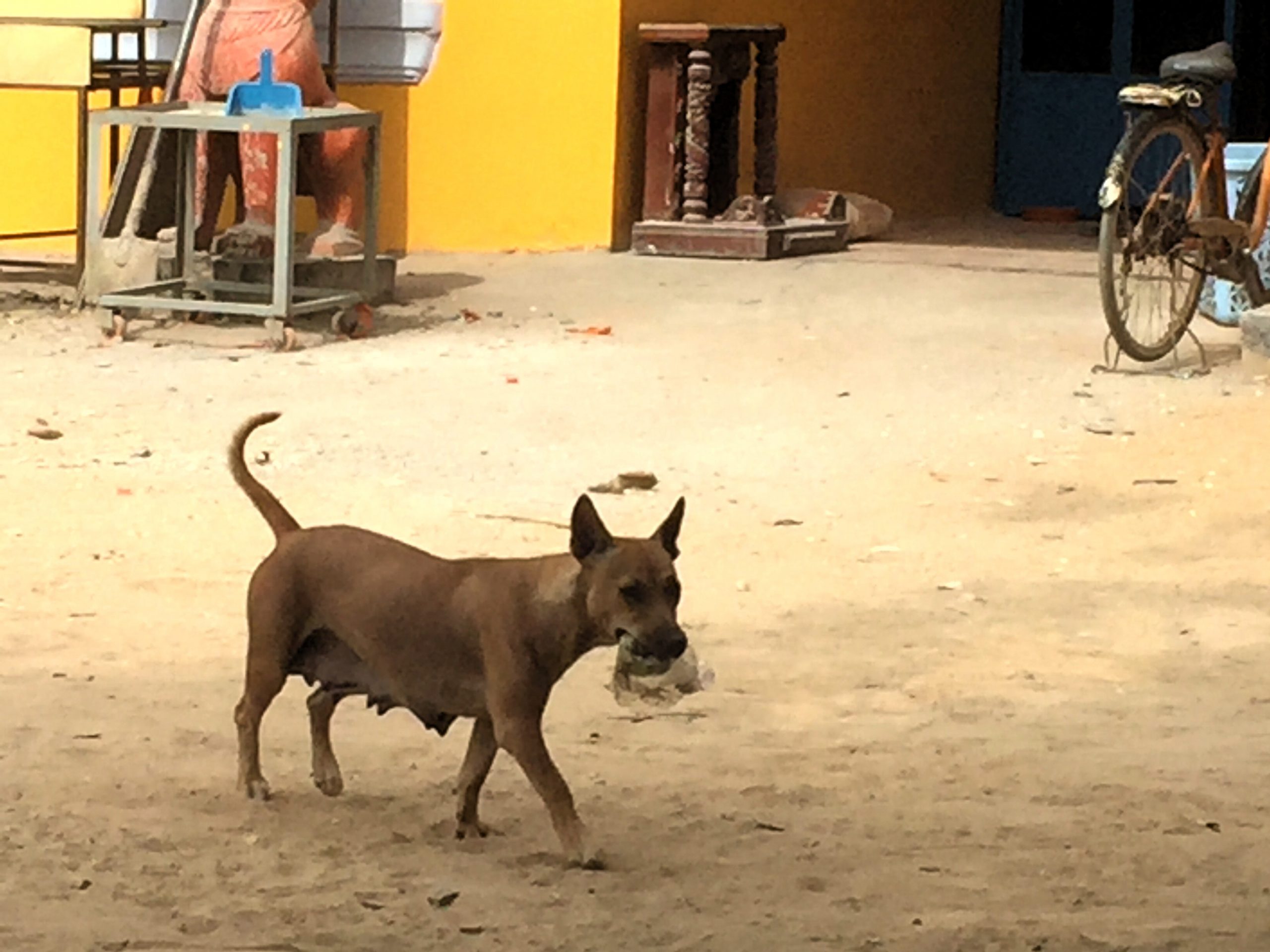
In any case, I found a quiet bench where I could eat my mystery fruit and swig H2O and watch strays dogs fighting over some unknown canine grudge. Later, one of combatants limped over to share my patch of shade. While it didn’t cozy up to me neither did it show any fear of me. Mostly it just displayed indifference. If I had tried to pet him he most likely would have displayed his teeth. We left each other alone and neither of us was the worse for the experience.
Phnom Penh
I still had enough water left and I felt that Phnom Penh was just around each corner and just over the horizon. It wasn’t but I got there in good time. I was happy when I saw the sign saying welcome to Phnom Penh. Phnom Penh is a big city. (Though, not so big as Tokyo me thinks.) Just because you have entered the city does not mean you have arrived.
The traffic in Phnom Penh was the heaviest that I experience during my whole trip. More cars, trucks, and tuk tuks than Saigon. (Actually there aren’t any tuk tuks in Saigon.) At a bridge leading into the center of the city I got embroiled in a traffic jam because of road construction on the other side. I think this bridge would have been a bottleneck anyway. I found myself wheel to wheel with tuk tuks and motorcycles. Traffic jams are not particularly dangerous for bicycles in the sense that it is moving really slowly. I was caught in it just long enough to get over the bridge. Once on the other side I dropped out and cut north following my route.
As I got near my hotel I realized that I had a problem. I hadn’t mapped the route all the way to my hotel. This is because I wasn’t exactly sure where I would be staying in Phnom Penh until about a week before leaving. I was trying to arrange another Warmshowers host but all of my attempts fell through. Not only did I not have any local currency I did not have any kind of cell receptions in Cambodia because the SIM card that I bought at the Ho Chi Minh City airport stopped working at the Cambodian border. I knew the general area where my hotel was located but I hadn’t mapped it out on my offline maps. Without cell reception I couldn’t just look it up on Google Maps and follow the directions. Finally, when I thought that I was close I approached a foreign couple I spotted on the sidewalk and asked them if they could look it up for me. I took a snapshot of the route displayed on the man’s phone. Somehow, I was able to reach my destination.
#10 Lakeside Hotel
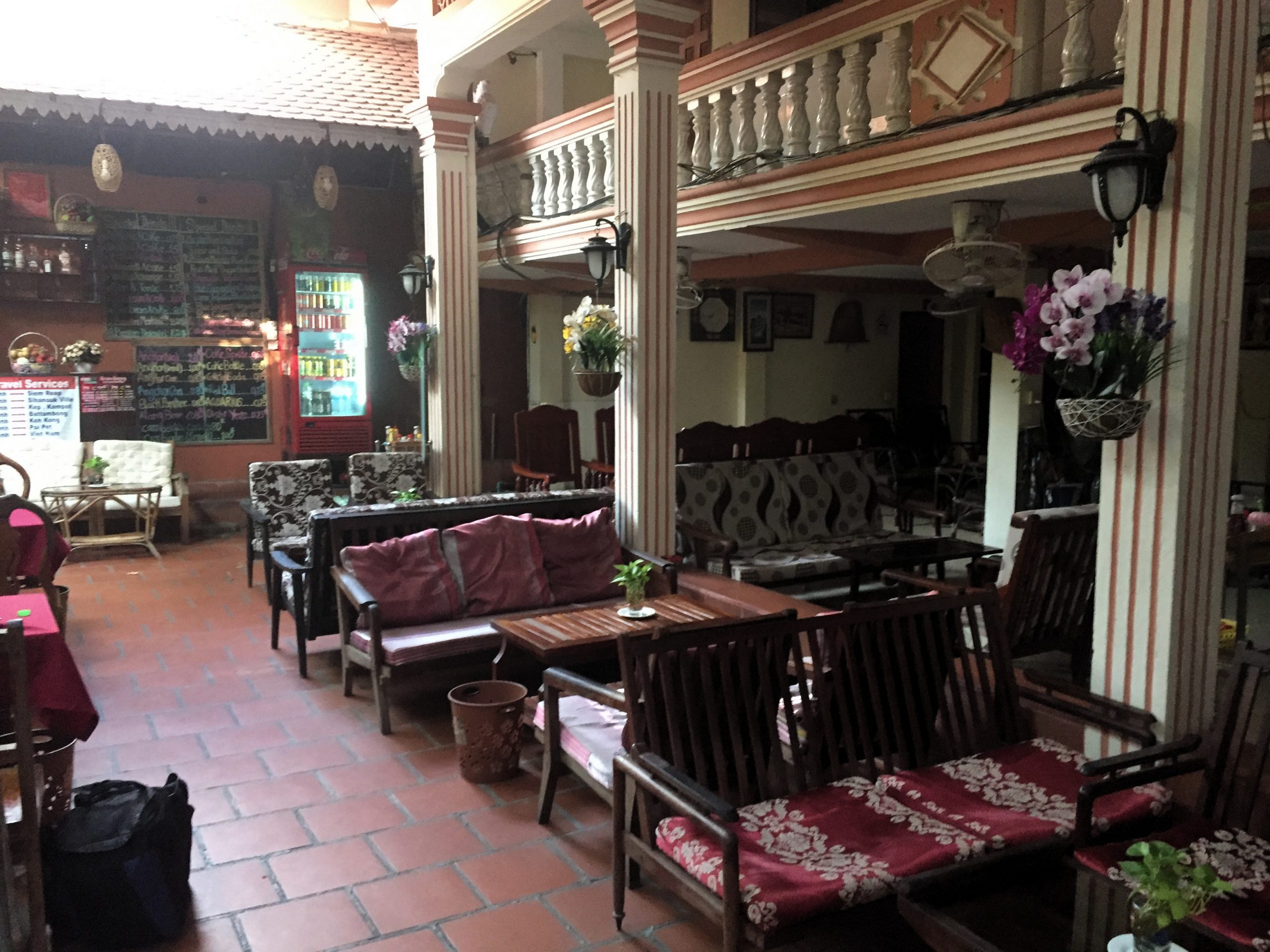
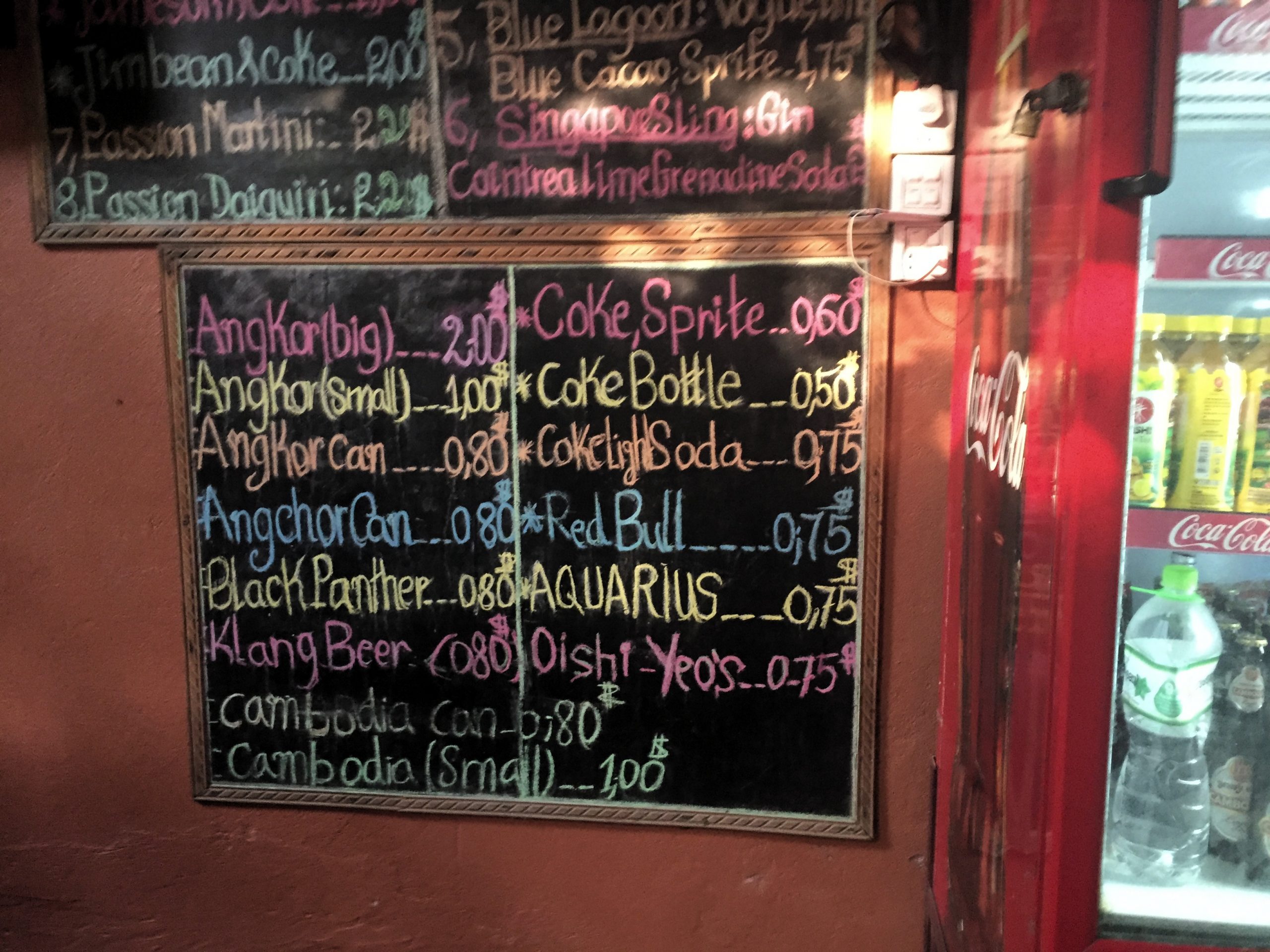
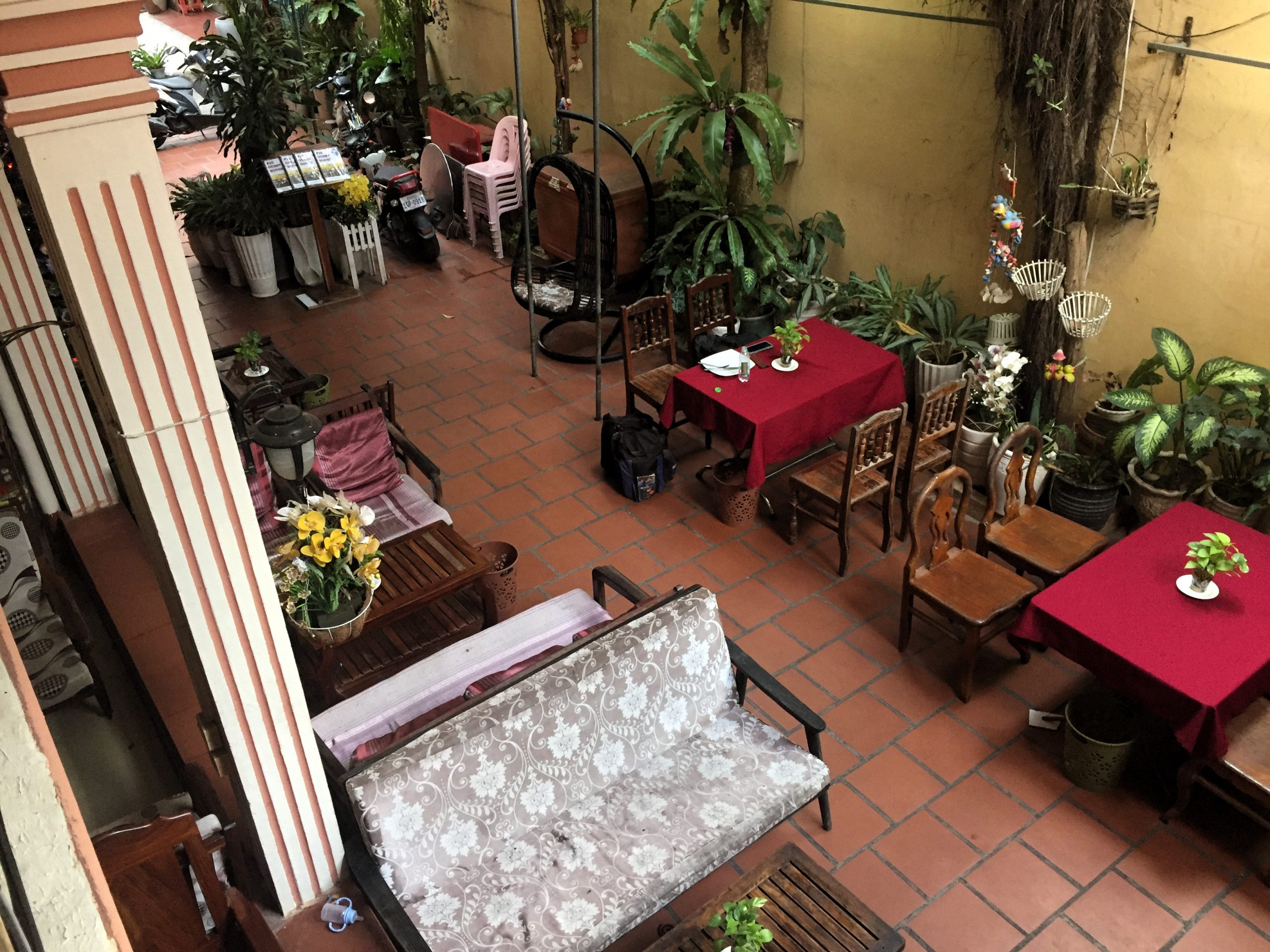
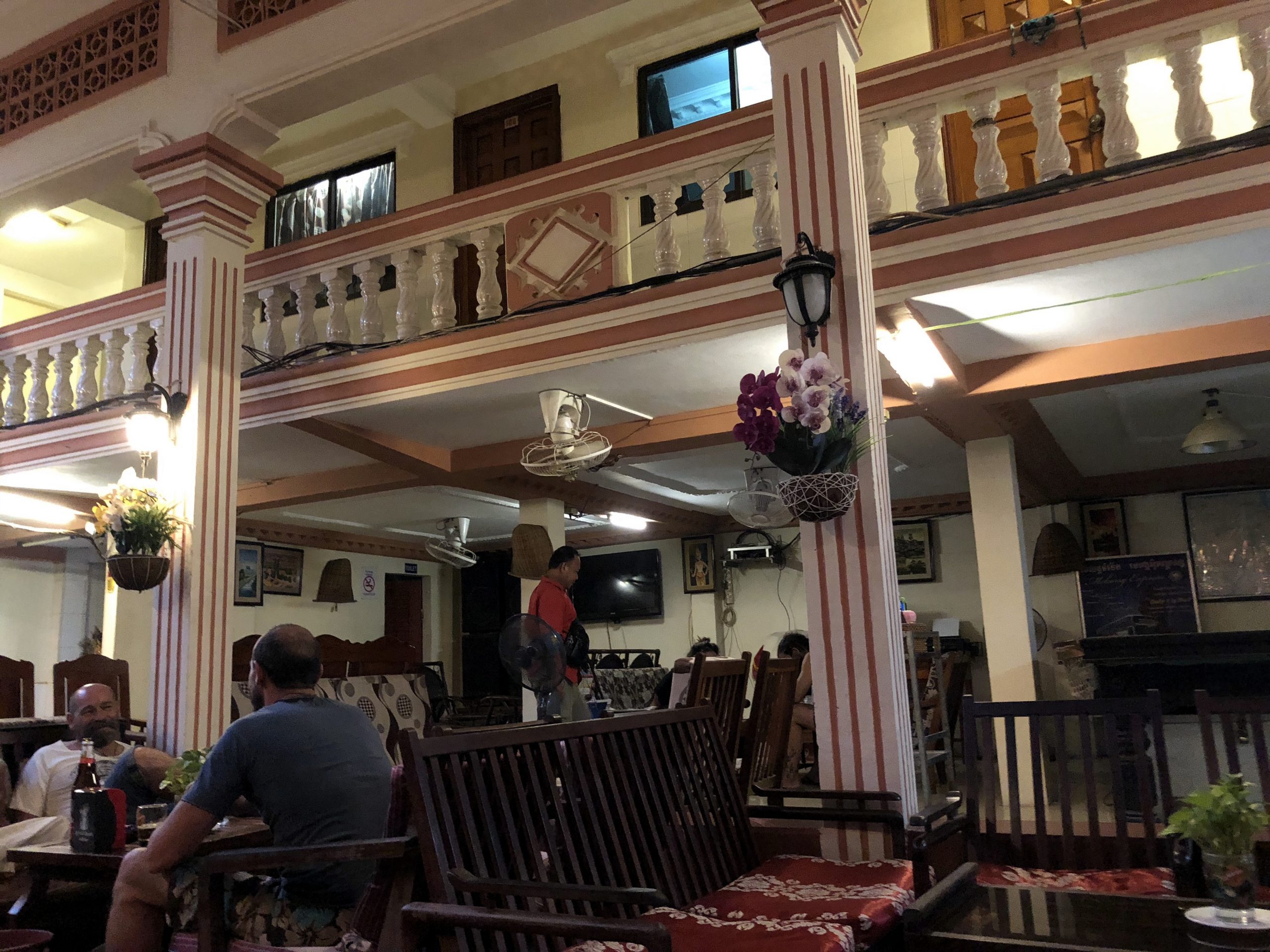
The #10 Lakeside Hotel has been a misnomer for the past decade. It used to be on a lake until the Cambodian government leased the land to a developer who filled in the lake and built condominiums on top of it. I lies tucked in a back alley off of the busy Monivong Boulevard next to other backpacker hotels. The first floor is a semi-open-air restaurant and lounge. It has an air of neglected Franco-Indochine decadence in a very small place. The cost for one night was about $5. It was here that I realized that Phnom Penh wants dollars. All the prices were listed in dollars. Of course, I had neither dollars or riel. The front desk allowed me to pay in dong and exchanged enough for me to get dinner which was about 15 dollars. They changed an exorbitant exchange rate. I figured I lost ten dollars of valley because of their liberal policy of rounding calculations in their favor. I found that a lot of rounding goes on in Cambodia. If I were changing a lot of money a 10 dollar surcharge would not have been such a big deal but I was on a shoestring budget and 10 dollars was the difference between eating breakfast the next day or not. The whole experience soured my feeling about #10 Lakeside Hotel and gave it an overall impression of seediness.
Lessons Learned
1. Map out your entire ride, including your alternative routes and download to your phone when you have connectivity.
2. Check the exchange rates before exchanging money.
Photo Gallery
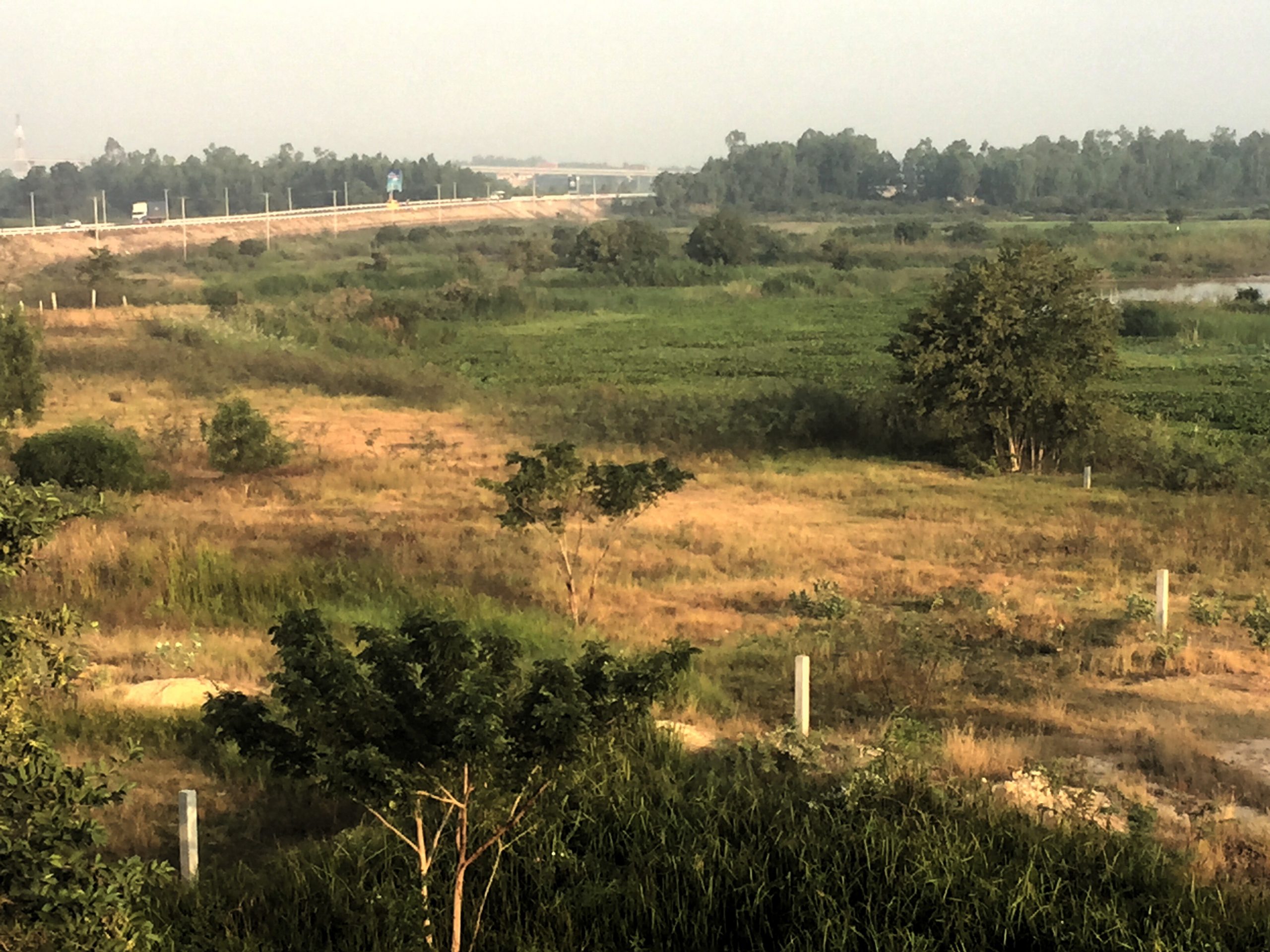
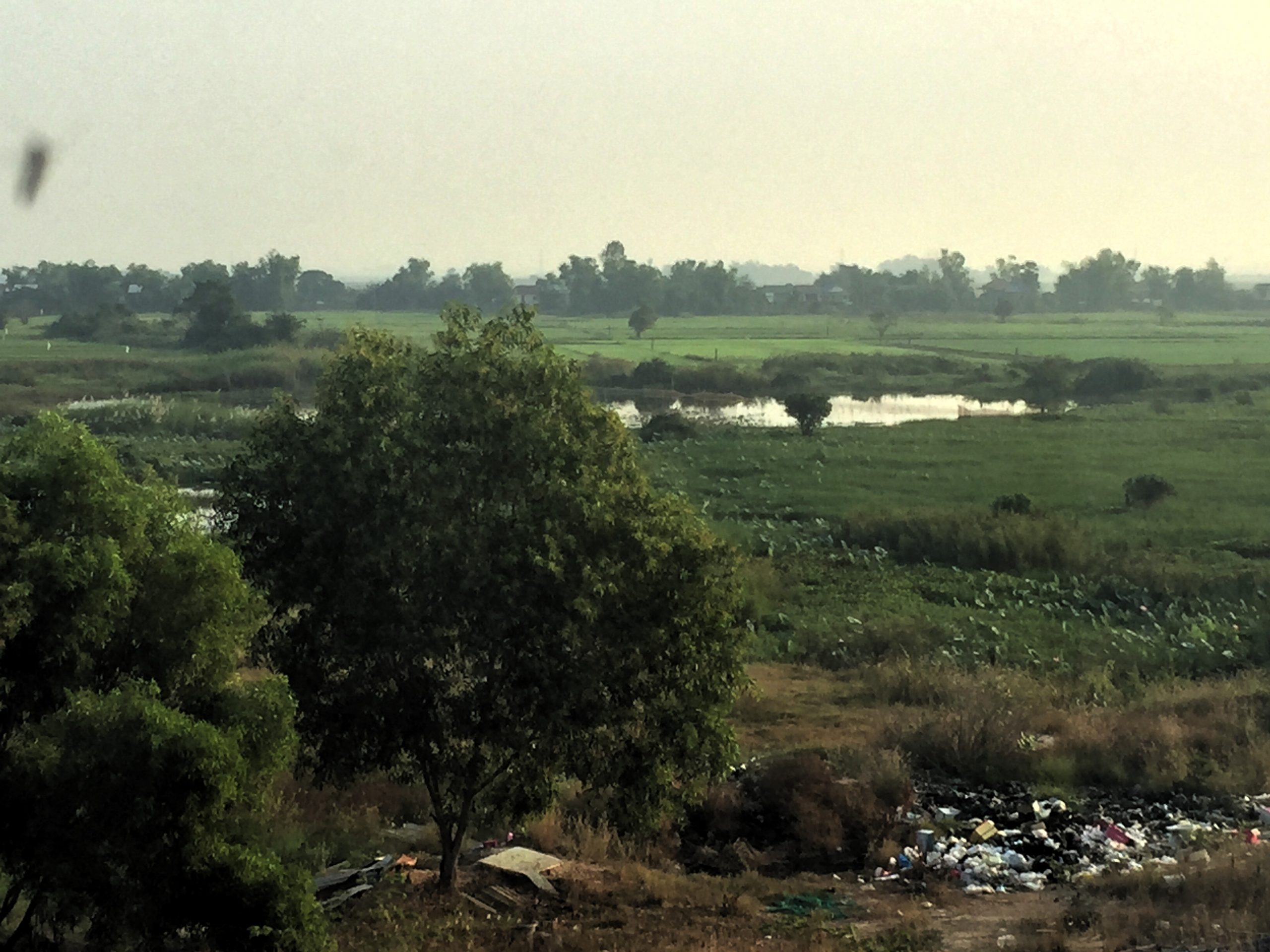
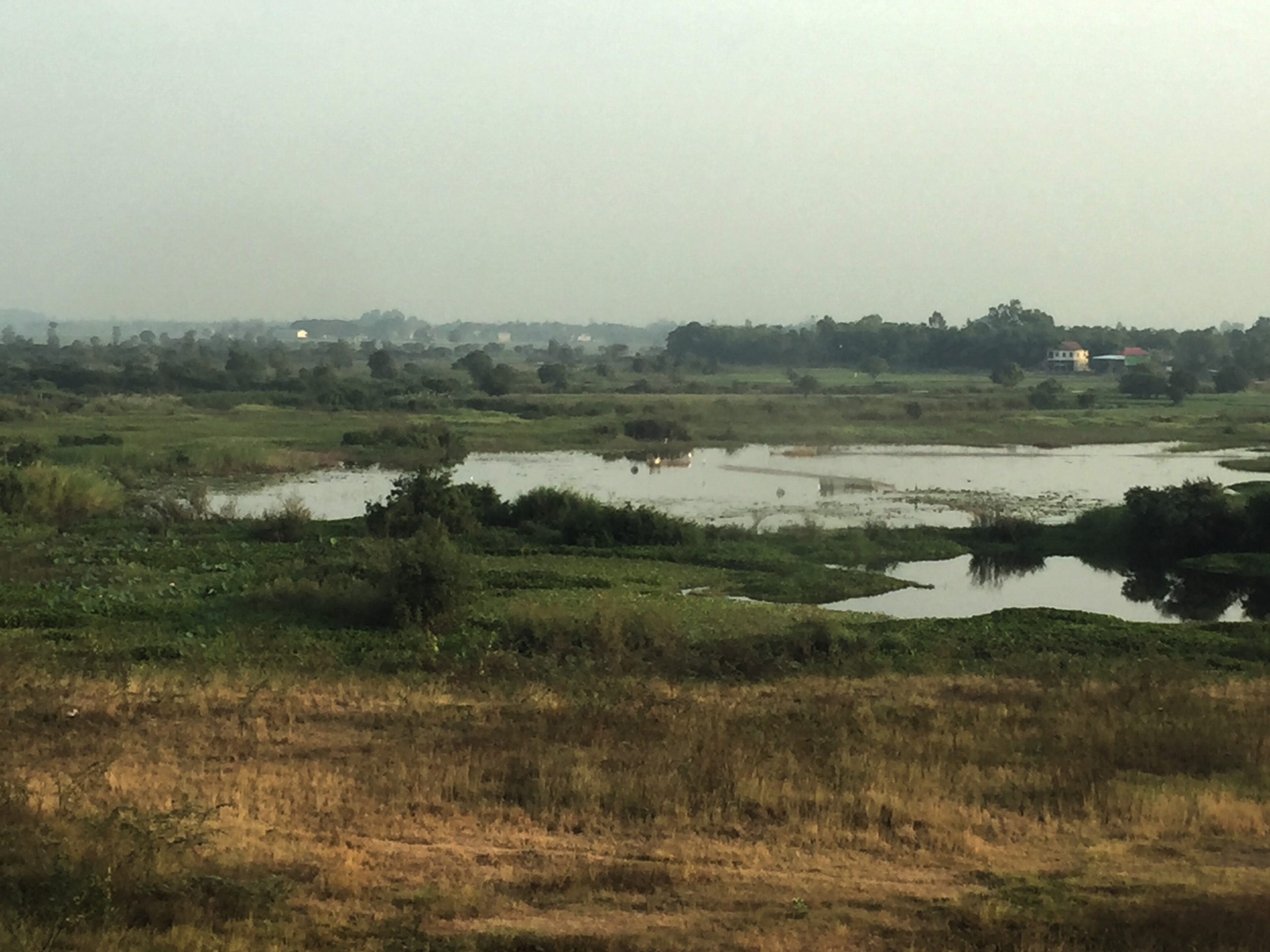
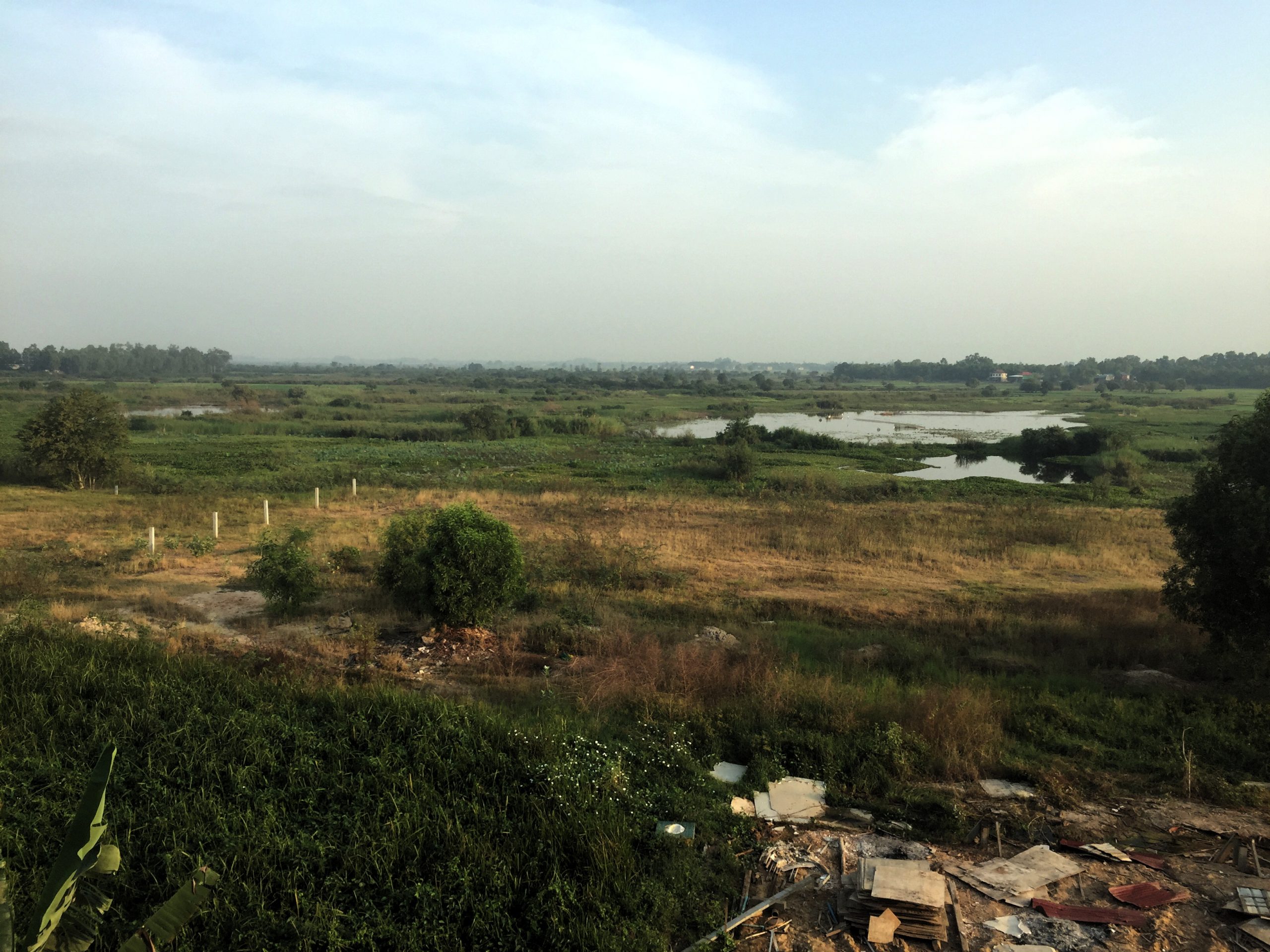
Podcast
Video
[yotuwp type=”videos” id=”mMVt6ITGCfQ” ]
Home | Photo Gallery | Podcasts | Videos
]]>2019/12/19
Border Crossings
In the morning my new friend, David, led me out of Tan Châu on his motorcycle. He set a quick pace but I was able to follow him to the ferry terminal and out of the city. On the other side of the river we parted company in front of the school where he teaches. I wish I had had time to visit his school too.
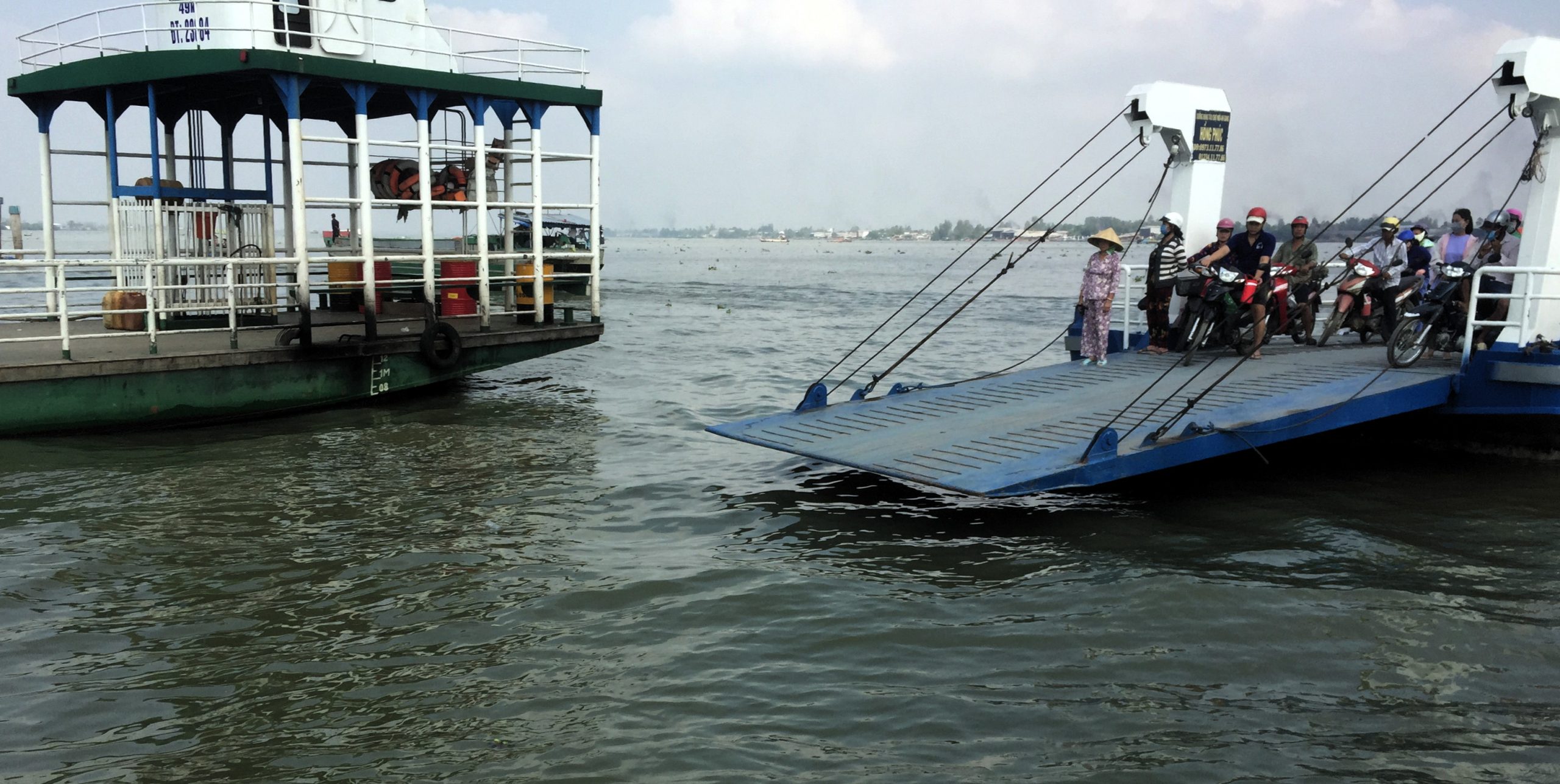
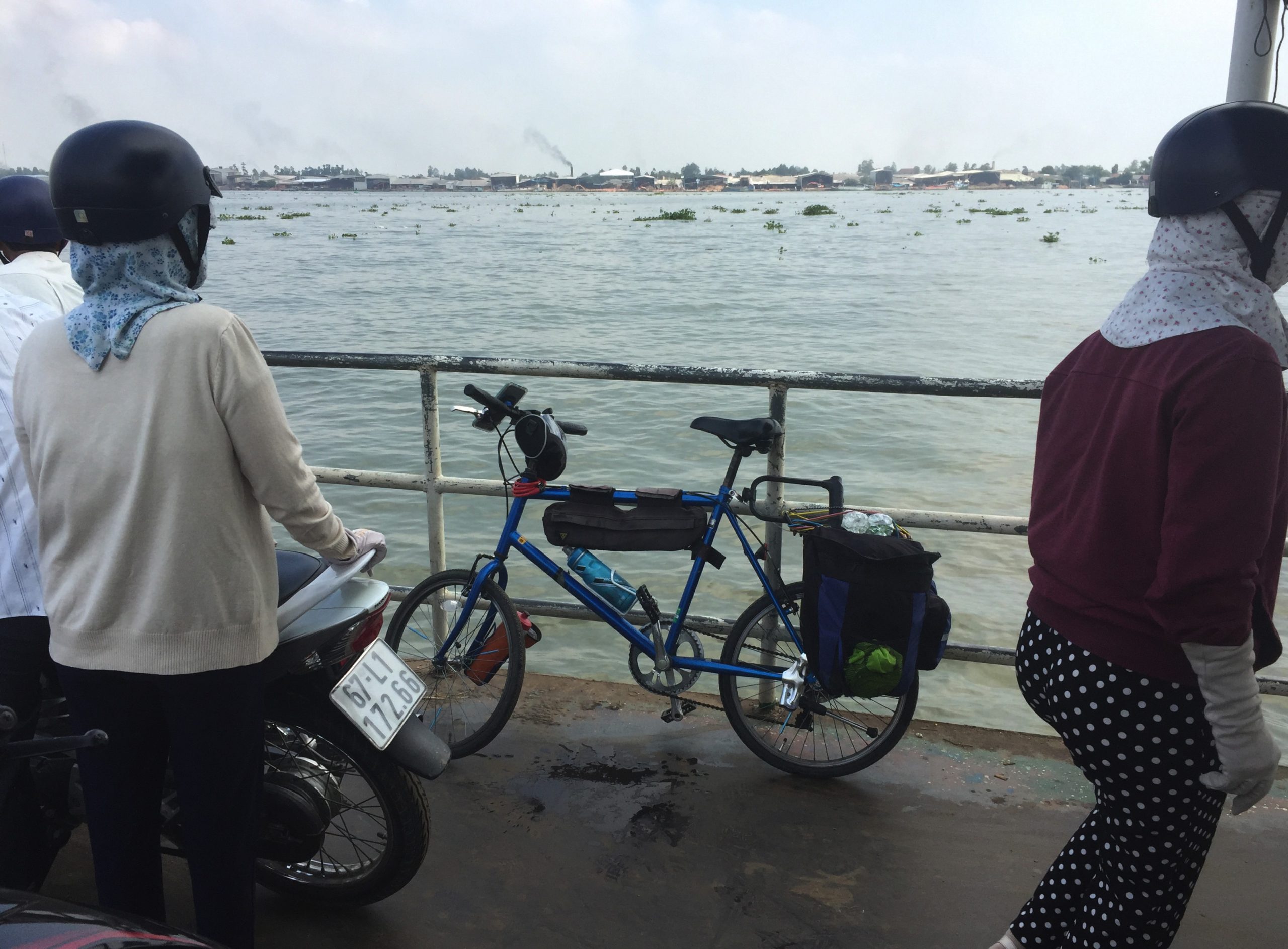
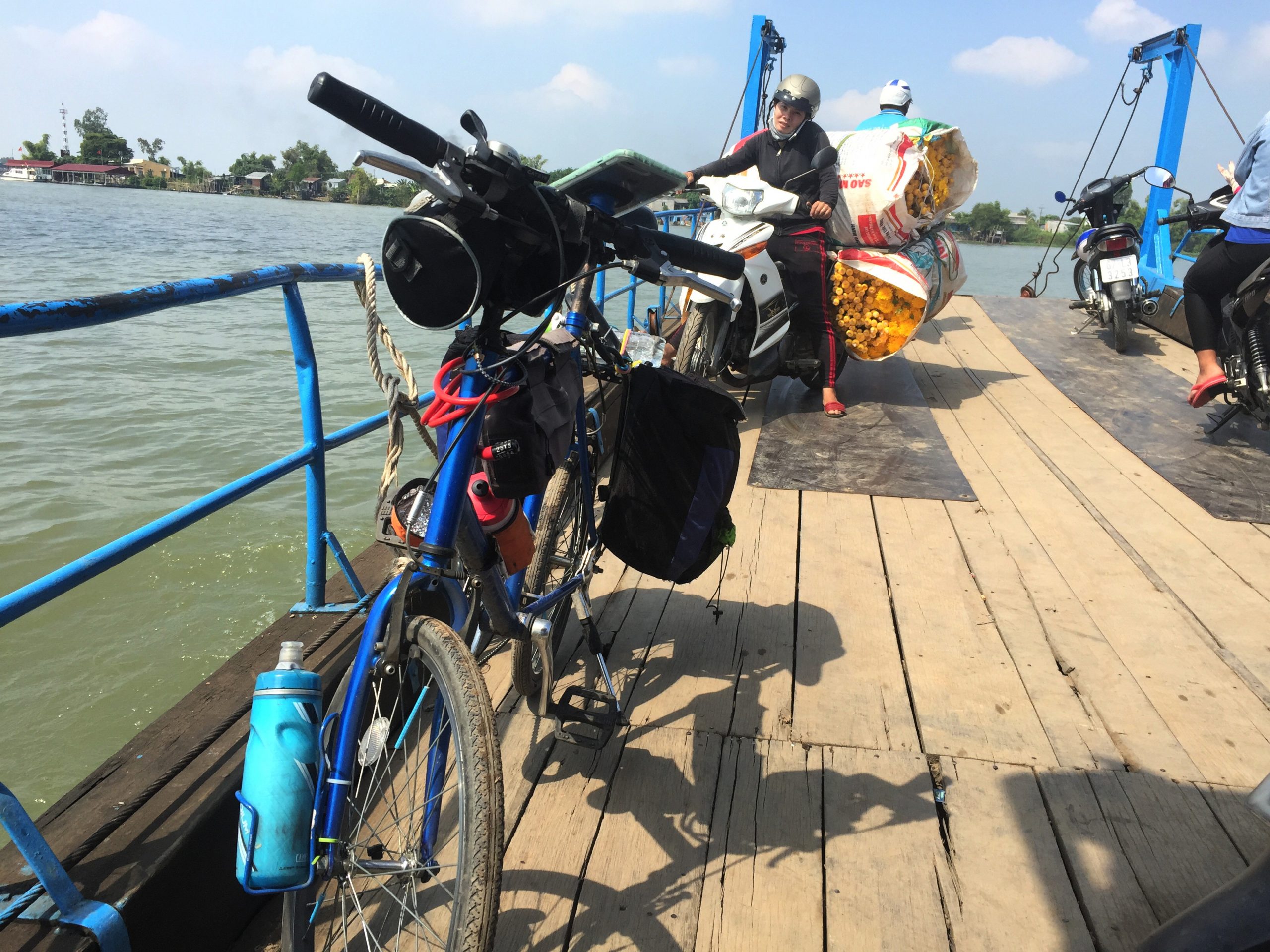
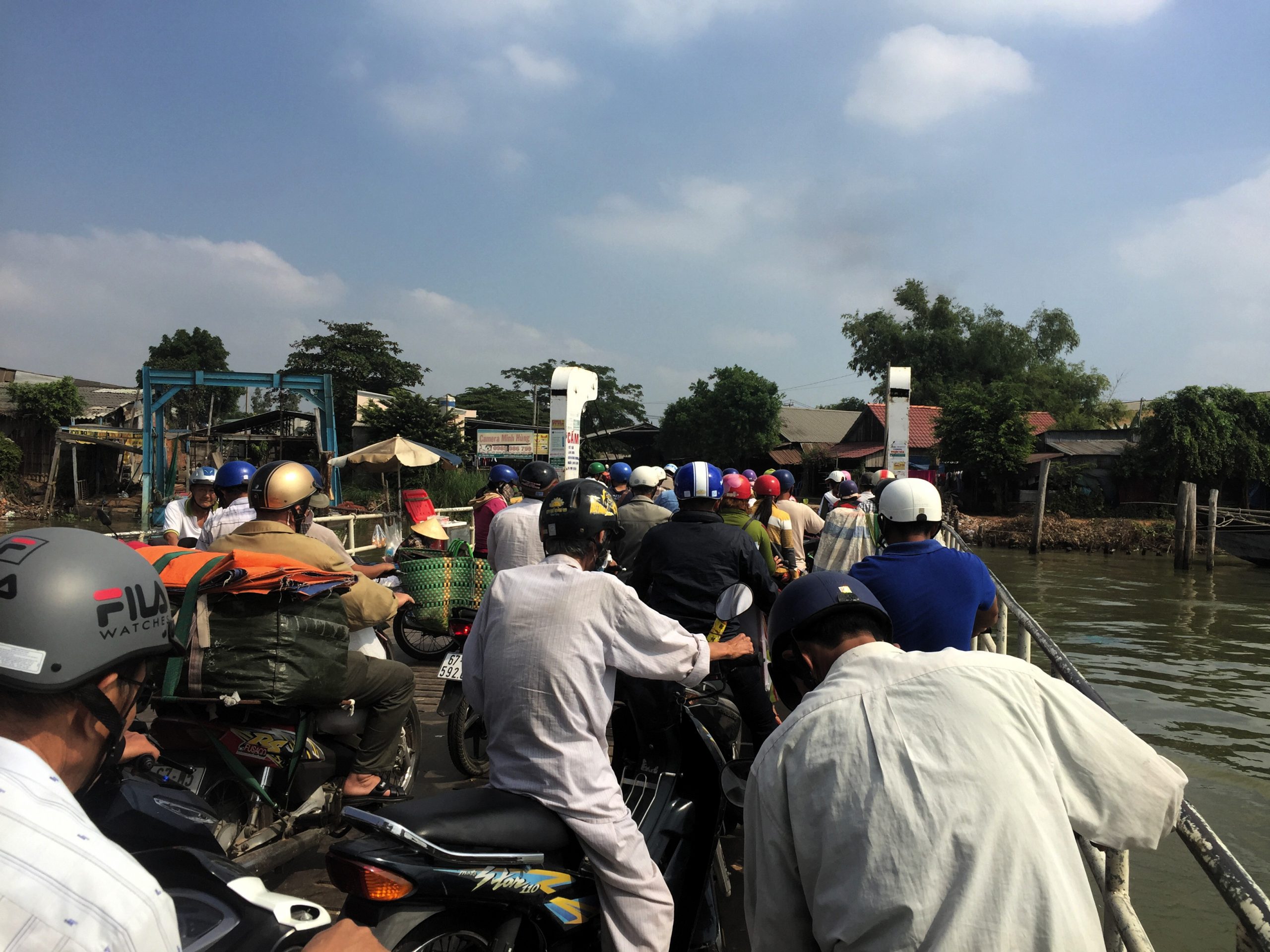
I really enjoy taking the ferries. They aren’t monstrous affairs like the Staten Island ferries or the Oshima Island Passenger Ferry. They are basically small platforms with a motor and a wheel house. I hope that in Vietnam’s drive to modernize they don’t replace them with bridges.
The ride from the ferry terminal followed the course of the main branch of the Mekong River to the border. As I road along I wondered what kind of people lived so close to the border and if they were all that different from those who lived farther away.
David described the border crossing to me. But despite his description and reading about other travelers’ experience I still wasn’t prepared. The only other land border I had ever crossed before was between the U.S. and Canada and that only just barely counts as crossing into a foreign country.
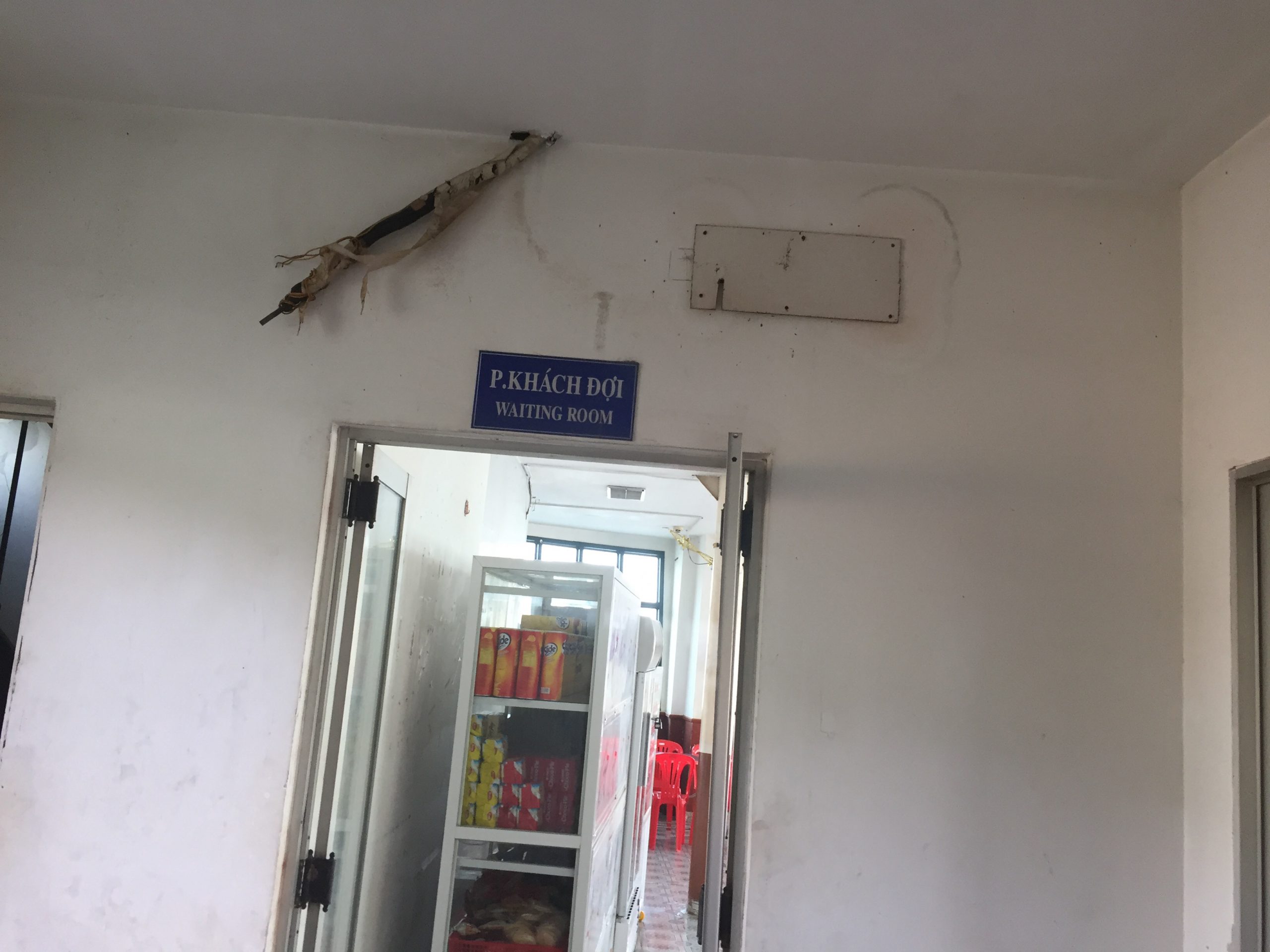
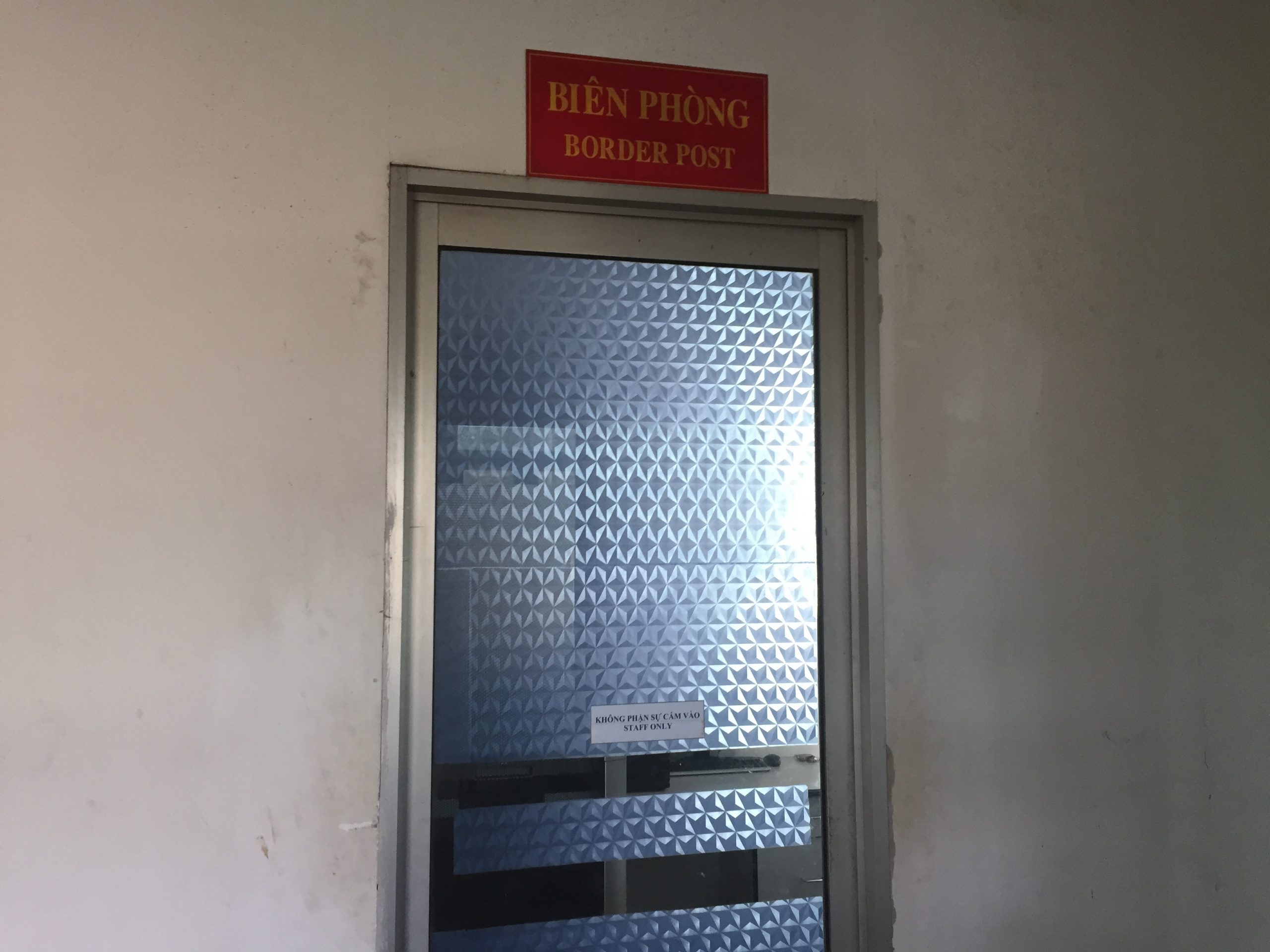
I found the Vietnam border station at Vĩnh Xương just as David described. The border station is a building built about 20 meters from the banks of the river and connected to the shore by a short footbridge. This location allows those crossing by boat as well as those crossing by land to be processed. I parked Mini-V on top of the river bank and walked down to the border station. If the river side is the front then I entered through the backdoor. On the bridge leading up to the door there were four very official military types sitting in front of the door and drinking coffee. They had all the appearance of government employees on their break. I walked past them assuming there would somebody on duty inside. When I got inside there was no sign of a border official. There were a dozen or so foreign tourist lounging around in a waiting room with a very nice view of the river and a tour boat docked to the river side of the border station. In the waiting area there was a glass case with snacks for sale and a woman willing to sell you Oreo cookies and chips. Nearby was a table where a young woman would exchange Vietnamese dong for Cambodian riel. But no border officials on duty.
For some reason I was under the mistaken belief that I had to take a boat to cross the river and the border. I asked a young Australian sounding couple, or maybe they were Kiwis, who can tell the difference?) where to catch a ferry across the river. They asked me in turn if I was with a tour and said the boat docked to border station pier was their tour boat. Nobody knew anything.
Not knowing what to do I went back out the way I came in, past the lounging border guards. They seemed completely unconcerned about my coming and going. I walked back up the bank to my bike and pedaled back up the road I came because, as David had explained, the real land crossing was on side road a couple of hundred meters before the border station. I went through the first gate, more like a rail crossing guard than a gate, to a building. There a Vietnamese guard indicated that I should follow him. I pushed my bike behind him as he led me back to the border station. The guard spoke not a word of English so I was still in the dark about what was going on.
Back at the bank above the border station I met two Indonesian men who had just pedaled across from the Cambodian side. I spoke with them briefly. They told me I needed to get a stamp at the border station. When I asked them about their trip they told me that they had ridden from Indonesia through Thailand and Cambodia. I asked them how the roads were in Cambodia. The warned me that they were good but dusty. Our brief conversation was interrupted by the guard waving me down to the border station.
I went down and the man took my passport. I thought, “Now I am finally getting somewhere.” Inside the office which I was not allowed to enter I could see that they had pulled up my picture on a computer screen. I supposed they had scanned my passport or I was already in the system from when the visa was issued by the Vietnamese Embassy in Tokyo. After a few minutes they gave me back my passport and once again I followed the guard. I notice there was no one in the waiting room and no one manning, or should I say womanning, the exchange table or snack stand. No Oreos or riel for me.
This time the guard led me back to the gate on a motorcycle. We went through the gate into the no-man’s land that I believe exists between all countries. At the railway crossing gate on the Cambodian side of no-man’s land he passed me off to a Cambodian policeman who was also on a motorcycle. This man told me in English to follow him and follow him I did to another gate and another side street where he handed me off to another policeman who took me to the Cambodian border station. Like on the Vietnamese side, the Cambodian border station was on the river though set back from the waterline a bit. The Cambodian border station was like a walled garden or park. Quite pleasant. The police on the Cambodian side all spoke English to some degree. I was processed with a boat load of tourists who had approached from the river side. The tour guide helped me out a little bit when the policemen’s instructions were lacking in clarity. They took my picture and my fingerprints, stamped my passport and I was done.
All of this took no more than an hour. It was probably closer to half an hour. I was really worried about entering Cambodia because the night before I noticed that my Cambodian visa was dated for the day after I was planning to enter Cambodia. I don’t know if this was a mistake on my part or the Cambodian Embassy’s part. Regardless, the date was wrong. If the border guard was a stickler for rules and details the mistake would be grounds enough to deny me entrance. There were three possible outcomes. 1) I would be denied entrance until the next day. In that case I would have to ride back across the border to Tan Châu and find a hotel. 2) I would be forced to pay for another visa with the correct date which would be problematic because I didn’t have any money that I could use. 3) The policeman didn’t notice the later date or didn’t care that I was trying to enter the country one day early.
I suppose there was a fourth possible outcome. The guard noticed the date was for the next day, decided I was just too suspicious and introduced me to the hospitality of a Cambodian jail cell thus extending my vacation. Fortunately, fate favored the third outcome. Like the Mekong River, humans and fate choose the path of least resistance.
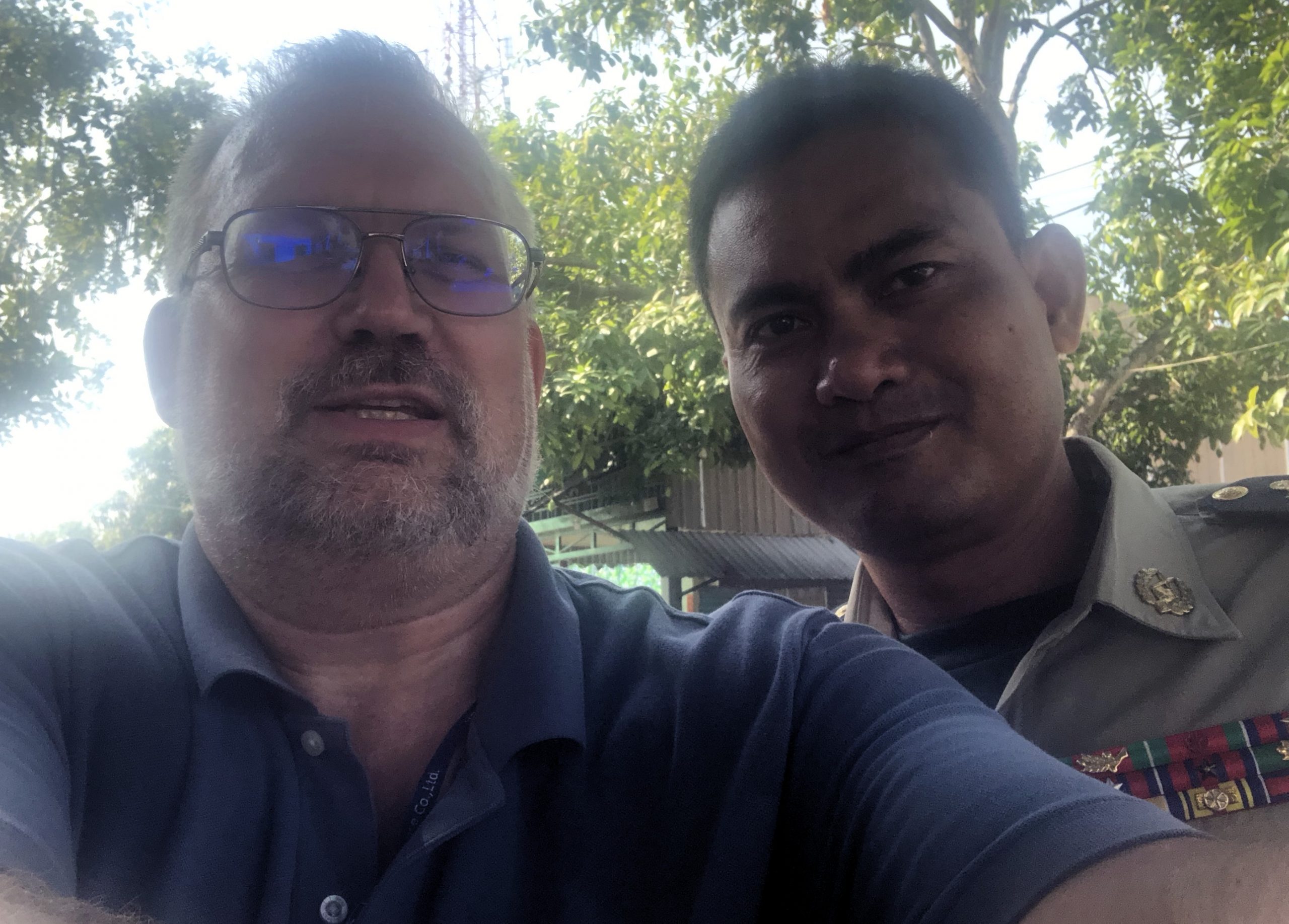
After getting my passport stamped I was standing on the road outside the entrance of the border compound taking a few pictures and video of the communist party banner fluttering in the wind when a different guard approached me. While inspecting my passport he asked, “Where are you going? I know you are going to Cambodia, but where are you going?” I answered, “Phnom Penh.” This seemed to satisfy him. I think he just wanted to talk to the idiot foreigner riding a mini-velo through his country or perhaps he decided that a tourist taking pictures in front of the border station was suspicious. I asked him to take a picture of me and Mini-V and then a selfie of the two of us. Weird but cool at the same time.
On the Cambodian Side
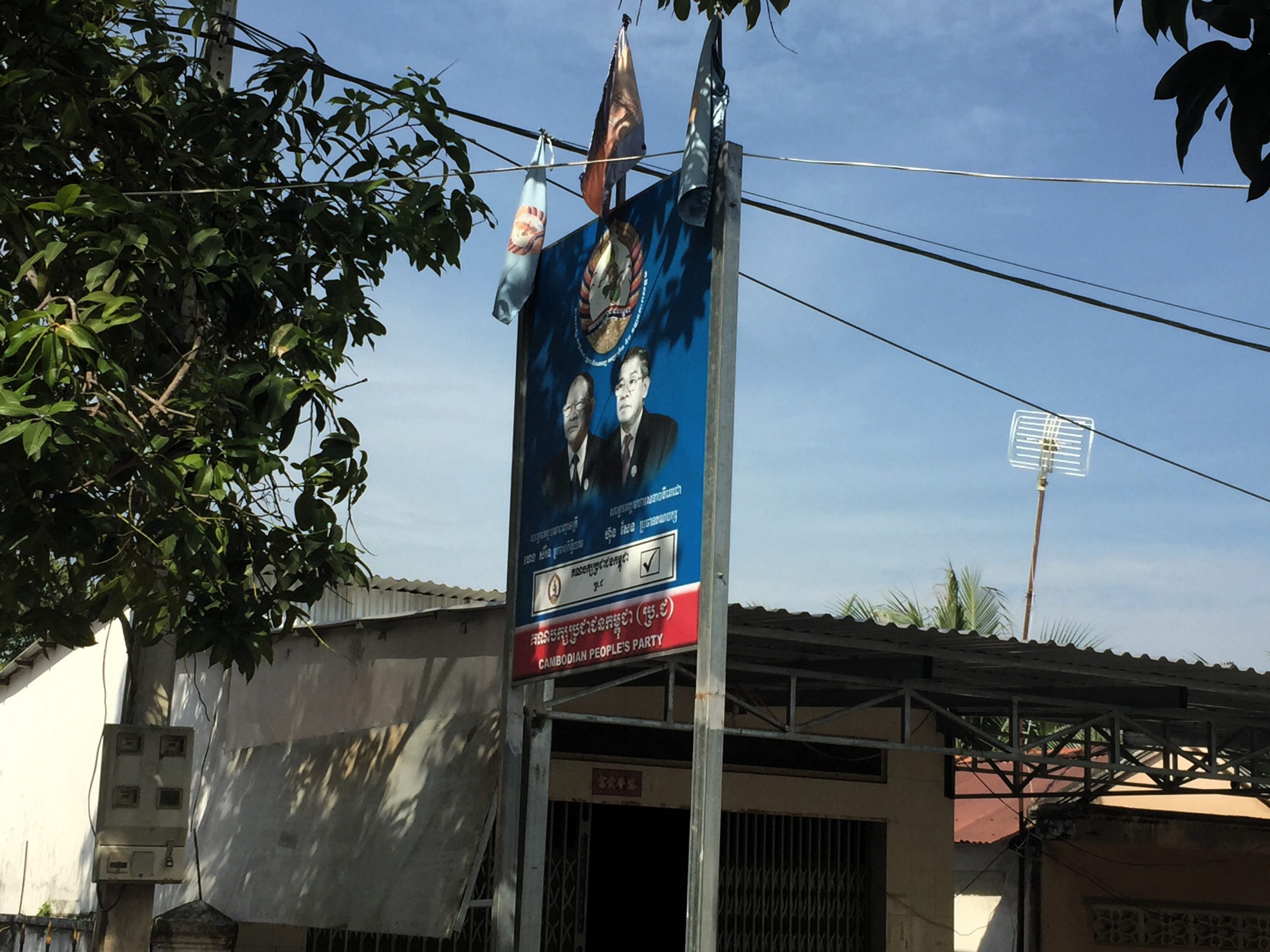
Safely through the border crossing I continued on my journey up the Mekong River. I immediately noticed a difference between Vietnam and Cambodia. While many things are very similar some are different. For one, there were fewer chickens and more households had two or three head of cattle. Another difference was that people seemed very interested in greeting me. Every couple of hundred meters someone was waving to me or saying hello. This was fun at first but as the morning wore on and I got hotter and more tired, constantly greeting people became exhausting and a nuisance.
As I rode along I was reminded of the Indonesian bicycle tourists’ warning about dusty roads. Within a few kilometers of crossing the border the soil seemed to become sandy. Also, there were stretches of unpaved road that showed evidence of road construction. Even though it was a weekday I didn’t see any workmen. Maybe it was a holiday.
For an hour or two I road through a semi rural area parallel to the Mekong River though it was mostly just out of sight. I got the feeling that all the houses and businesses were lined up along the road and if I detoured onto a side street I would quickly find myself all alone in the countryside.
After a while the rural road fed into a highway. This is the famous Asian Highway 1. Like Vietnam, there seemed to be no restrictions on what kind of vehicles (or livestock) could use the highway. One significant difference was that I saw fewer motorcycles being used for transportation (still many used for hauling cargo) and more Japanese and American cars.
The Kindness Of A Stranger
I was making reasonable progress towards Neak Loeung, the first town I would stop at in Cambodia. The heat was really wearing me down and I was running low on water. All along the road from the border crossing I saw large signs advertising Ganzberg Beer. The thought of a cold beer was tempting. Unfortunately, I had no currency that I could use to buy beer or anything at all. When I was about 10 km from my destination I really needed to take a rest break. In Tokyo there are lots of little municipal parks and if you are in the countryside you can just pull over to the side of the road and sit in the shade but I couldn’t find a quiet place away from the road to take a break that wasn’t someone’s home or business.
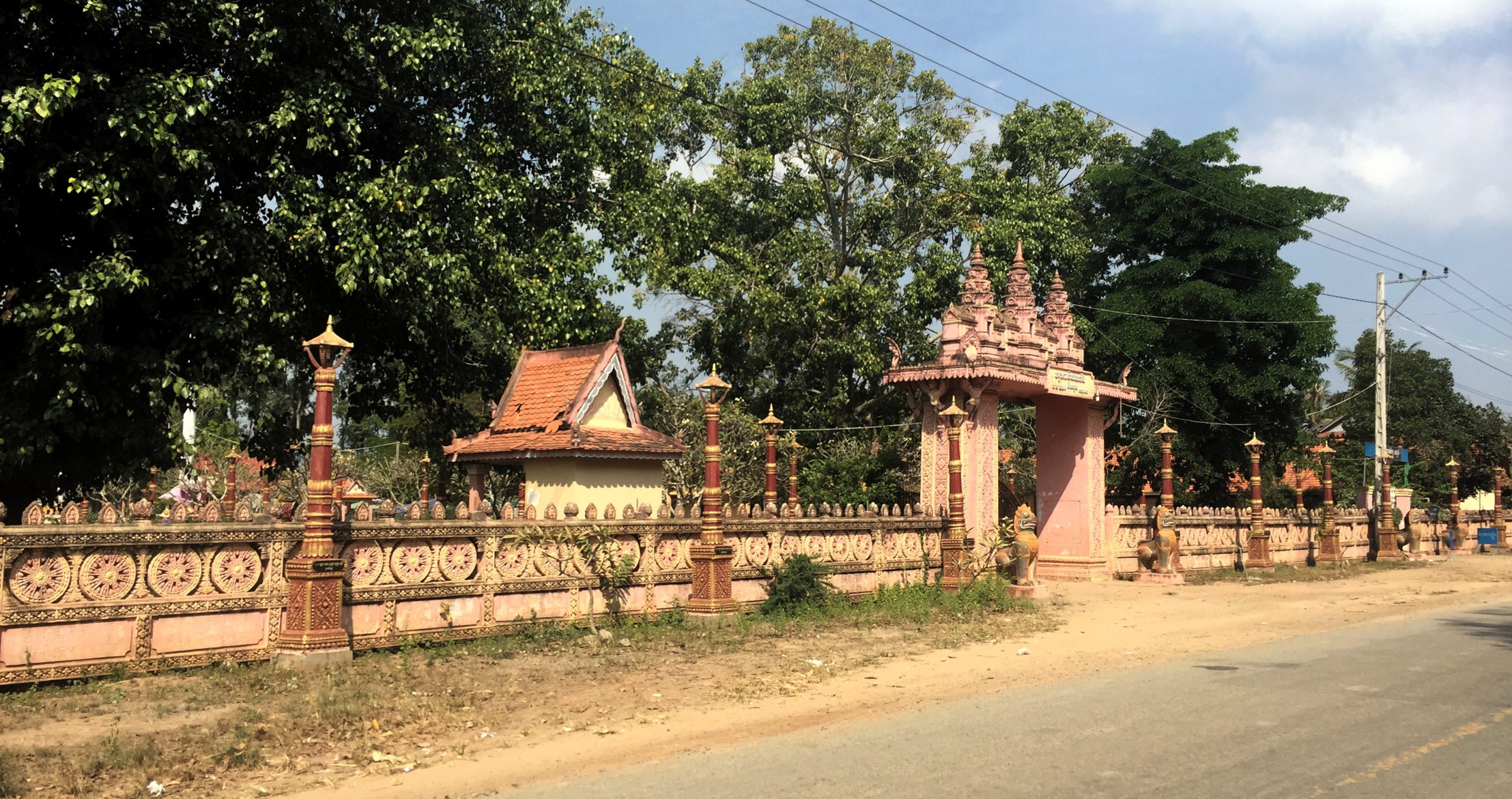
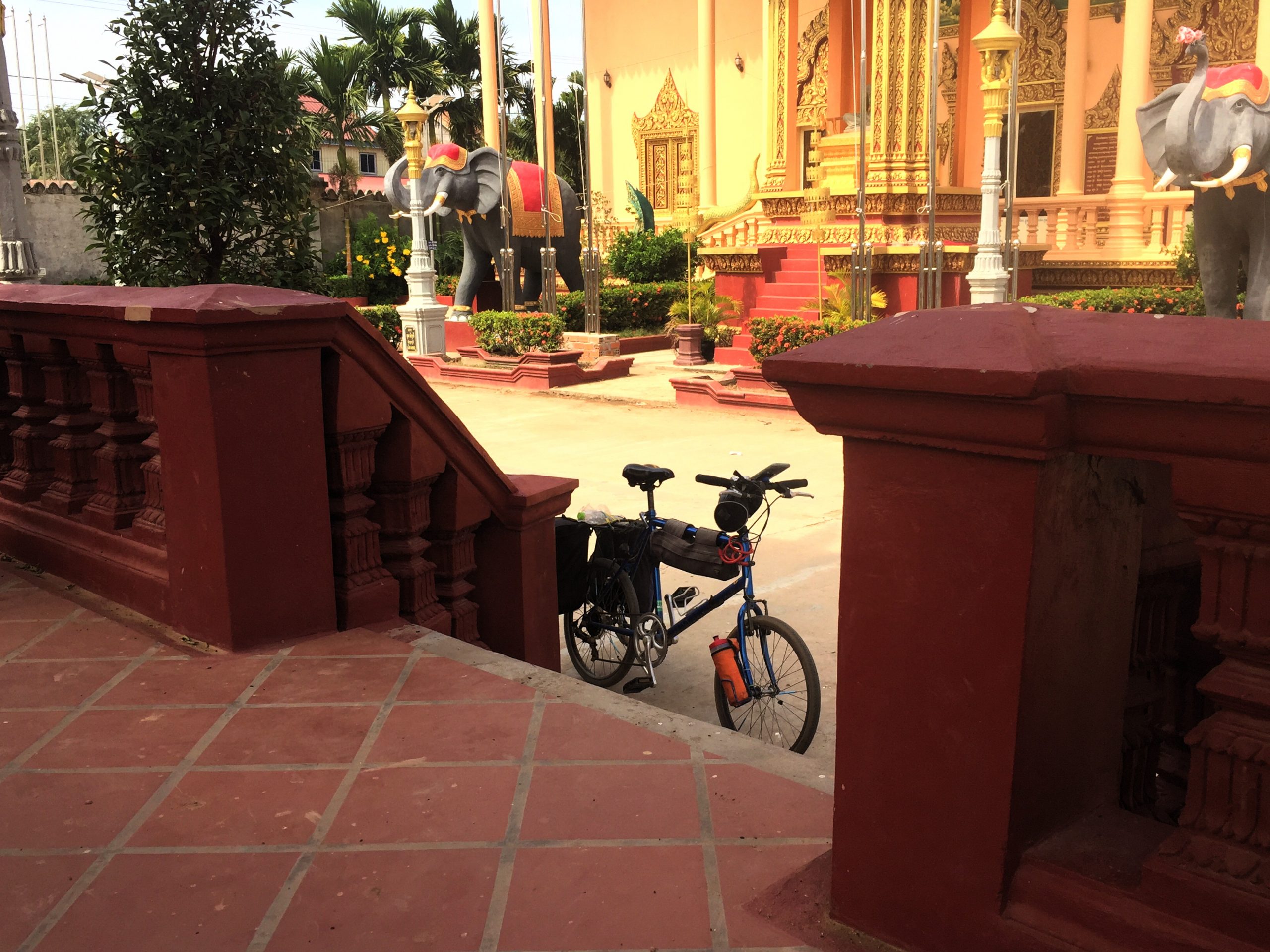
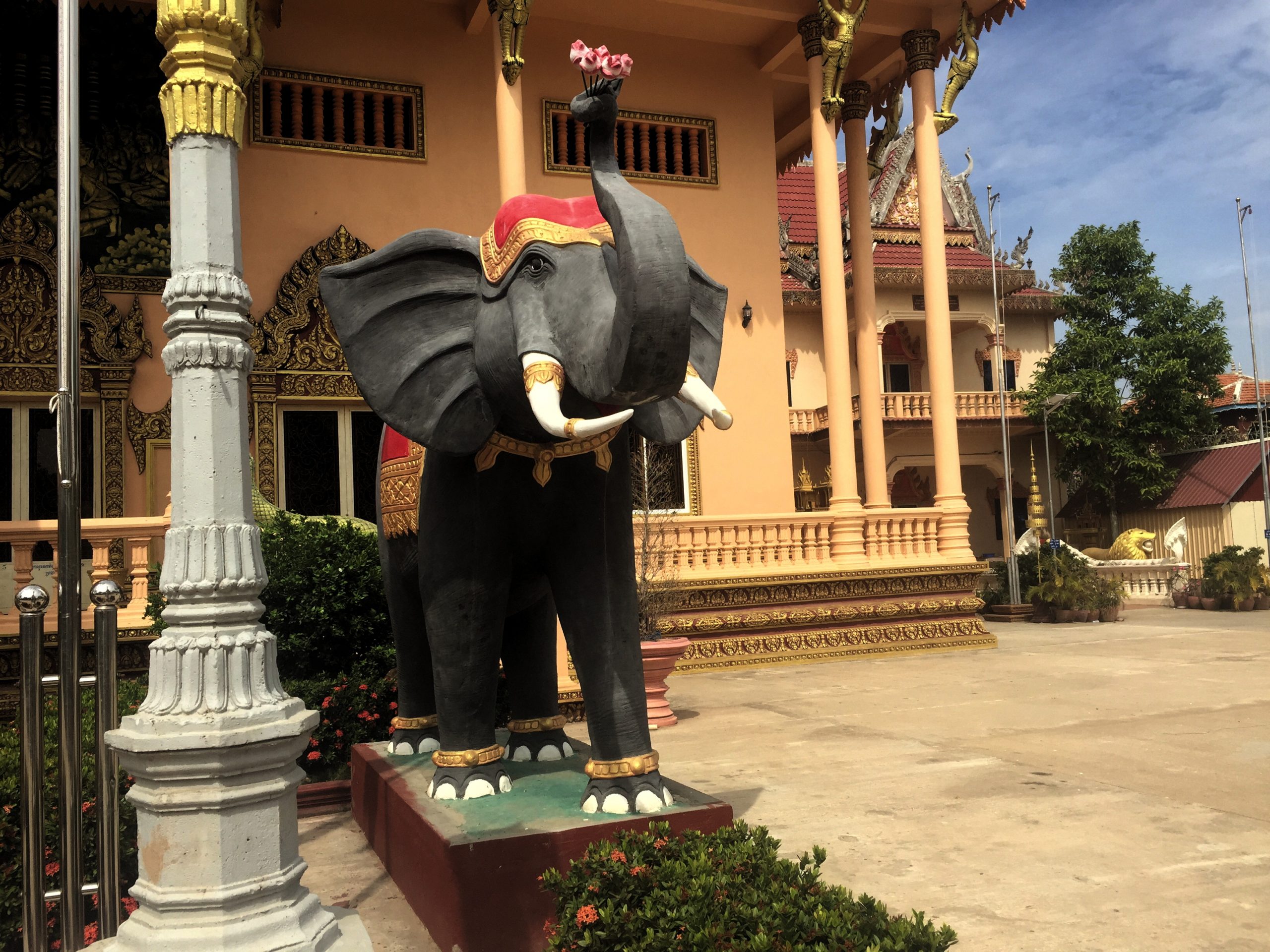
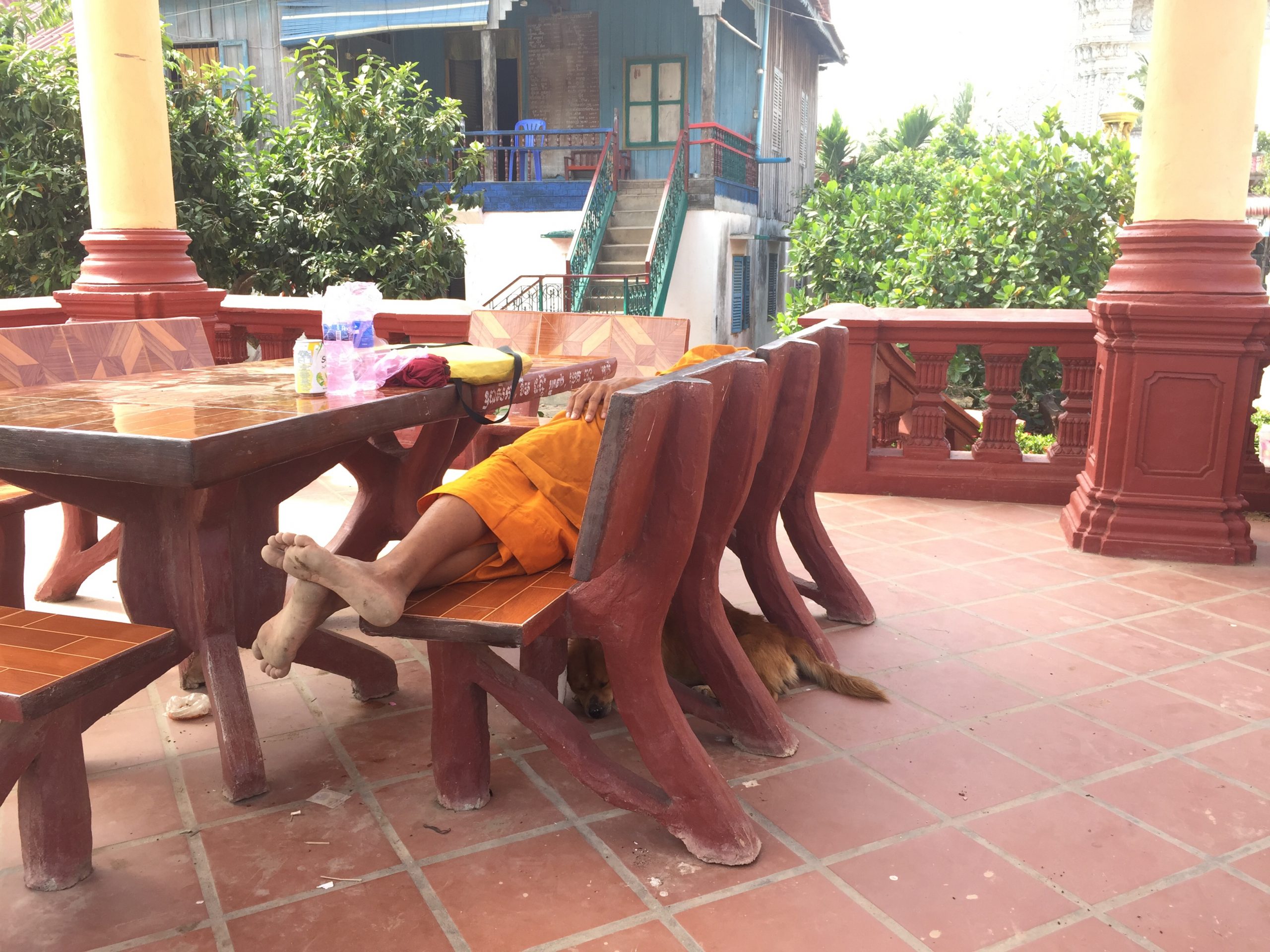
Finally, I pulled into a beautiful Buddhist temple to get out of the sun and rest in the shade away from the dust and noise of the highway. I found a pavilion with a table and benches. There was a monk napping on the bench by the table. I took a seat on a bench in the shade a few meters away not wanting to disturb his nap. I took my shoes off and ate some trail mix I carry for emergencies and drank my water. I was probably experiencing borderline heat exhaustion.
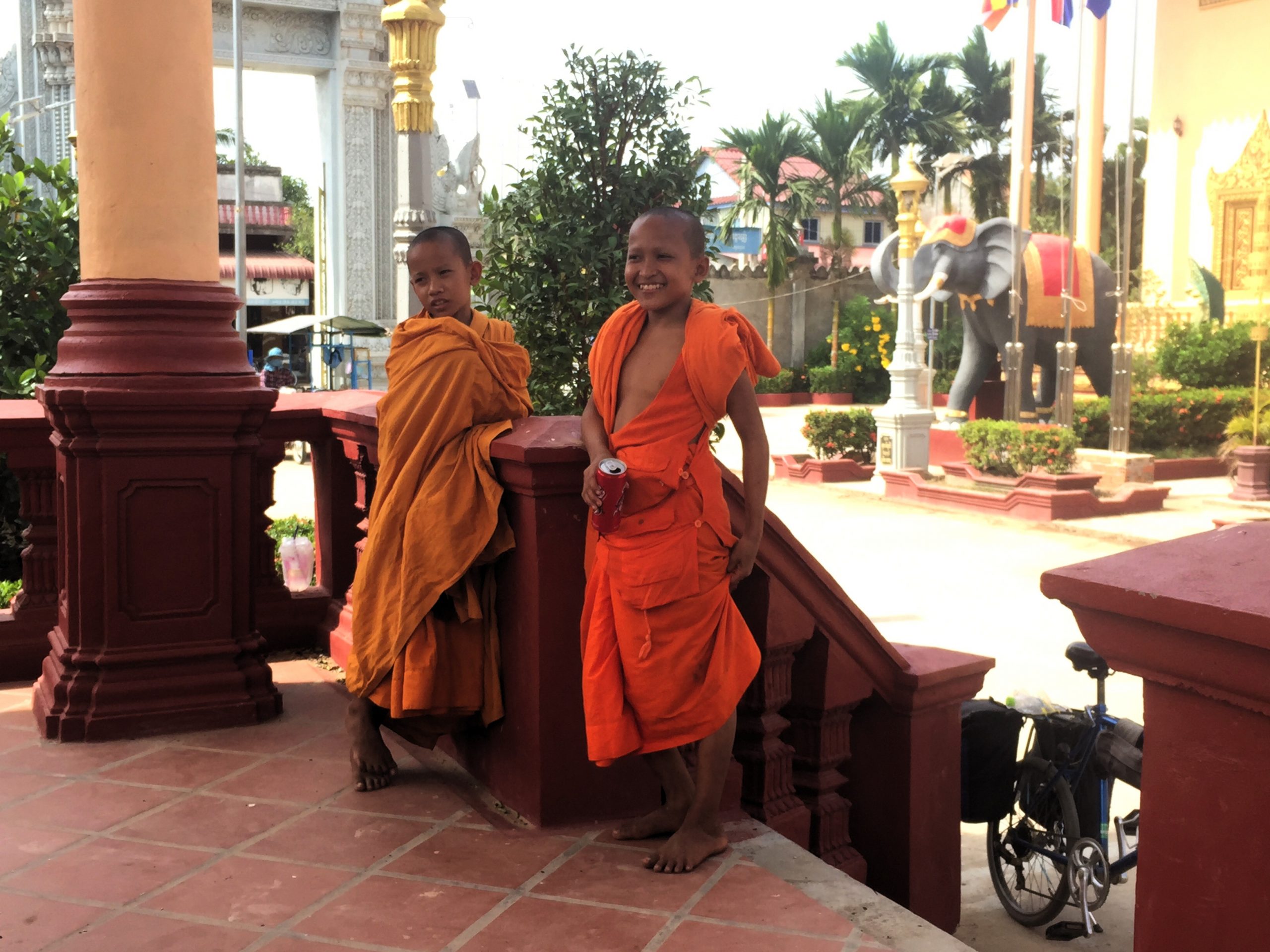
Eventually, the monk roused himself. He must have thought I looked bad because he pulled out of his bag a can of soy milk and gave it to me. I accepted gratefully. It was the best soy milk I have ever had. I didn’t know if his religion would allow him to eat it but I offered him some of my trail mix in exchange. He turned it down. I don’t blame him. It had been reheated in the sun several times by now and I noticed that tiny ants had gotten into when I was in Long Xuyên. The monk went an extra 2nd mile. He offered me a bottle of water and an energy drink. Apparently, Buddhist monks can and do drink energy drinks. I am sure he wasn’t carrying it around just in case he found an exhausted Westerner intruding on his nap. We didn’t share a common language or culture but he shared with me kindness that crosses borders, culture, and politics. In a world that is becoming more polarized and divided we need to reach across all of our borders. Ideological, economic, ethnic and social.
Enough pontificating. Thanks to the monk I was revived enough to continue my journey. Looking at the map it was clear that I would have to cross the river because Neak Loeung and my hotel were on the other side.
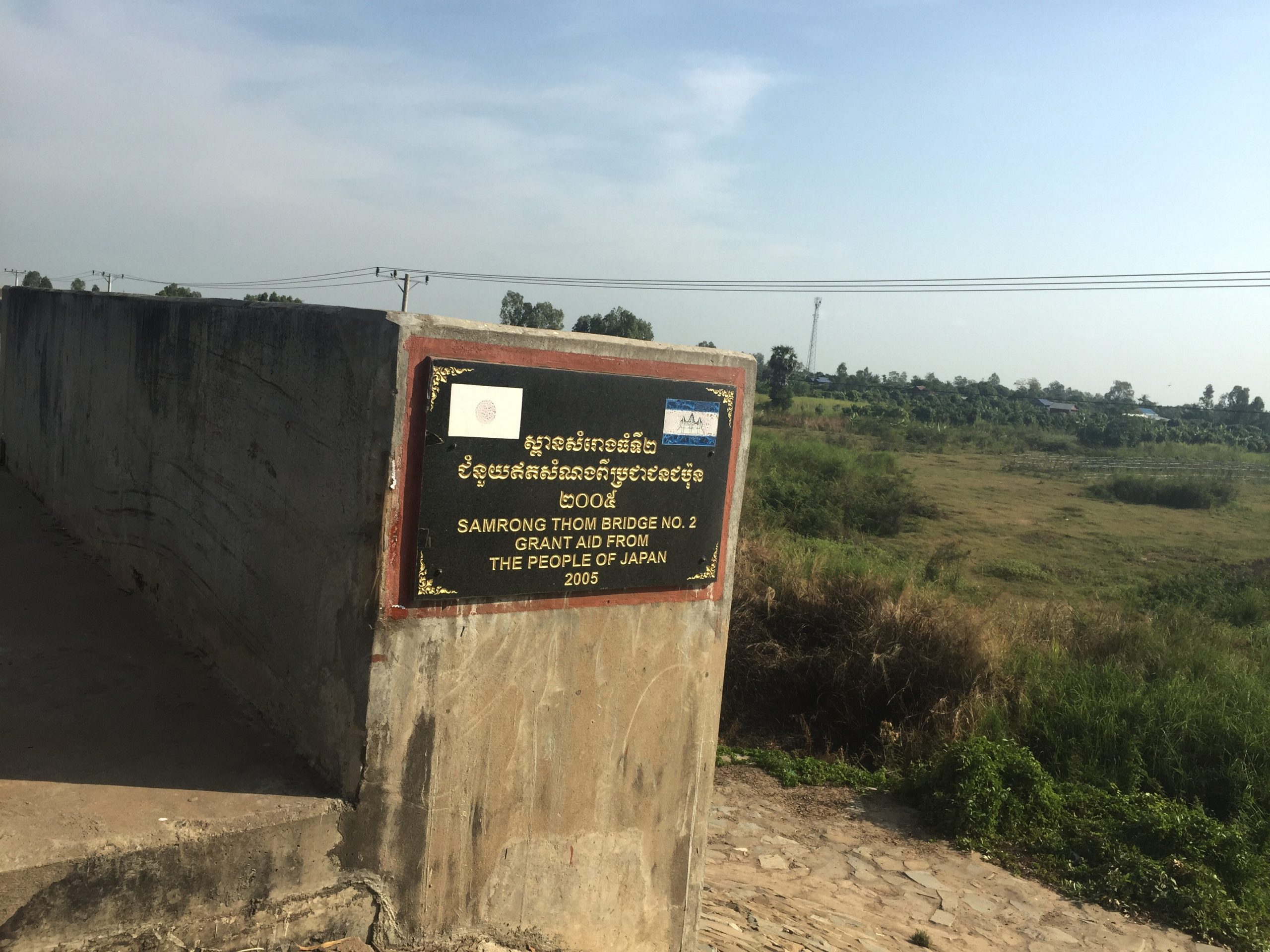
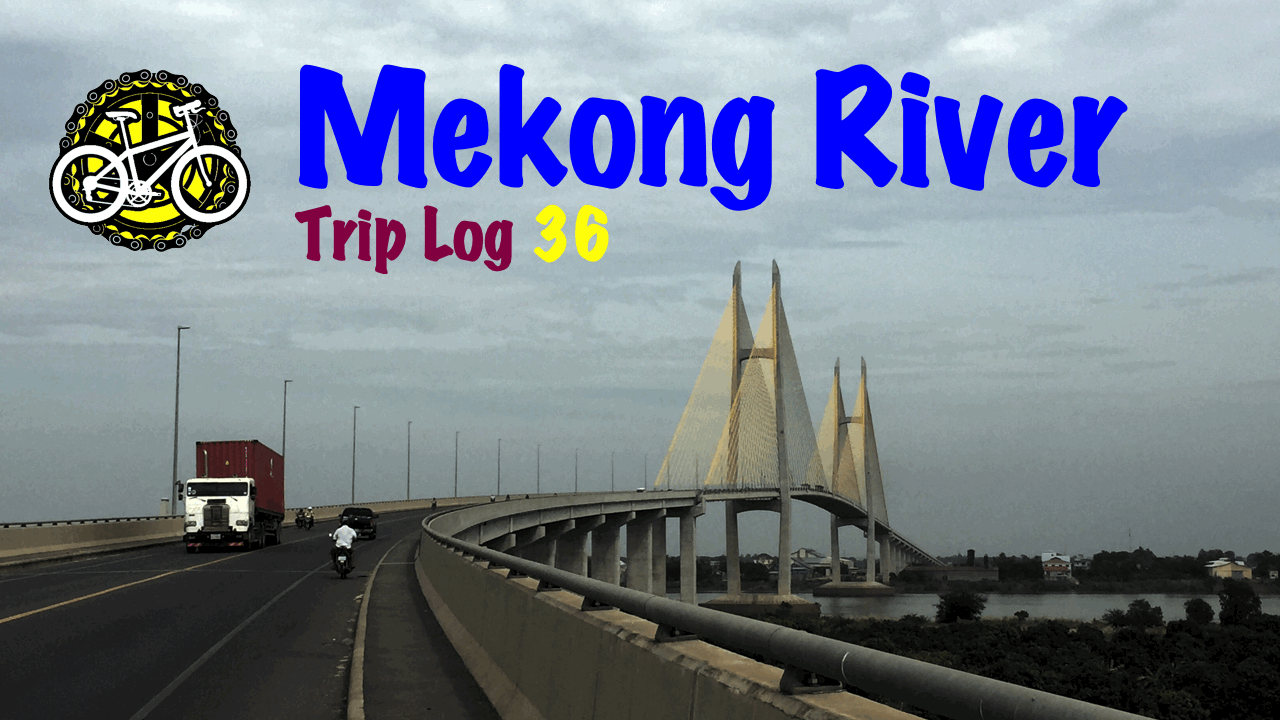
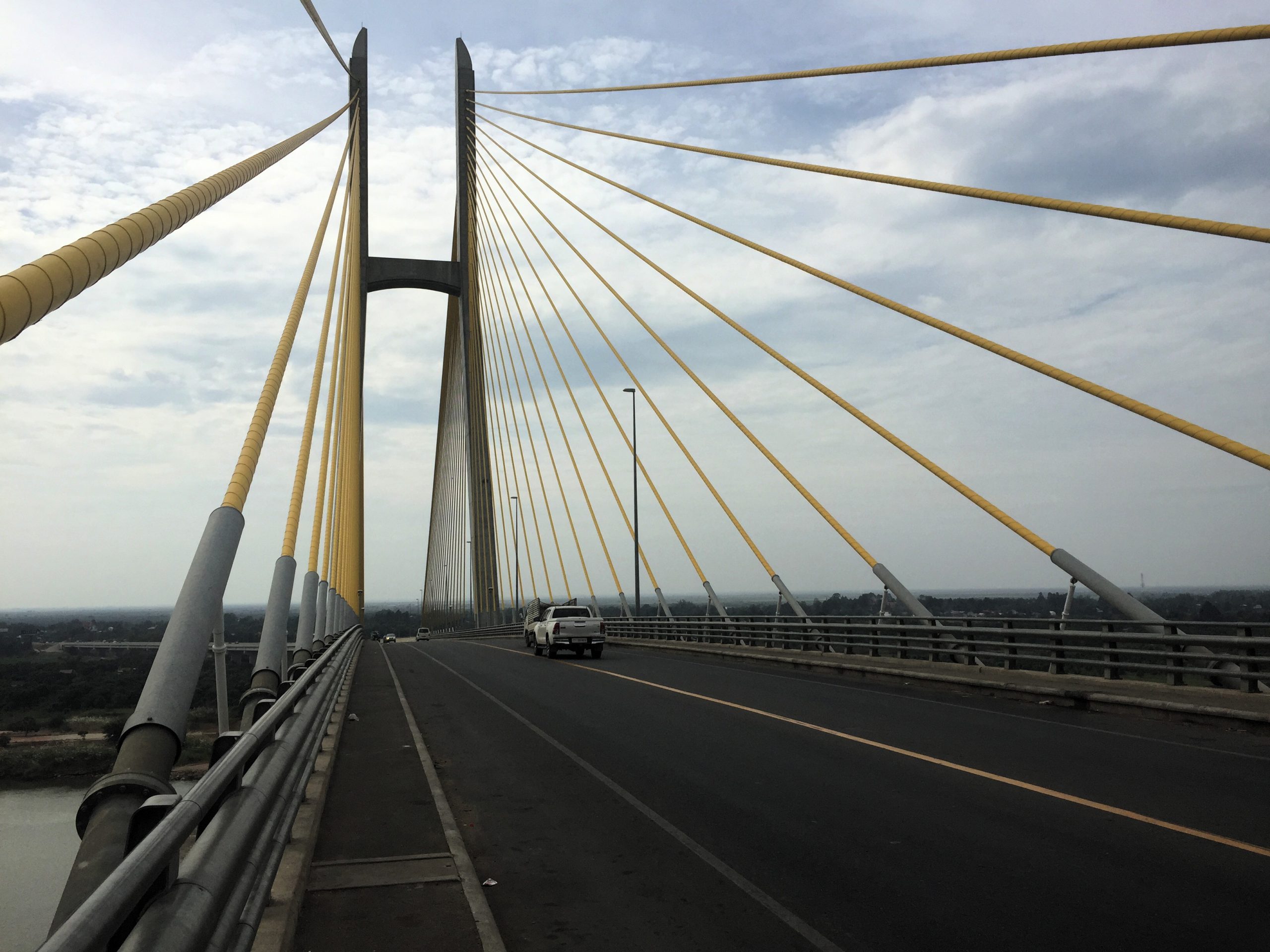
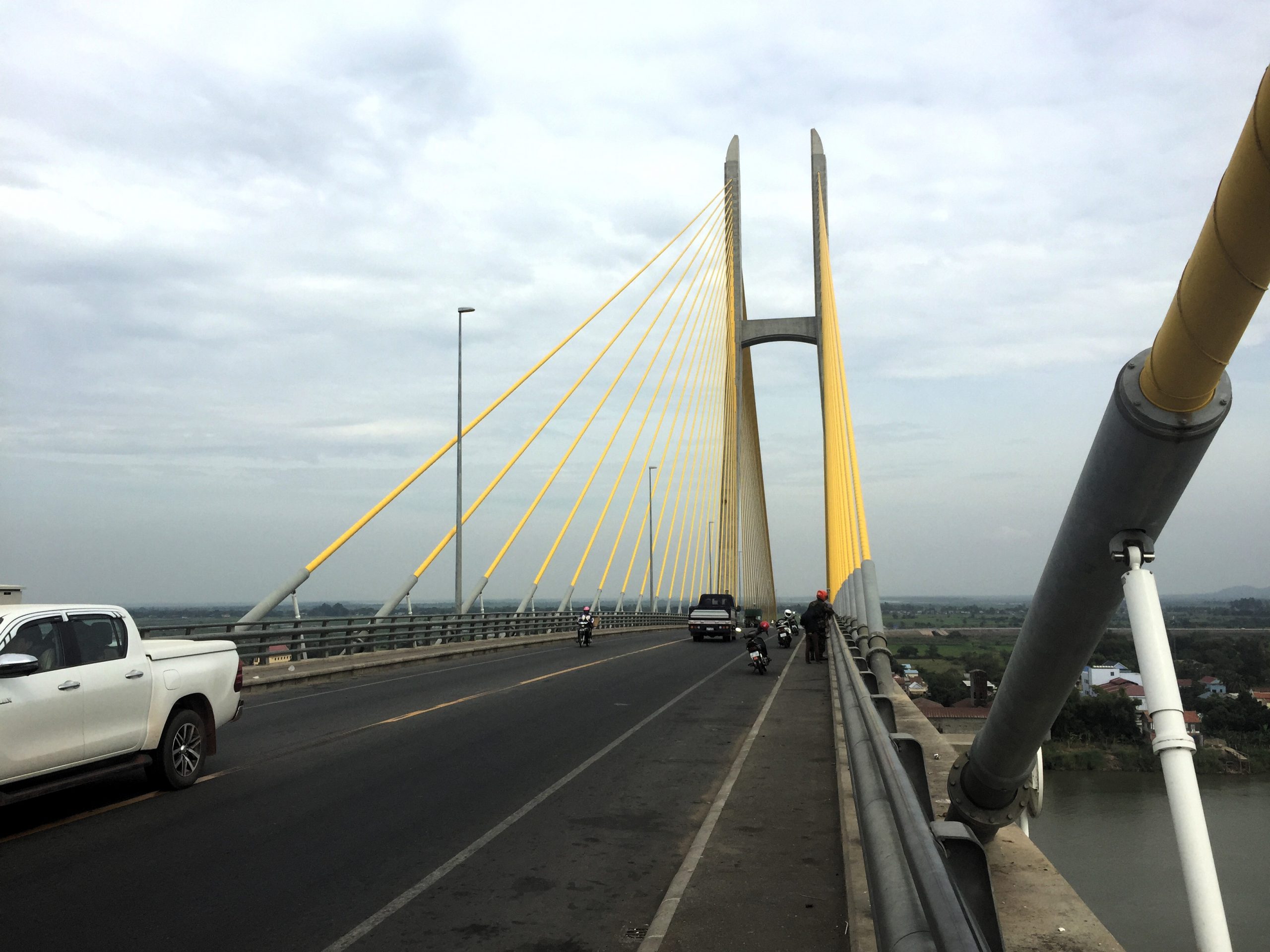
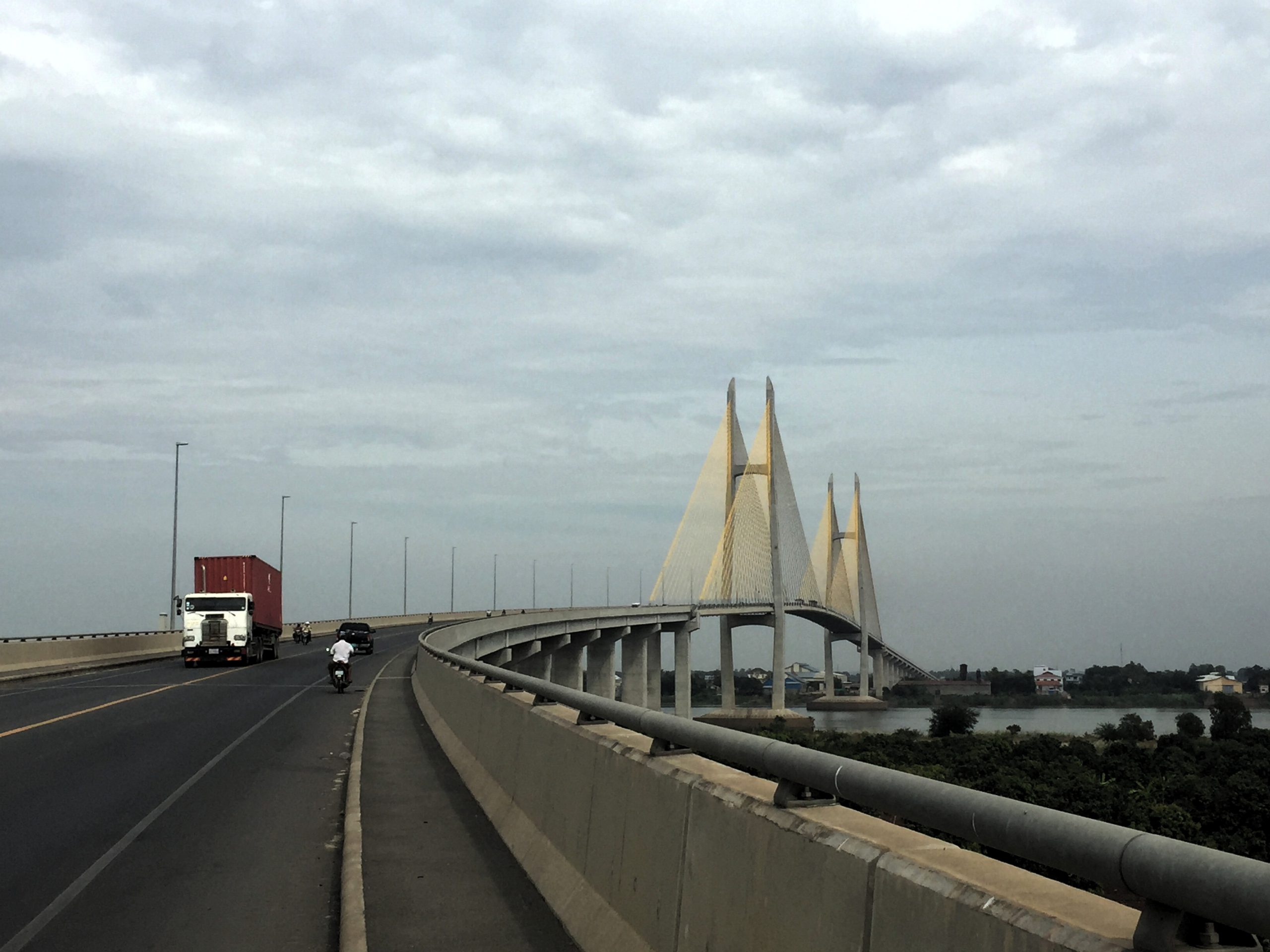
It turns out the bridge crossing the Mekong River has two names. The obvious name is taken from the nearby town, Neak Loeung. The less obvious name is Tsubasa Bridge. There are some of you gentle readers who might be thinking that tsubasa sounds distinctly Japanese and you would be right. Tsubasa means wing in Japanese. The bridge was donated to the Cambodian government by the Japanese government as part of a larger project to improve Asian Highway 1 from Thailand to Vietnam. During my travels in Cambodia I crossed two other such bridges. I’m glad I had a chance to cross it as my tax yen helped pay for it.
There are three outstanding features of this bridge. First, the bridge is the longest bridge crossing the Mekong River at 2.2 km long. Second, going over the bridge represented the steepest climb of my entire trip through the Mekong River Delta at around a 4.5% grade. The third and most outstanding feature is that the suspension cables are bright yellow.
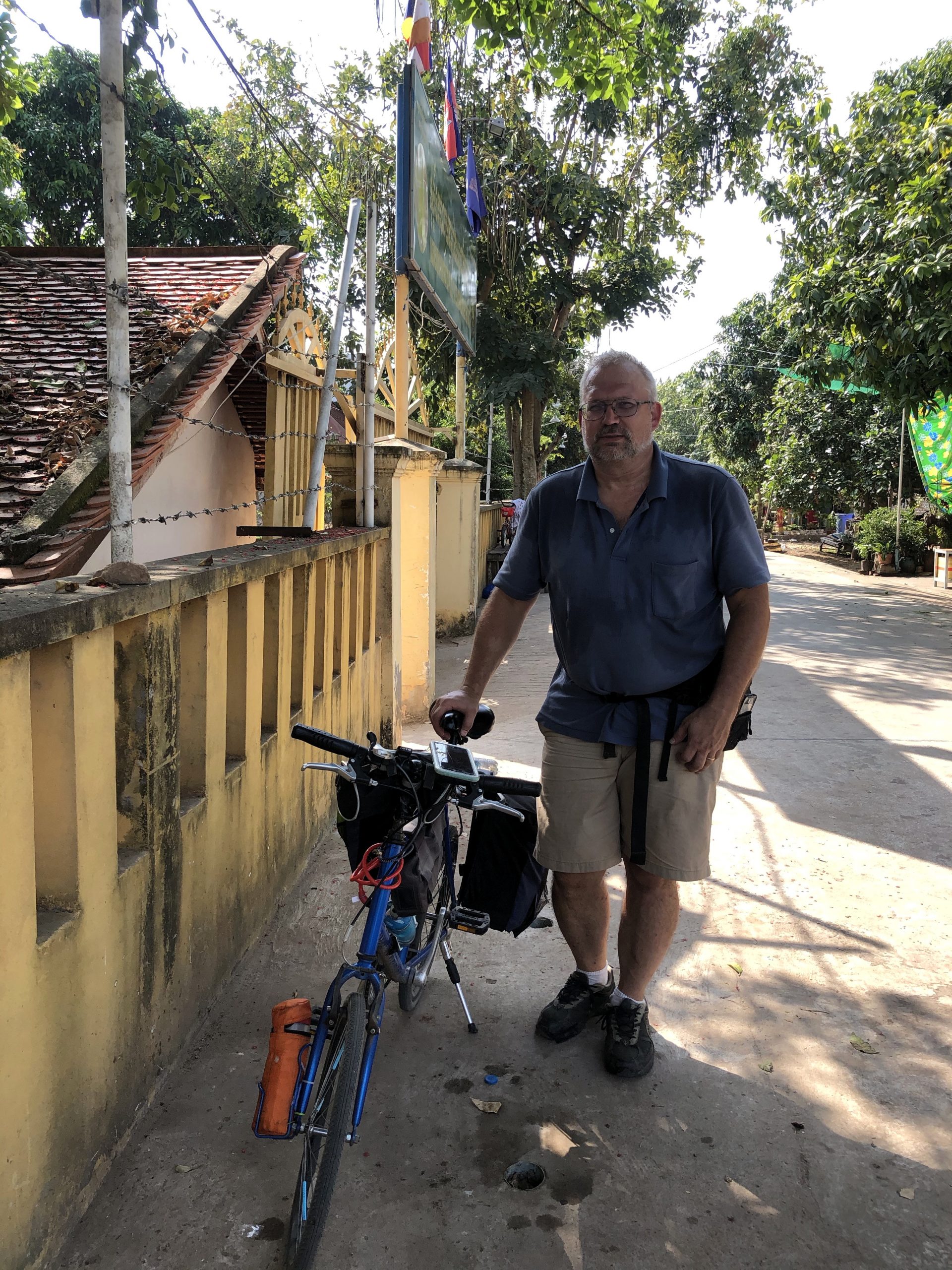
Now, I have to admit my faithful, little Mini-V is a wonderful bike on the flats but she has a hard time going up hills with her little 20 inch wheels and lack of granny gears. But her and I did our best and managed to get the top. Partway Mini-V insisted that we stop to take a picture and some videos. I happily obliged her whim without remarking that she might be too tired after riding 50 km in the hot, Cambodian sun. One does not want to get on the wrong side of one’s bicycle.
After crossing the bridge, cursing out the inconsiderately placed rumble strips on the downhill side that I thought were going to taco my front wheel when i hit them at speed, it was a short ride into the town. Fortunately, my hotel was on the near edge of town.
At the hotel I was able to exchange enough dong for riel to get dinner at a nearby cafe, a beer at the tavern across the street and some mystery fruit. (Watch the video to learn more about the mystery fruit.) I should have exchanged more but I thought I would be able to in the morning.
Money Makes the Wheels Go Round
The challenge of traveling in a foreign country for the first time is that you never know how much money you are going to need. Ideally, you want to exchange just enough so that you have very little left when you leave the country. All during my stay in Cambodia I miscalculated how much money I would need. I kept getting Cambodian currency and Vietnamese currency mixed up in my head and my wallet. I think I even accidentally payed for something with a 10,000 yen bill instead of 10,000 in riel or dong. 10,000 yen in Cambodia and Vietnam is a princely sum.
Neak Loeung
My hotel in Neak Loeung was at the edge of town overlooking a swampy area. The hotel staff led me to my room on the second floor. The room was clean and brightly appointed. When the woman closed the curtains I didn’t think much of it at the time. I later opened the curtains so I could get a look out of the window and never closed them again because the only thing outside my window was open space. The room came complete with a television. I turned it on and started surfing the Cambodian air waves. The reception wasn’t very good. First, I found a sports channel with English sportscasting of a sailboat regatta. Boring. Then I found what appeared to be cock fighting. The screen was so staticky it was really hard to see what was going on. I finally gave up and went to the next channel. Click. A Cambodian soap opera. I don’t want to watch soap operas in any language. Click. Now we are talking. Crystal clear reception in English! Oh wait, it is the RT News Channel. The Russian Times News Channel. Why does the only channel that gets good reception in Neak Loeung have to be the Russian propaganda channel. I watched it for a while because it is always good to know what your adversaries are saying. It was just as bad as watching Fox News (only better produced) and I turned it off after 15 minutes.
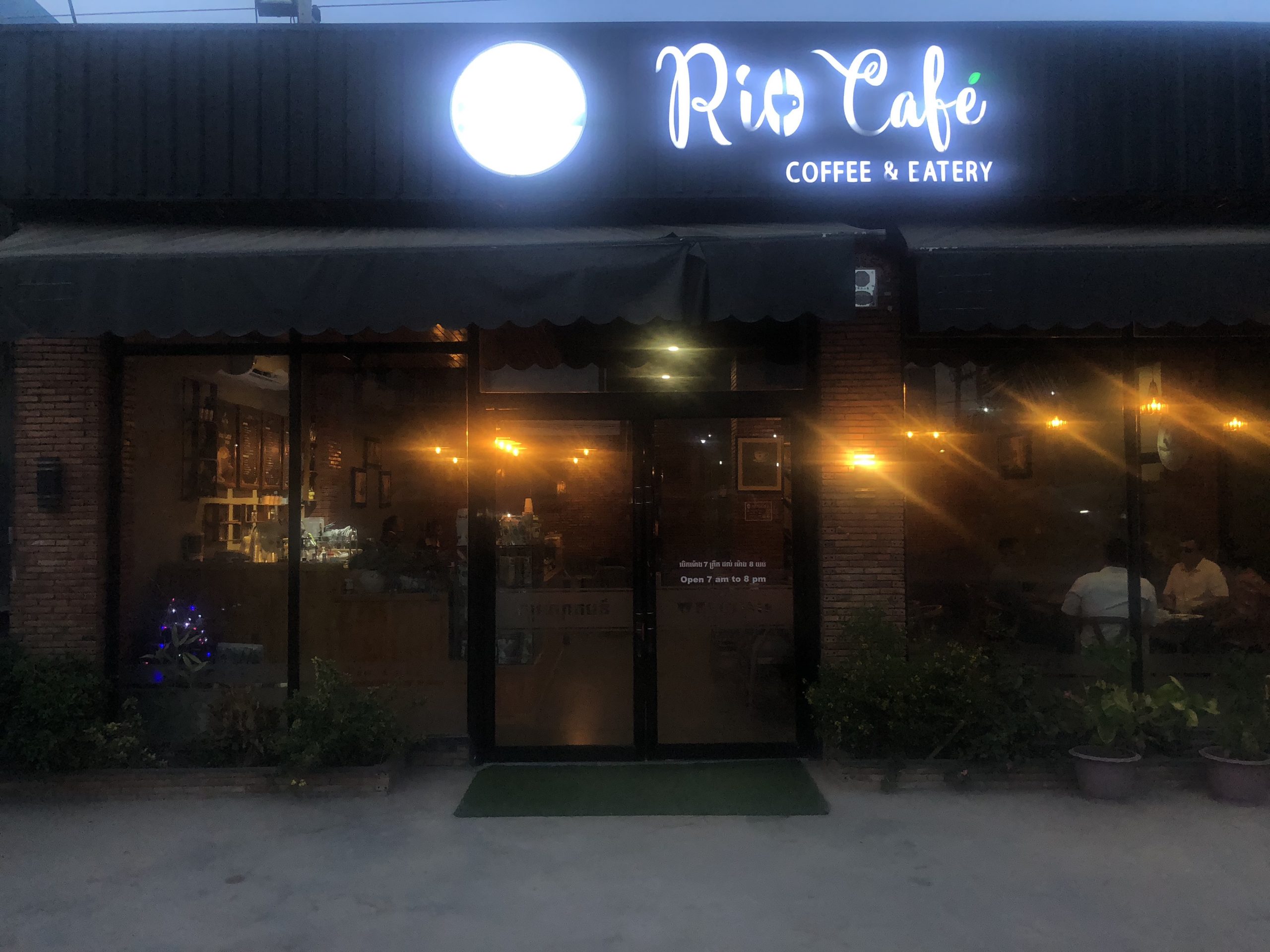
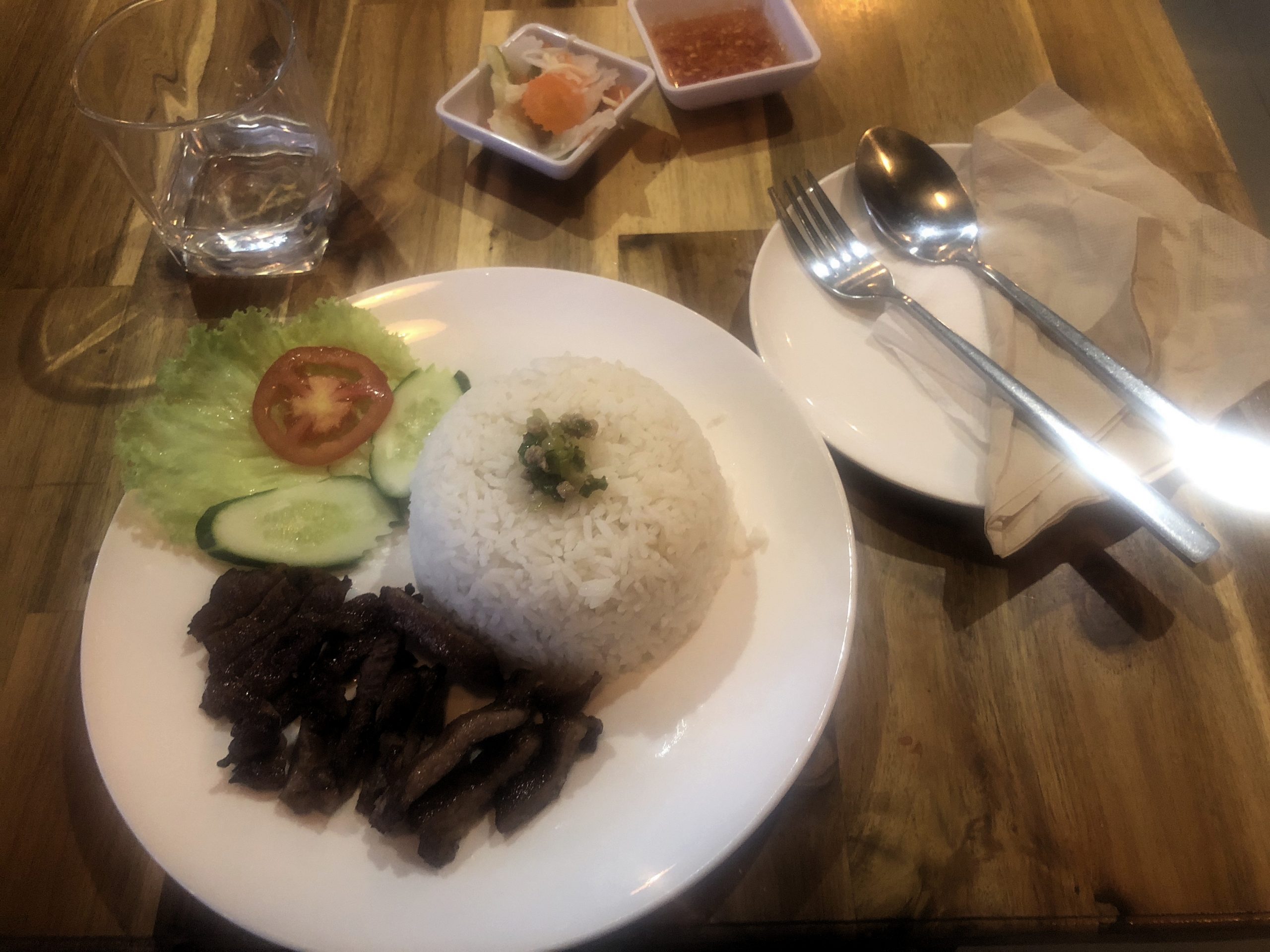
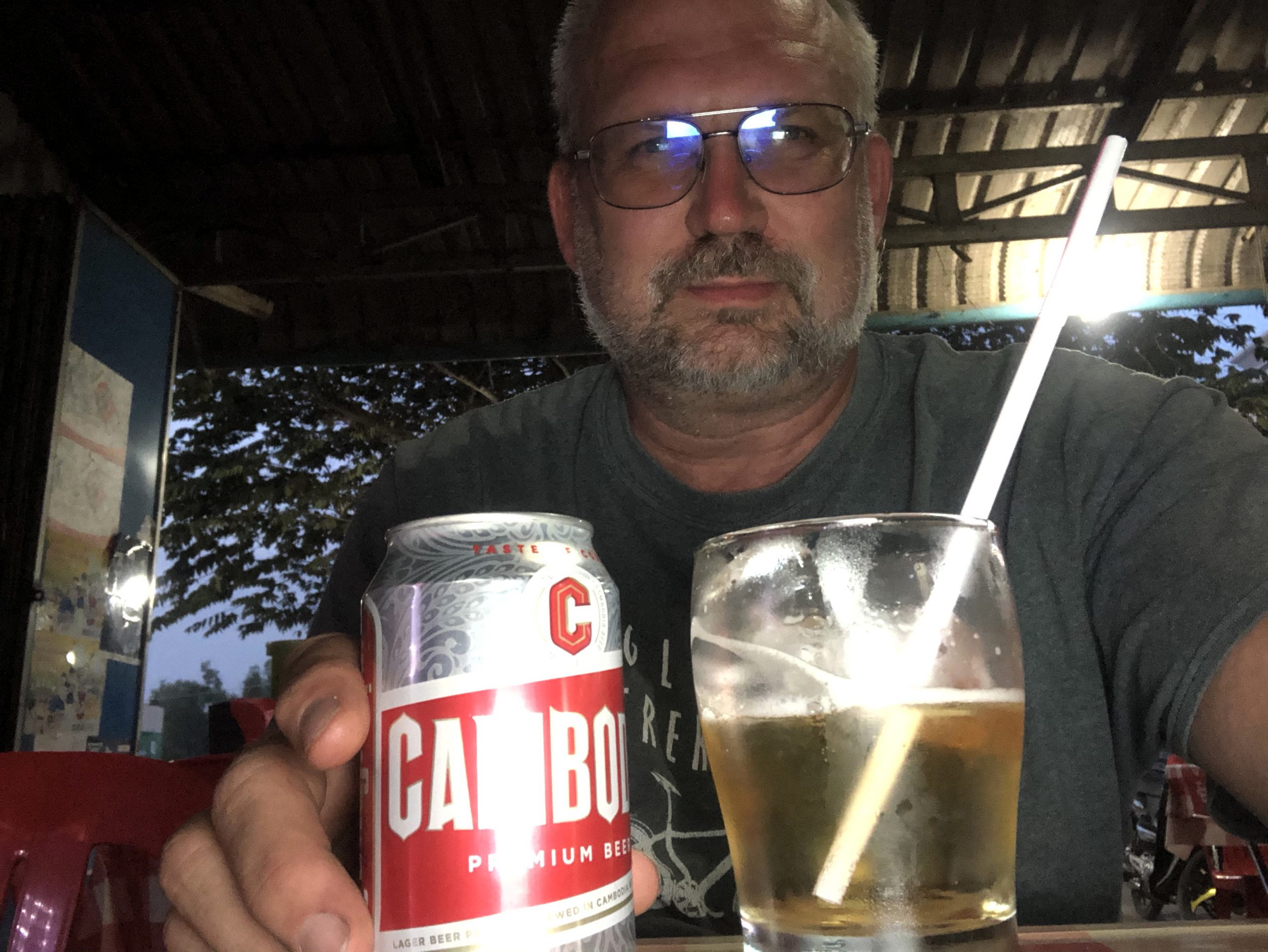
Enough television. I took a shower then went next door to a restaurant for dinner called the Rio Cafe. The restaurant looked like it could have been plucked out of New York, Tokyo or London. At the same time, very comforting and very uninteresting. The menu was in English and the prices were in dollars. I felt like the prices were on the high side. My meal cost a whole 2 dollars. After dinner, I risked life and limb to cross the street to an open-air tavern where I got a beer so patriotic it was named in a burst of inspiration Cambodia Beer. The beer was outrageously priced at a dollar fifty. I pet the tavern cat and drank my cold Cambodia. After imbibing I strolled next door for mystery fruit and a crocodile shaped pastry. (To see the croco-pastry and the mystery fruit check out the video on the wayfarer.bike YouTube channel.) The pastry and fruit were for breakfast.
Too Many Bugs For One Gecko
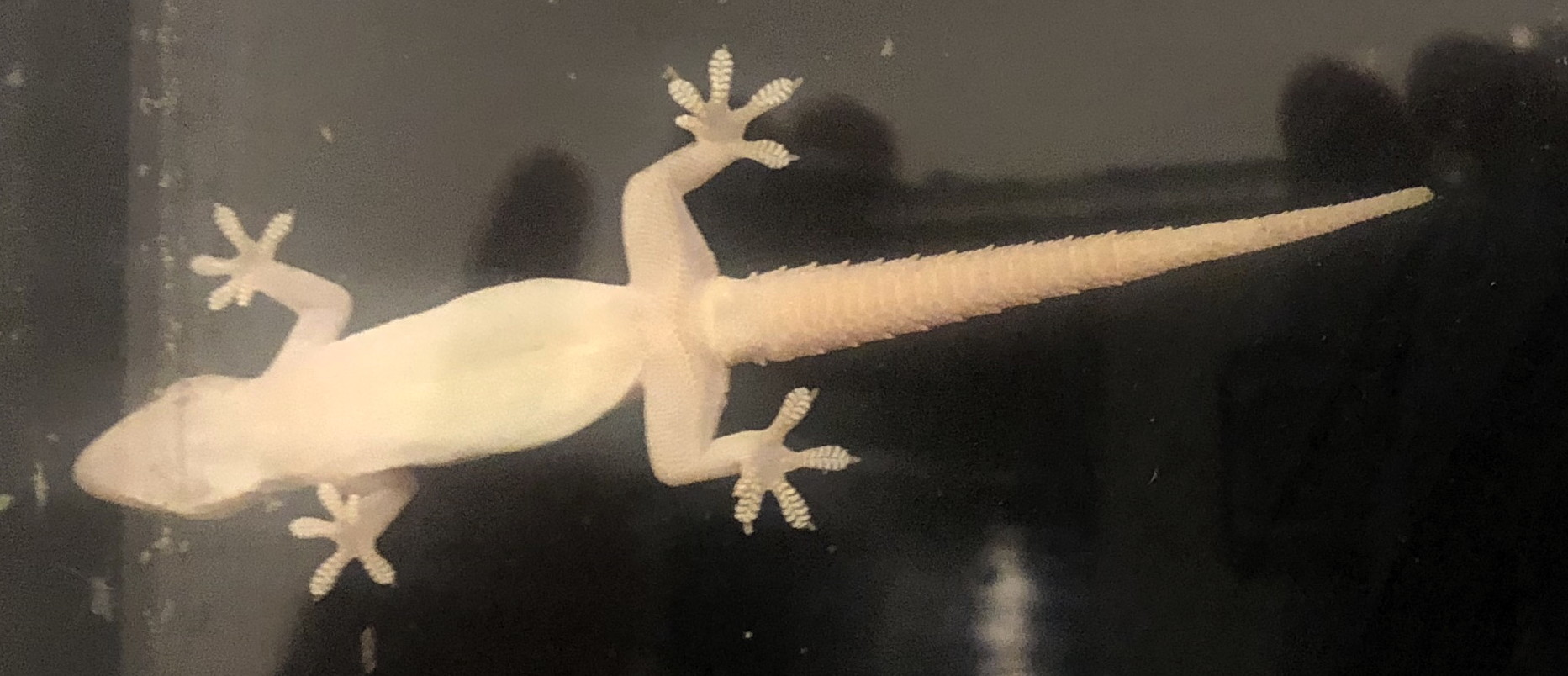
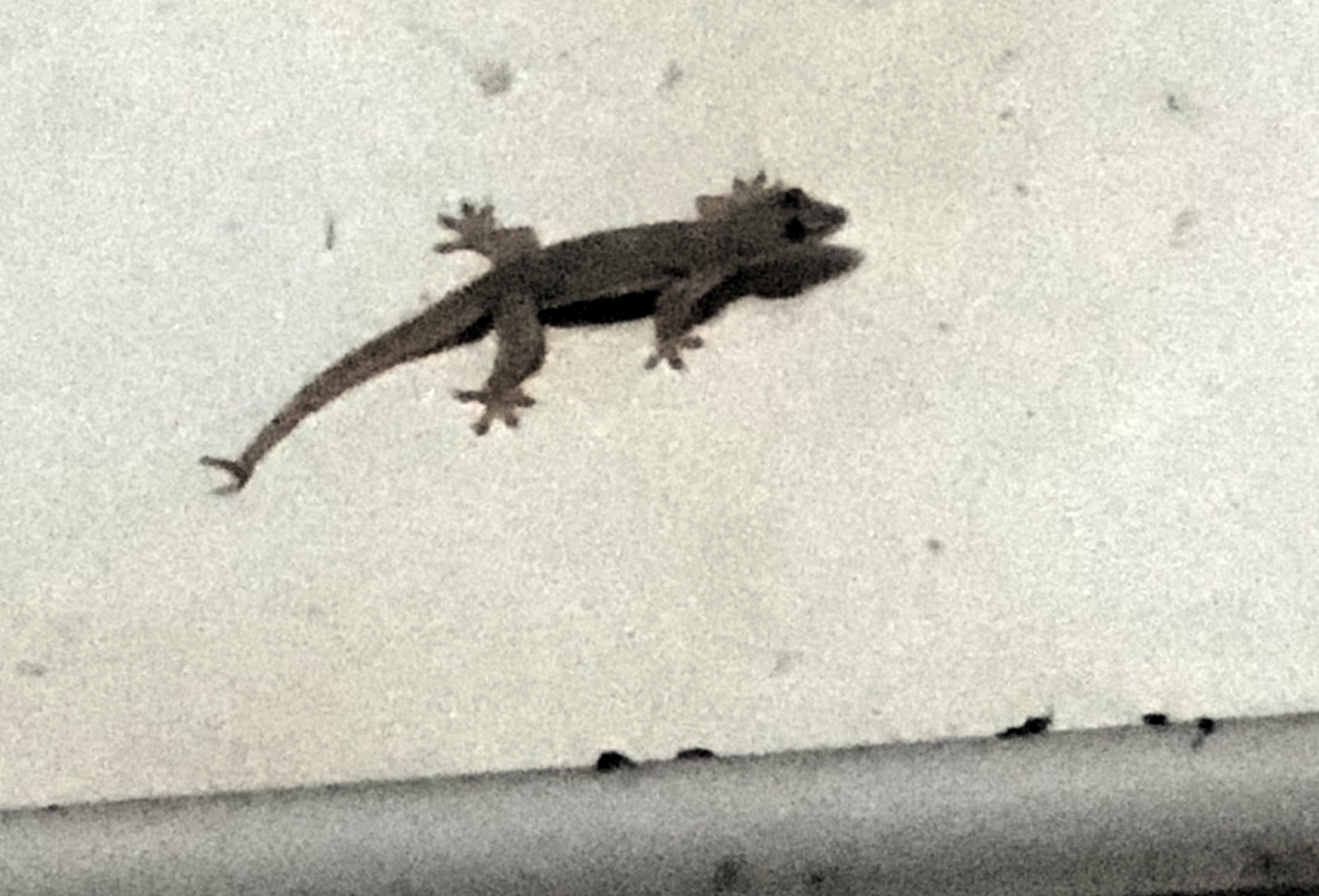
I got back to my room well after dark. I turned on all of the lights in the room as one does. I didn’t pay any heed to the open curtains. I settled down to write a few words and delete a few pictures. Before I knew it there were little flies swarming all around. Fortunately, they weren’t the biting kind. They were just the annoying kind. They weren’t doing so well. The bed sheets and floor were peppered with dead flies. Earlier in the evening I noticed a gecko hiding in the curtains and periodically making forays along the walls. A little known fact about geckos. They make chirping sounds like song birds. Actually, more like newly hatched birds that can’t carry a tune yet. Mr. Gecko was in good company because I can’t carry a tune either. I spotted another one clinging to the outside of the window. I’m glad I was able to provide them with the equivalent of a smorgasbord. I wished they had brought all their friends and relations too. Finally, I made the connection between the open curtains and the room lights. I closed the curtains and turned off all the room lights except one on the far side of the room. I worked this strategy out with Lt. Gecko. Closing the curtains would keep more flies from getting in and the light would lure them away from the bed where Mr. Gecko would ambush them. It seemed to work. In the morning there was no evidence of living bugs. The floor and the overhead light were littered with the carcasses of fly soldiers that didn’t survive the night. I don’t know if my compatriot, Capt. Gecko (He surely deserves a promotion after his heroic efforts during the battle of the bugs) survived. There was no sign of him in the morning.
Lesson Learned:
1. In Cambodia, Buddhist temples make great resting places.
2. Kindness is colorblind and tone deaf. It knows no boundaries or obstacles.
3. If hotel staff close the curtains it is a good idea to leave them closed.
4. The sound of geckos in the night is comforting but don’t ask them to sing campfire songs. They just can’t do it.
Photo Gallery
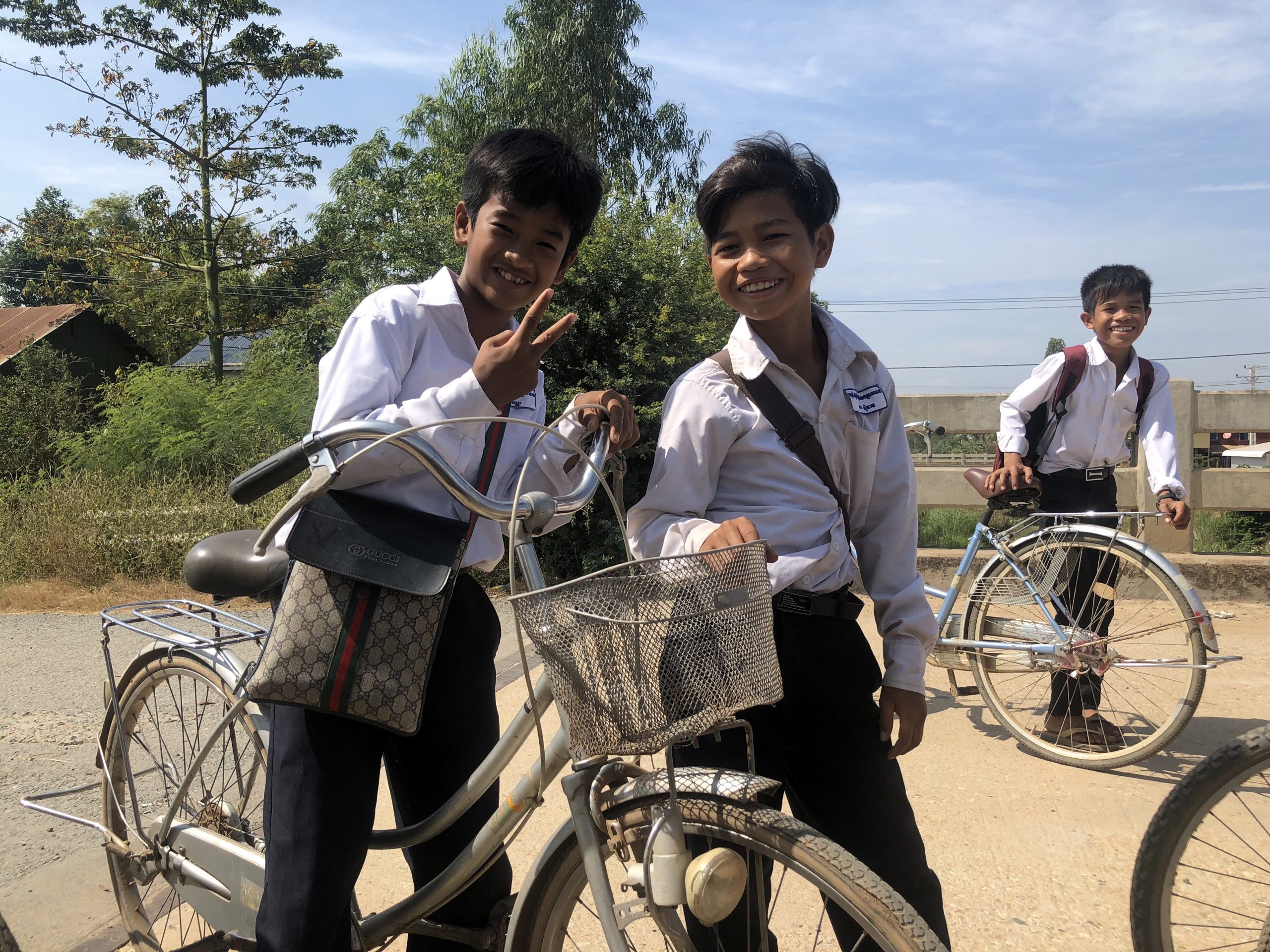
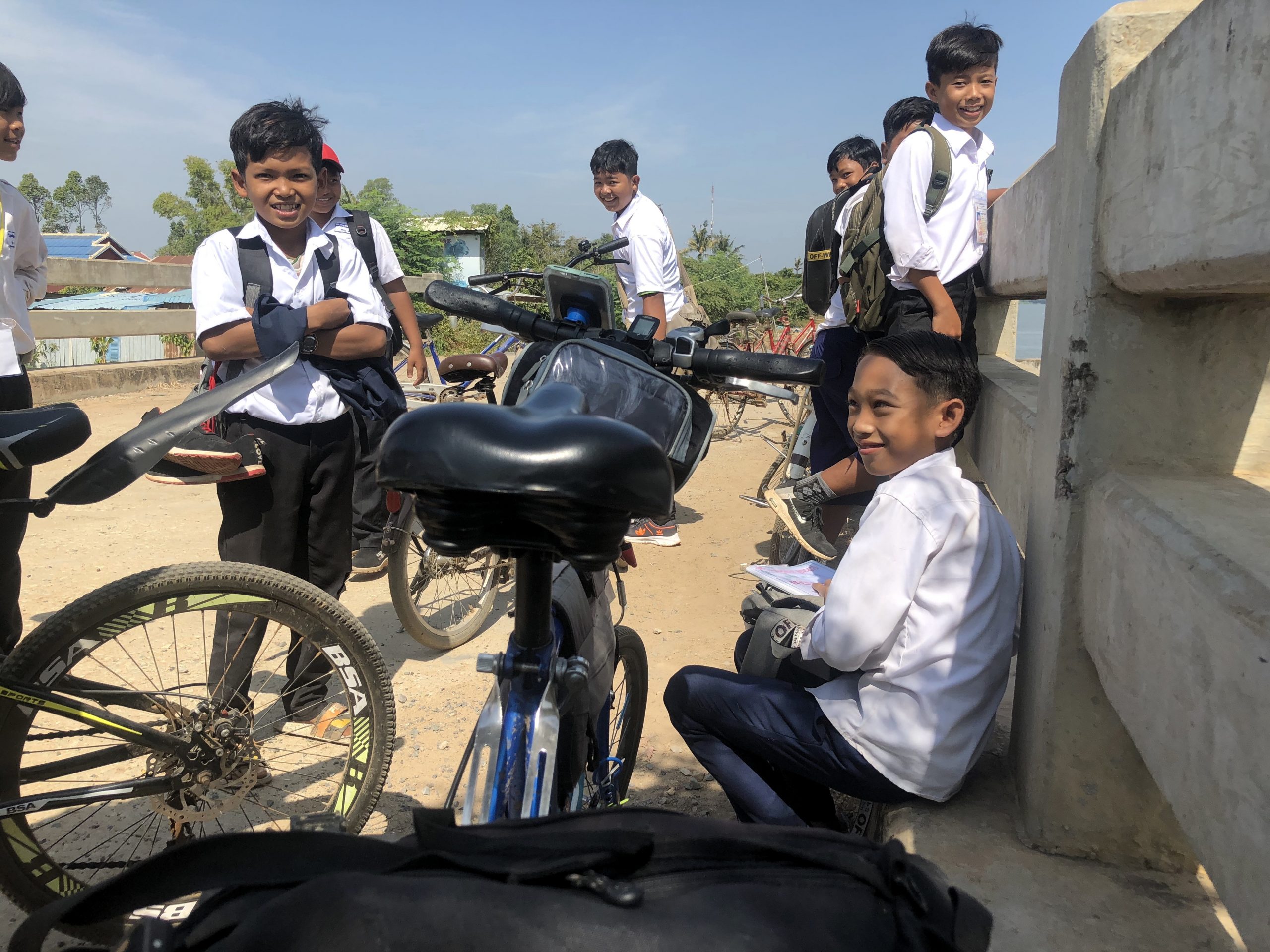
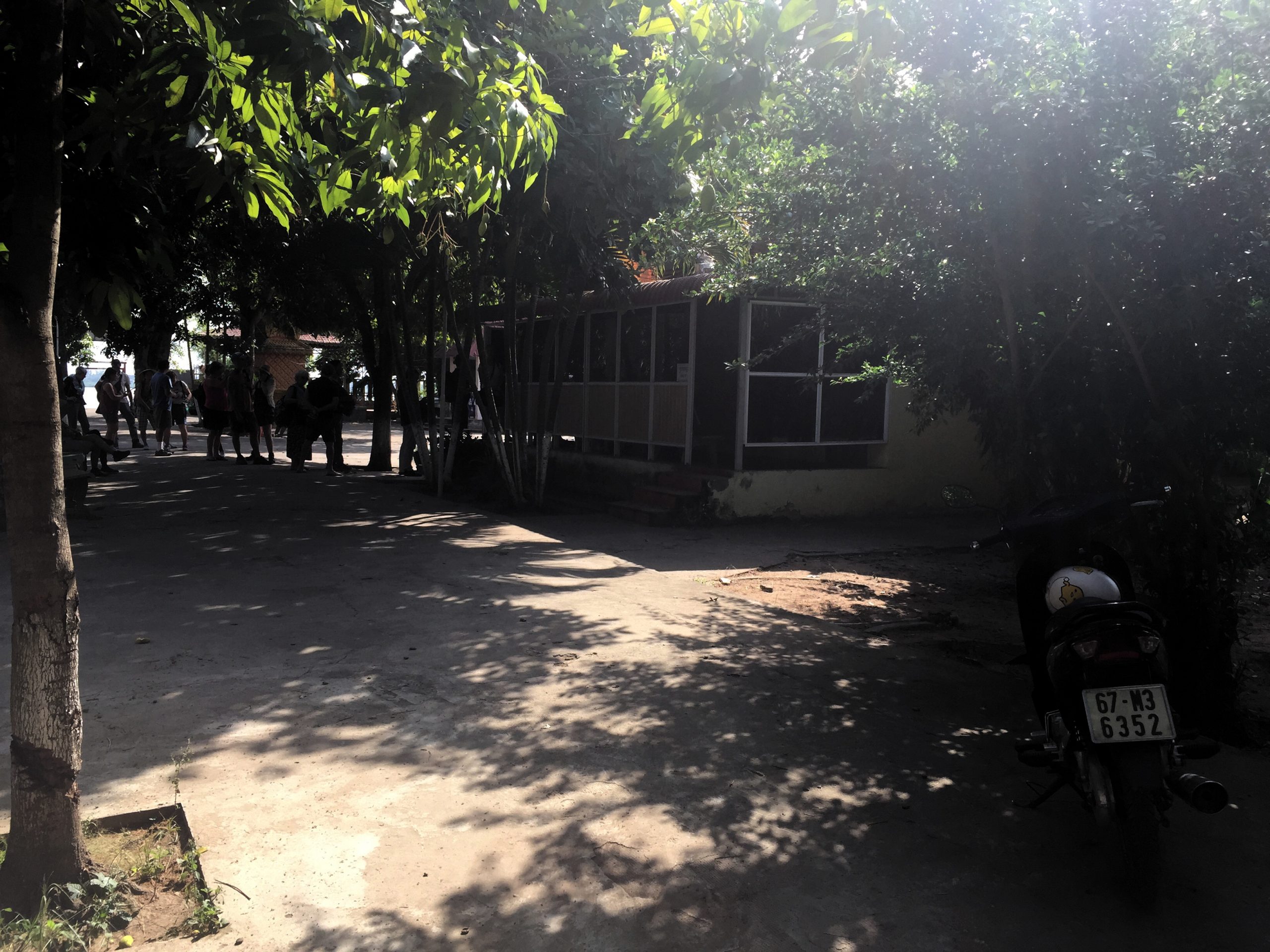
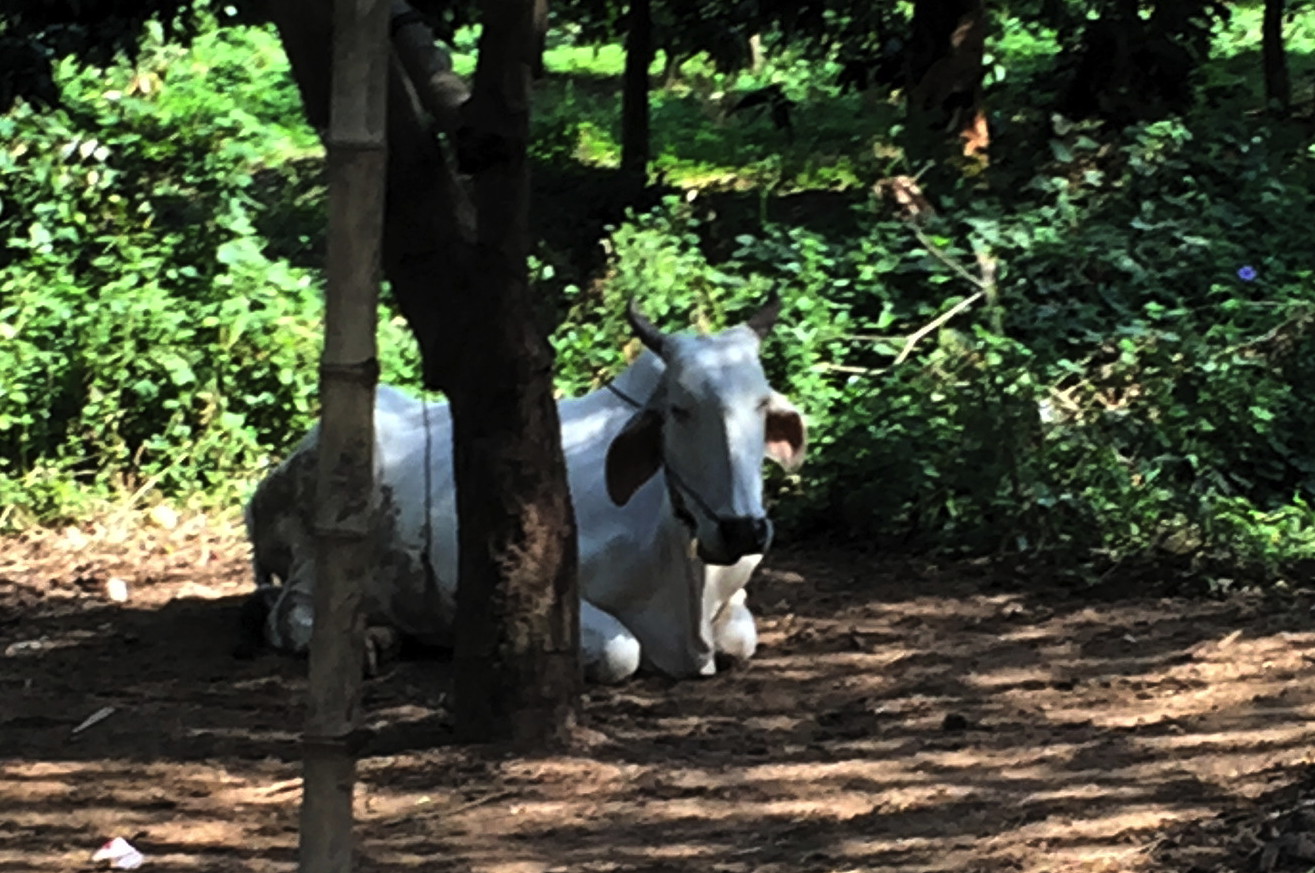
Podcast
Video
[yotuwp type=”videos” id=”FkQsmJL7mgo” ]
Home | Photo Gallery | Podcasts | Videos
]]>2019/12/17
Day 3
My trip from Long Xuyên was a very interesting one. While the distance wasn’t the longest the miles were the most varied.
The adventure started before I even left town. The plan was that I was to cross the river at least three times during the day. Not all of those crossings were strictly necessary. I just thought, when I was mapping out the route from the comfort of my computer in Kodaira, Japan, that it would be more interesting. What I didn’t know then was how interesting those crossings would be or that they weren’t bridge crossings.
Getting Taken For A Ride
The first crossing was near my hotel in Long Xuyên. The ferry dock, which I had found the previous night while looking for my hotel, was located in a busy market. When I got there at around 8 a.m. business was already booming. While I was still scoping things out a man approached me with a business card. He was trying to sell me something. I had no idea what he was saying and I didn’t take a very close look at the card before turning him down but I did notice the word Dien. The local name for the branch of the Mekong that flows past Long Xuyên.
I rolled my loaded bike to the ferry dock where the man and two others approached me again. This time I thought, okay maybe this guy is trying to tell me about the ferry or maybe a water taxi. So, through the power of Google Translate, I asked him how much and whether I pay before or after. I understood him to say 15. Based on my limited experience in Vietnam that usually mean 15,000 dong. I thought that was a bit high for a ferry as I only paid 2,000 the day before. But what do I know? I am far from being an expert on the Vietnamese ferry system.
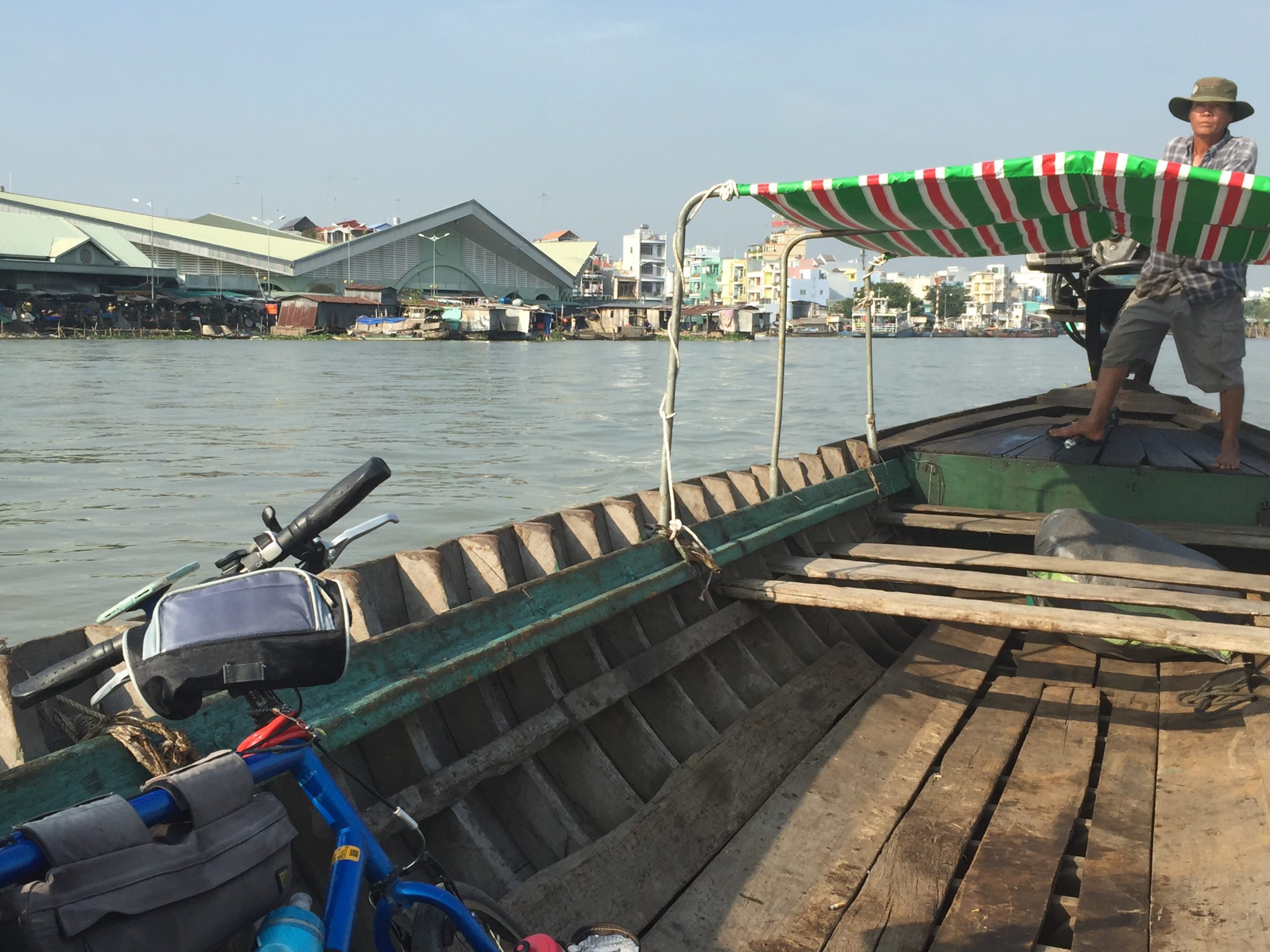
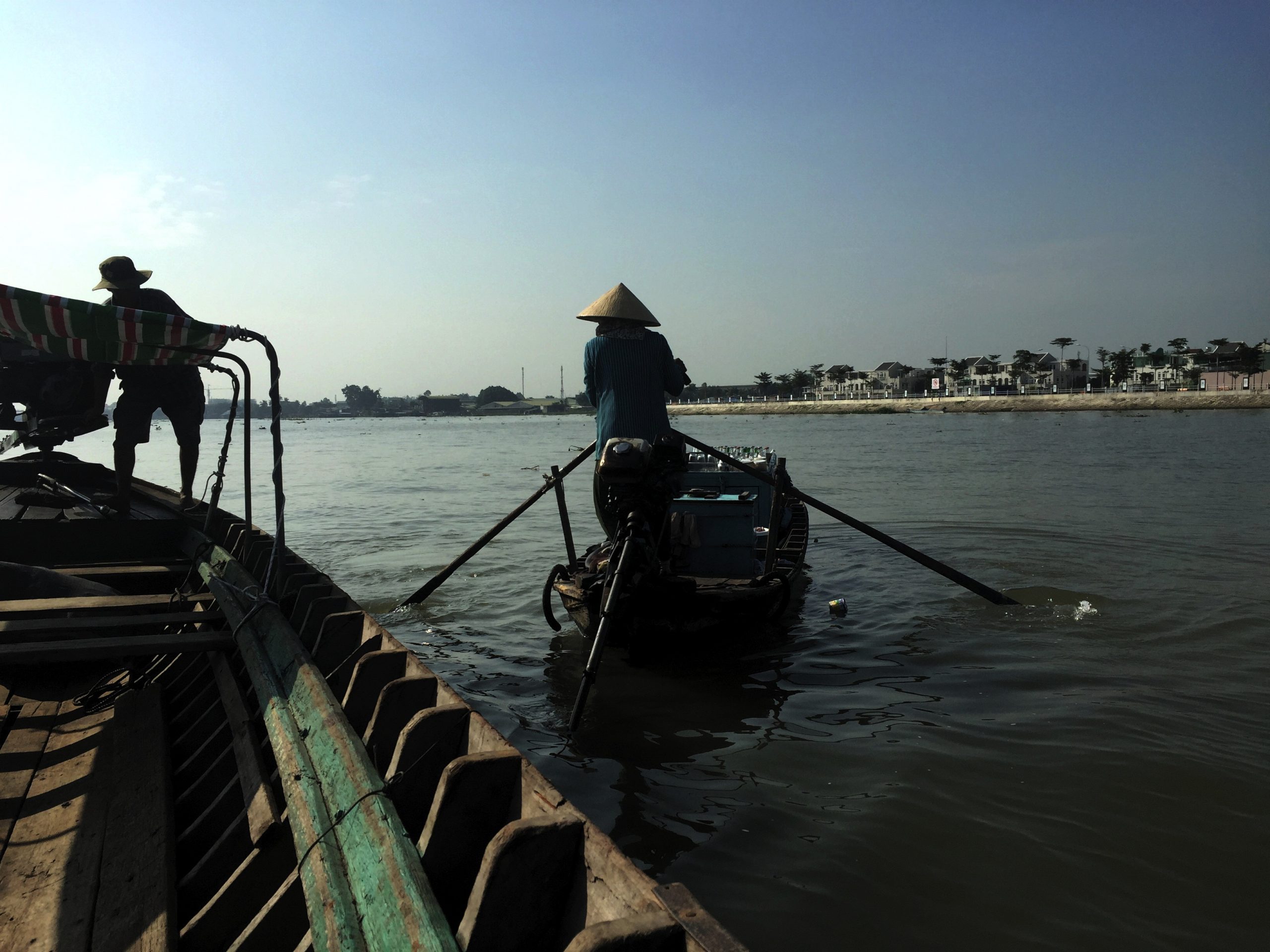
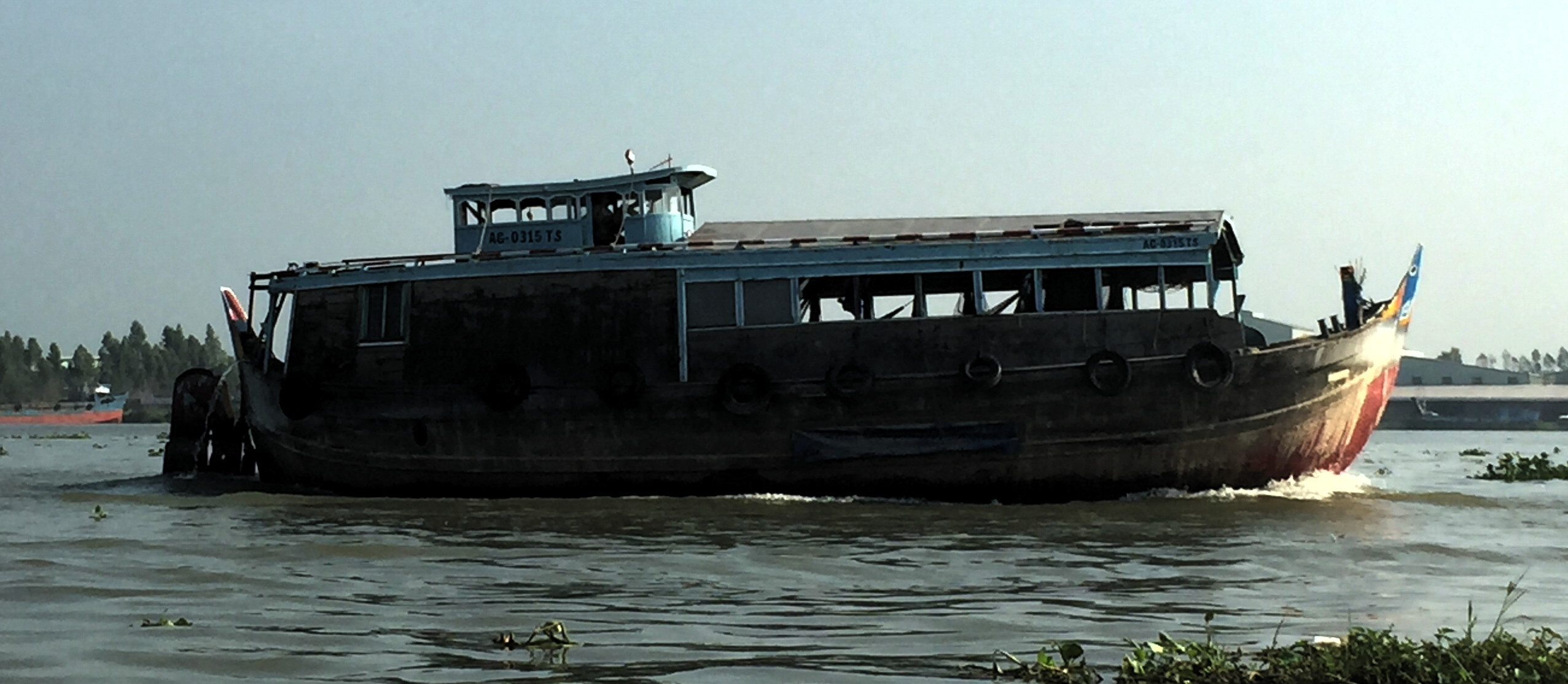
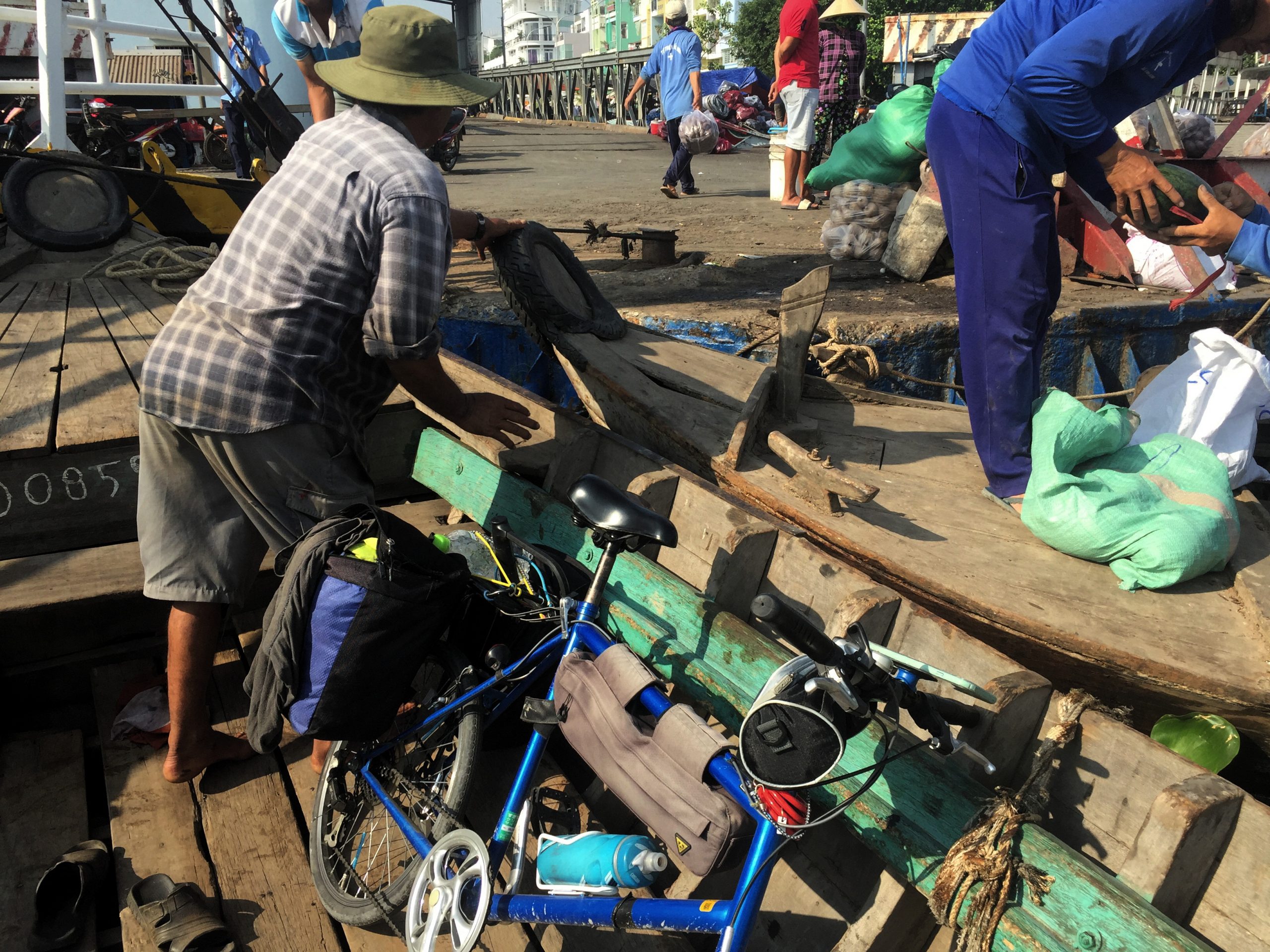
I agreed to the deal. I rolled up to the dock and watched as a ferry came in. I watched motorcycles, bicycles, pedestrians and even a car disembark. Just as I was about board the man came alongside in a wooden sampan (I’m not sure that his the proper word for it. Normally, this landlubber would call it a skiff.)
My next thought was, “Okay. That’s not a ferry. Did I just contract for a private water taxi?” There was a good reason for why I thought this. Just moments before a similar boat had docked in front of me with a small boy and a woman with a load of fruit.
The boatman loaded my bike onto his boat then I boarded. Across from the ferry dock and the market was an island which, according to the map the ferry would go around on the downstream side to another larger island on the other side. My boat captain headed downstream and appeared to be following the ferry route. So far, so good. But that was all just coincidence. The sampan continued downstream past all the working boats on the river. I realized I was being taken for a ride.
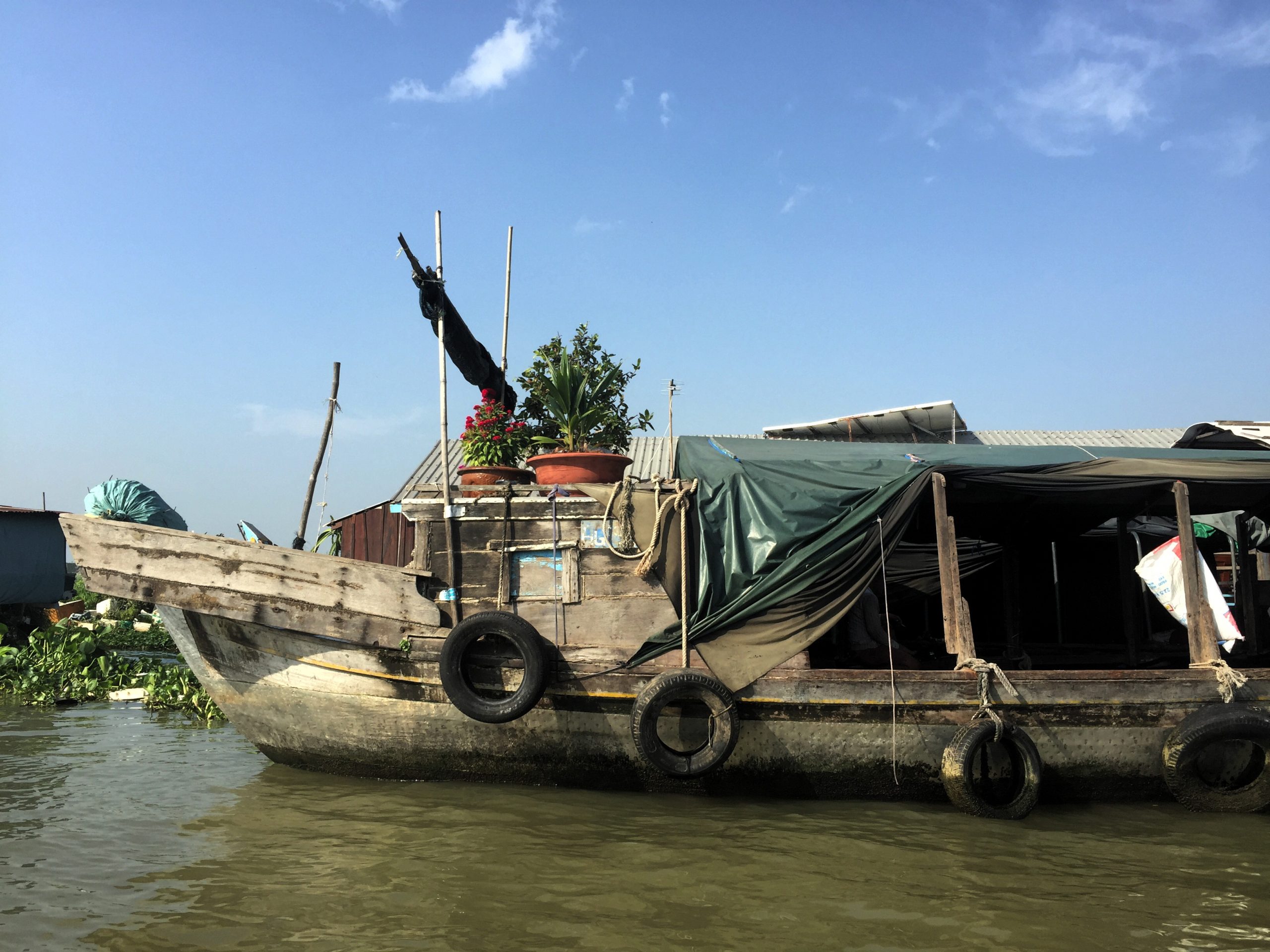
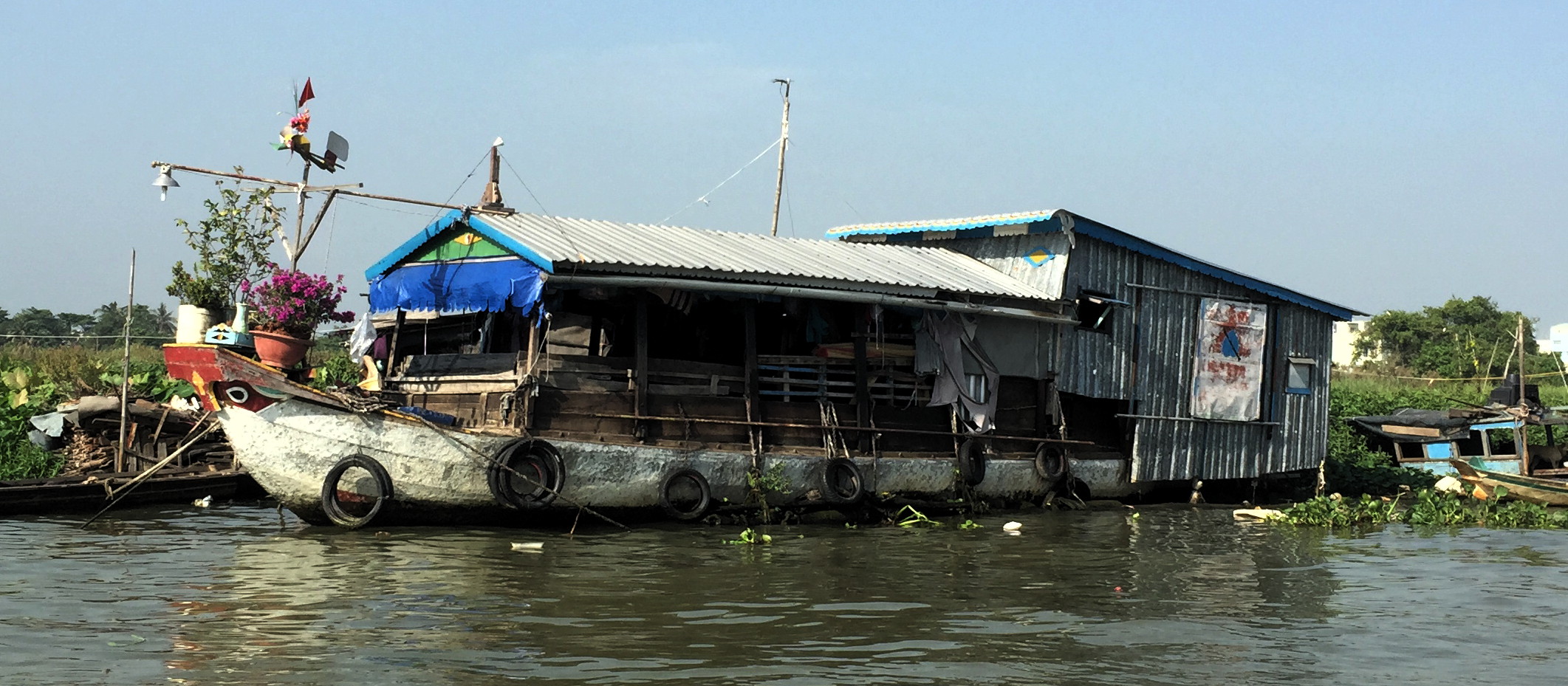
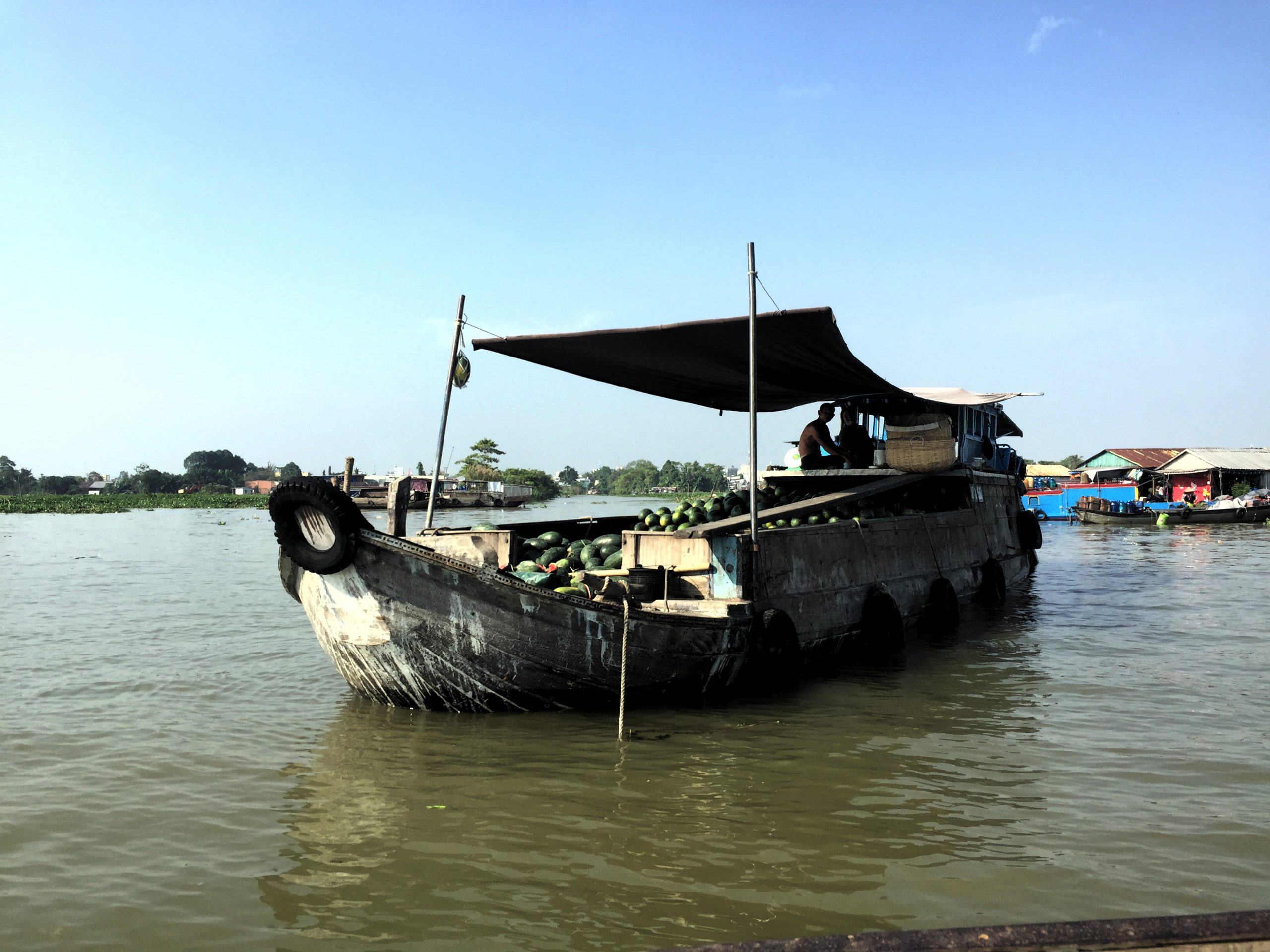
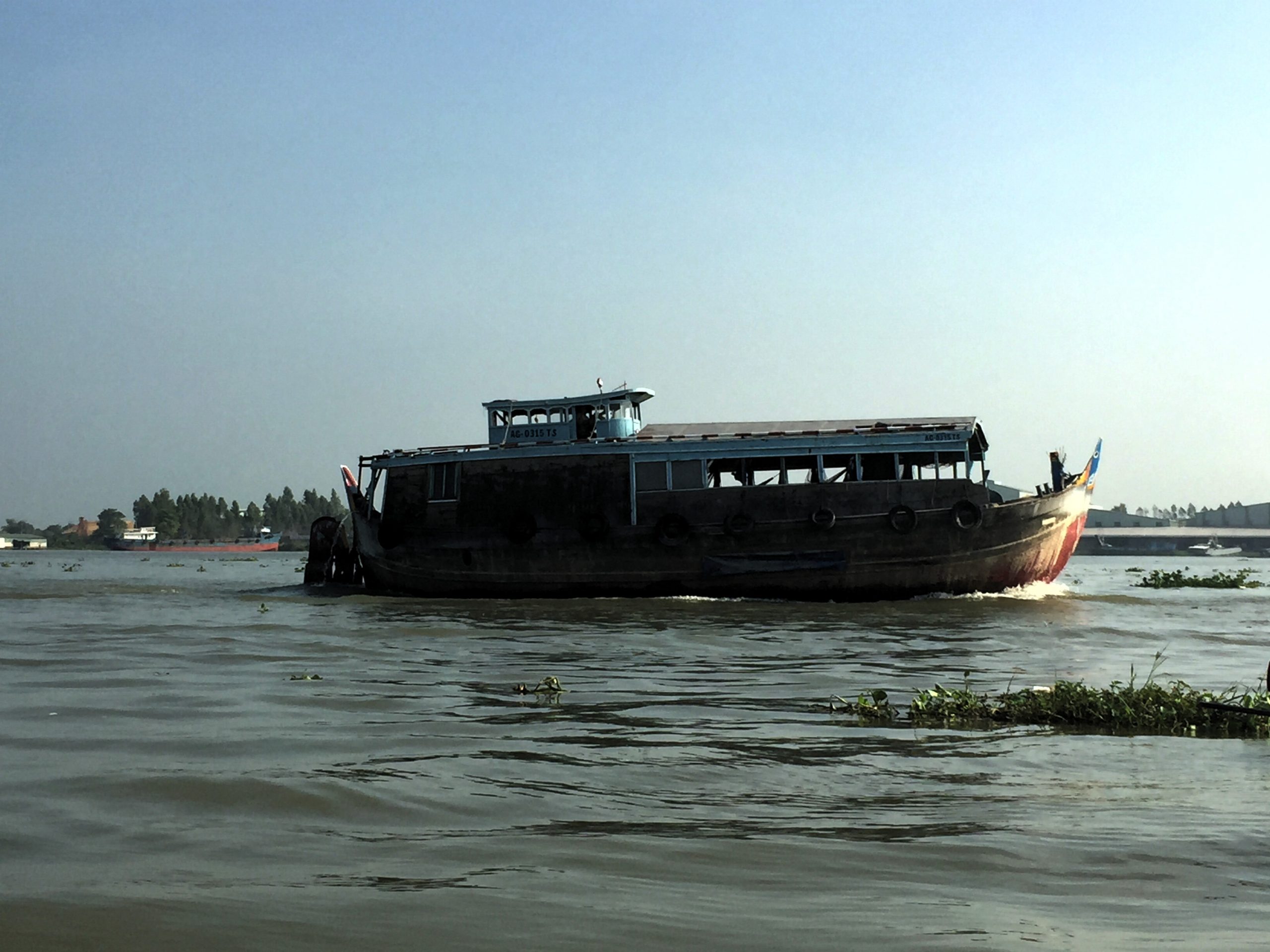
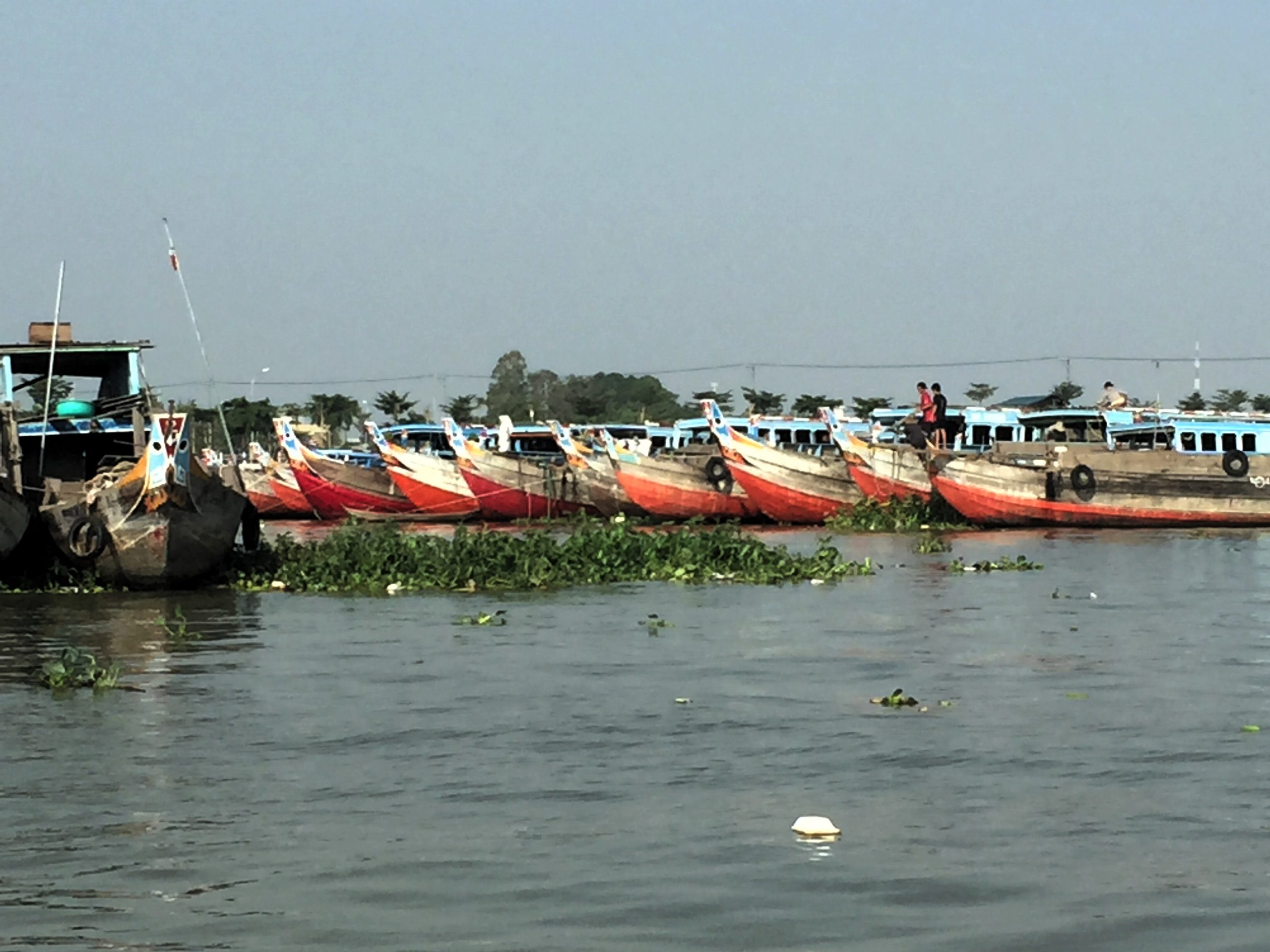
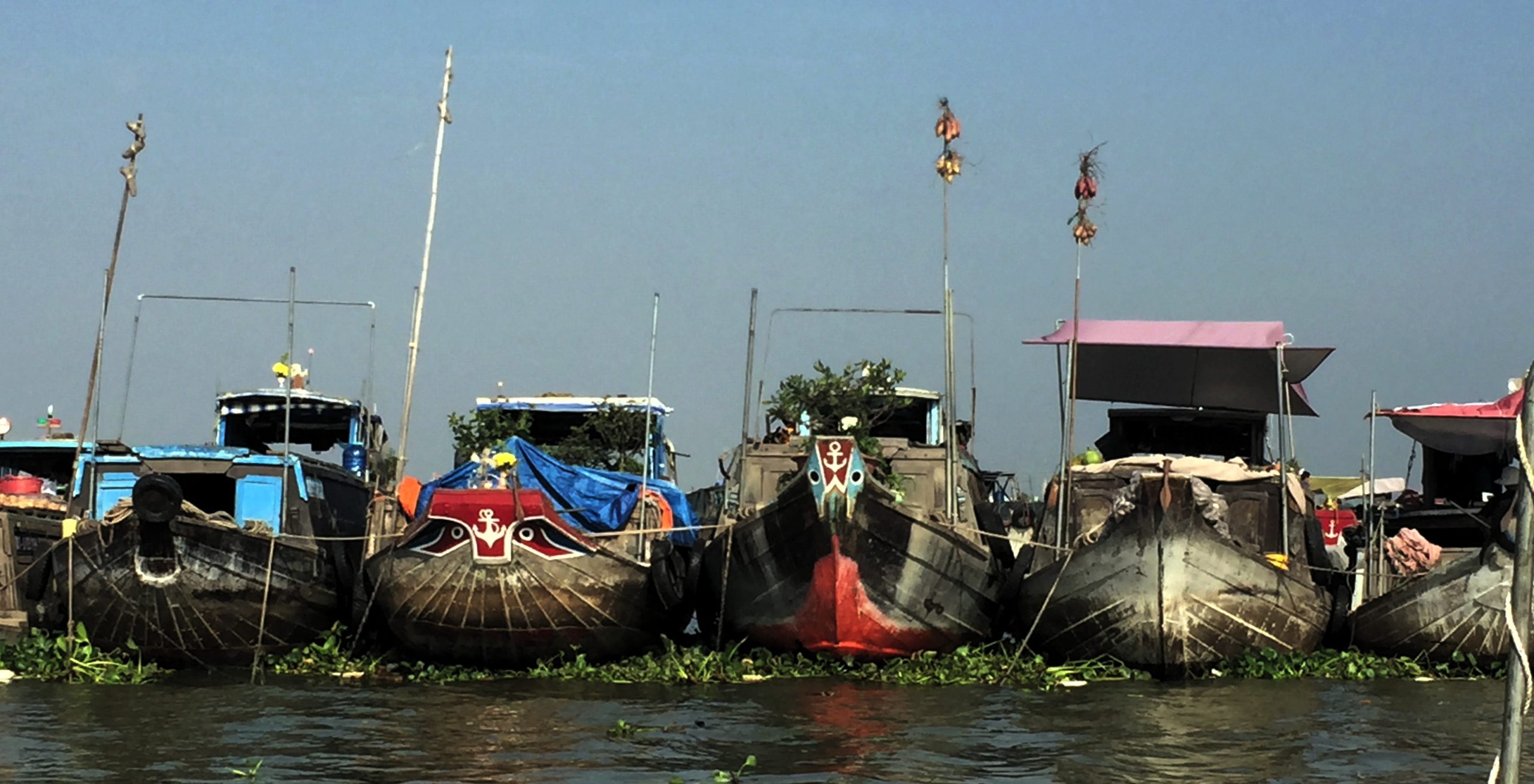
There are many boats of varying sizes and types on the river. You might even say the river is crowded with them. They mostly hug the shoreline which in this part of the river is choked with water plants. (Watch the video from this part of the trip to get the larger story of this part of my tour.)
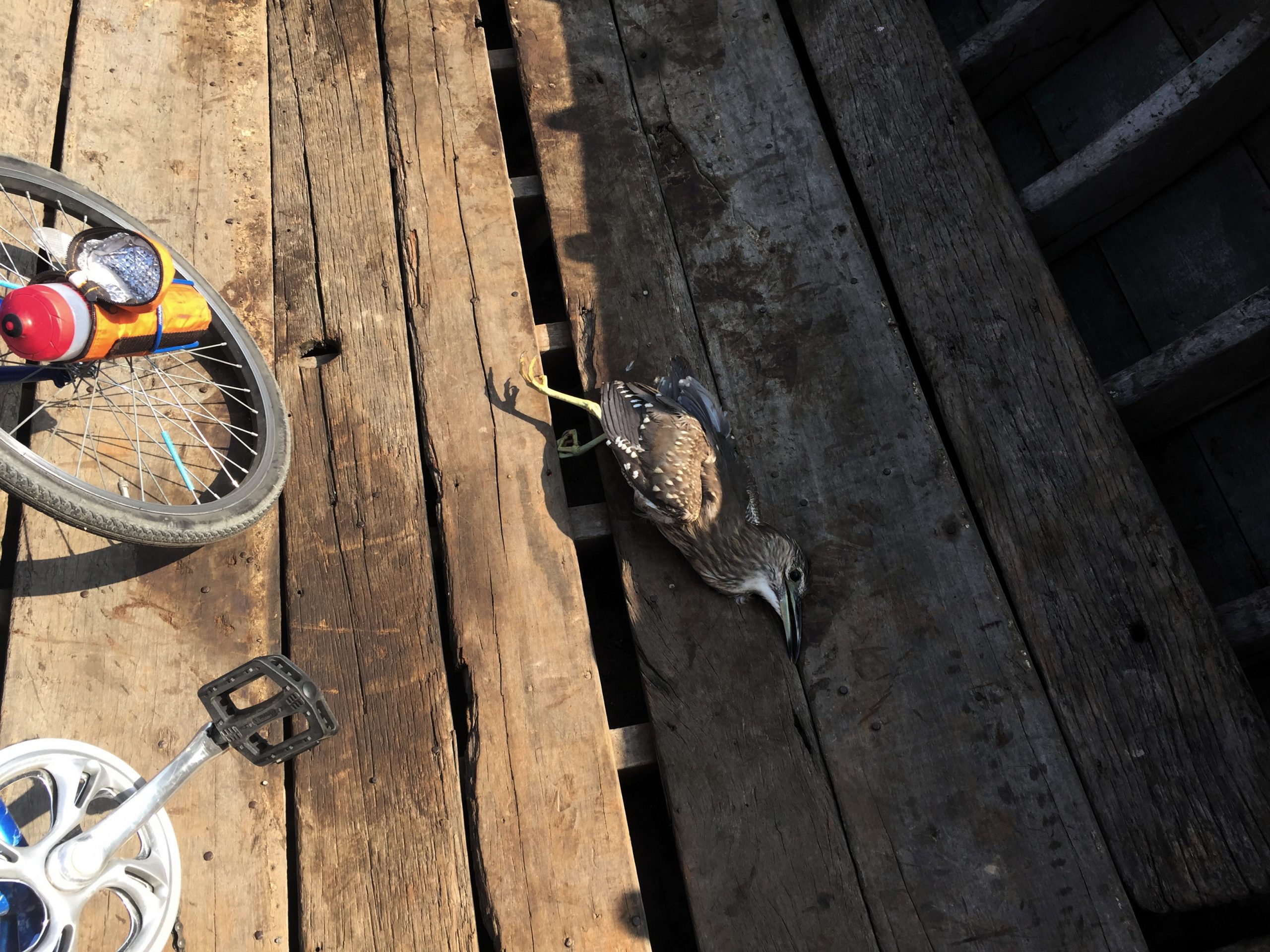
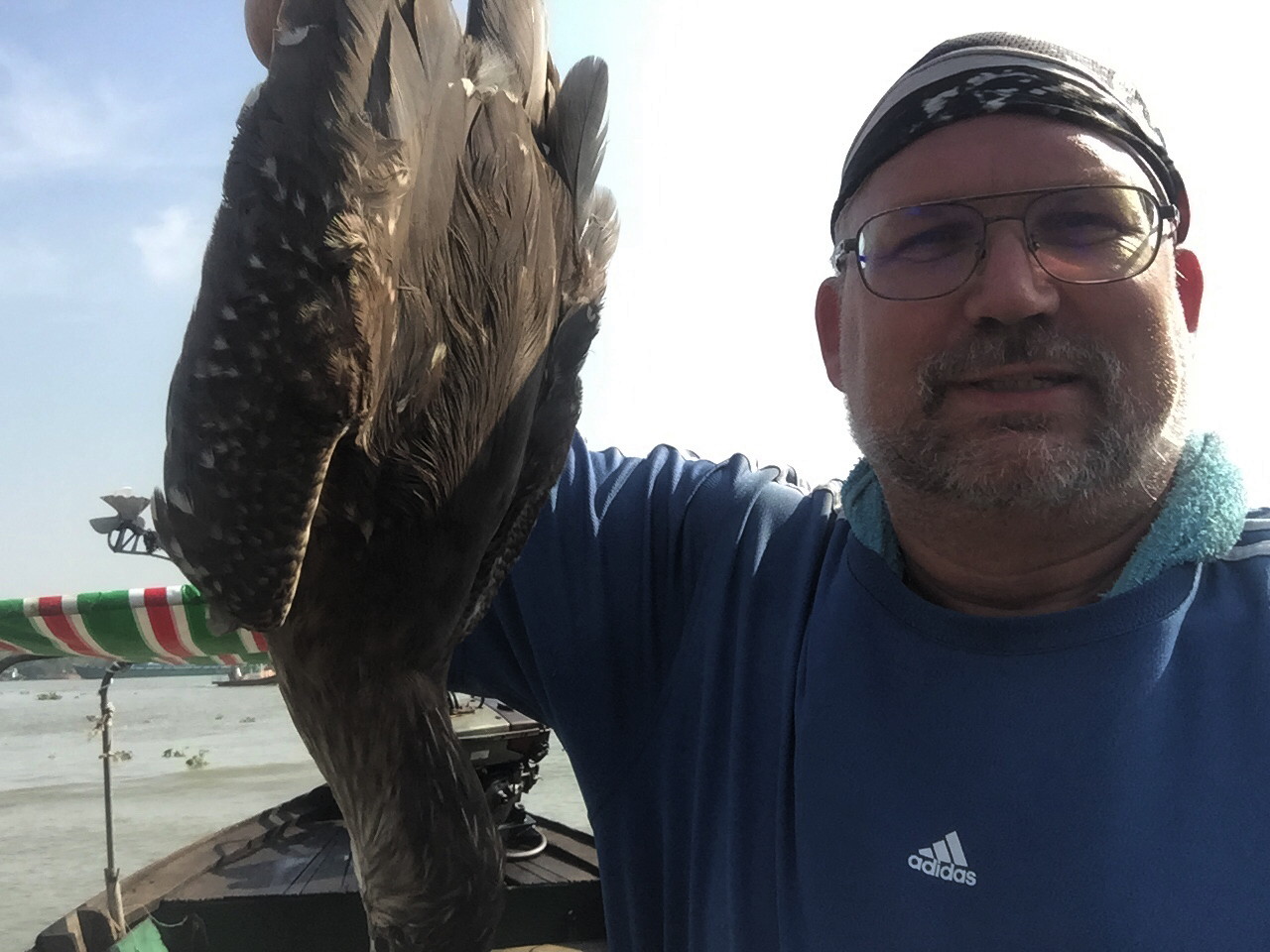
At one point the boatman shut down the motor to clear the rotor of water vines that had tangled around it. The other astonishing incident was when he idled the motor and walked to the back of the boat where I was sitting. He opened a hold behind me and pulled out a dead duck. Mumbling he threw it down on the floor in front of me with a very annoyed look on his face. I don’t know if he was annoyed because he was trying to keep it alive or because the bird somehow interfered with his boat and died or some other reason.
The final surprise came when we returned to the ferry dock about a half hour or so after we left. The boatman and one of his compatriots on shore lifted my fully loaded bike out of the boat. I pulled 15,000 dong out to pay the man. Through gestures and pointing at the money in my wallet he made it clear that price was not 15,000 dong. The price was 150,000 dong. Wow! I got taken for a ride in more ways than one. When you say the price in dong it seems high but when you do the conversion is comes to about 750 yen or 7 dollars and 50 cents. Not much but when you consider that ferry I was planning to take would have cost about 15 cents I can’t help feeling that I got scammed. However, looking back I feel like it was money well spent. It gave me a rare view into the lives of the people who live and work on the Mekong River.
After my river excursion I decided I had spent enough time on boats and the cool morning hours were burning up in the sun. I made the decision to cut out the first two ferry rides that would have just brought me back to the same side of the river. The route change would shorten my day by only two or three kilometers but boarding ferries would take considerably more time than just a 3 km detour represents. It turns out that there were still 2 more ferries ahead of me that I couldn’t avoid so easily.
After finally leaving Long Xuyên I followed Highway 91 for awhile. Just when I thought it would be highway riding all the way I came to another ferry crossing. This one I managed to take without unsolicited river tours or exorbitant fees. The road on the other side of the river took me through a village that seems to be 5 km long and a 50 meter wide stretch on the east side of the river. This area has a booming incense cottage industry. The street was lined with shops drying sticks of incense in the sun. I also passed a few places drying cattle dung in the sun. And in case you are wondering, no, it didn’t stink. Around 11:00 it was starting to warm up and I began looking for a cafe where I could take a break and get a cold drink. I came upon the only grocery store I found during my entire trip. I really like grocery shopping so this was as good a place as any to take a break. I bought a 2 liter bottle of water, a Coke, and an orange.
Since I had just had a snack and I thought that I would continue riding through an area where I could easily find a restaurant or street food I decided to take a lunch break around 1:00. Little did I know that the environment would change drastically in just a few short minutes.
Lunch On The Hoof
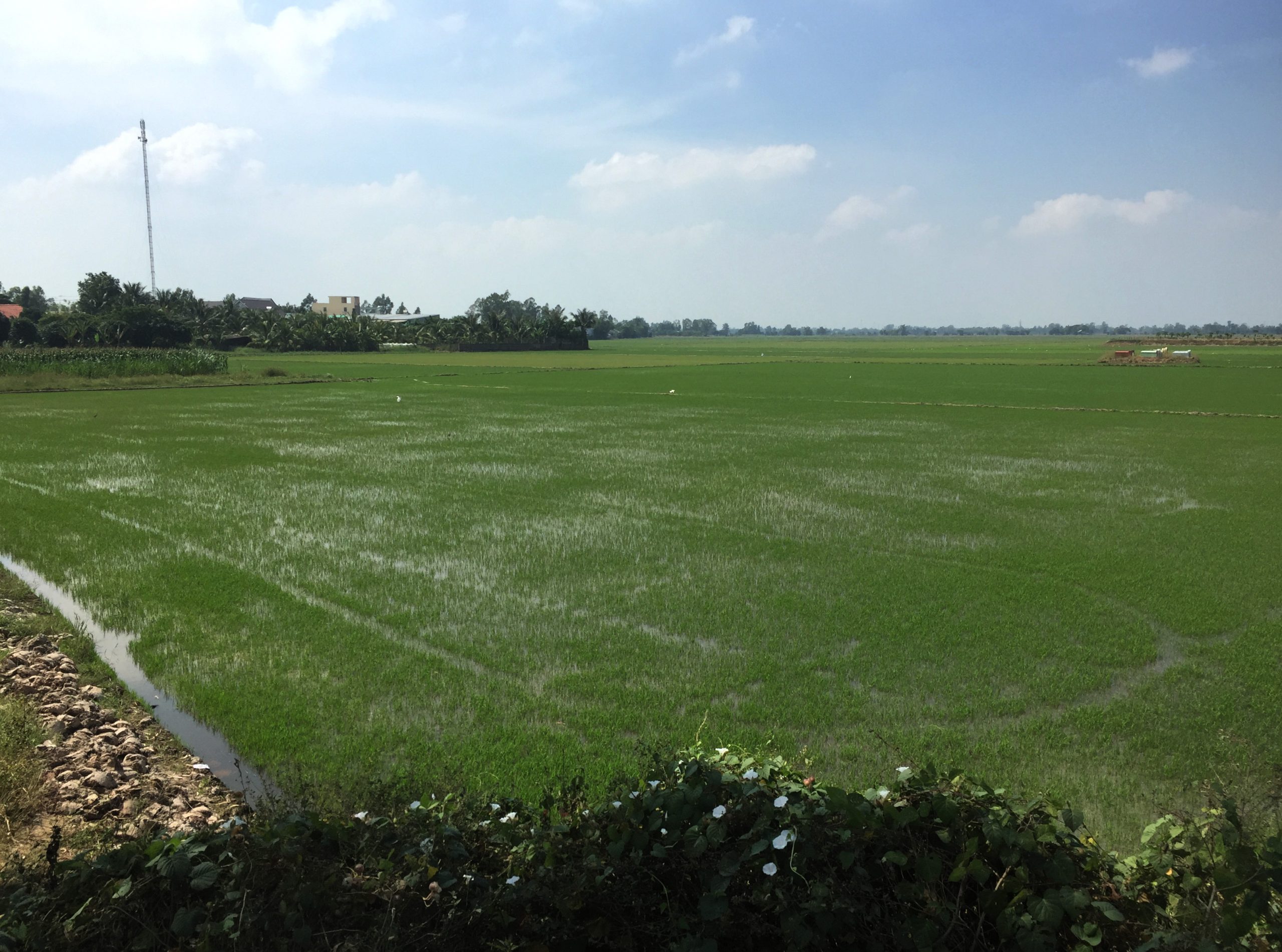
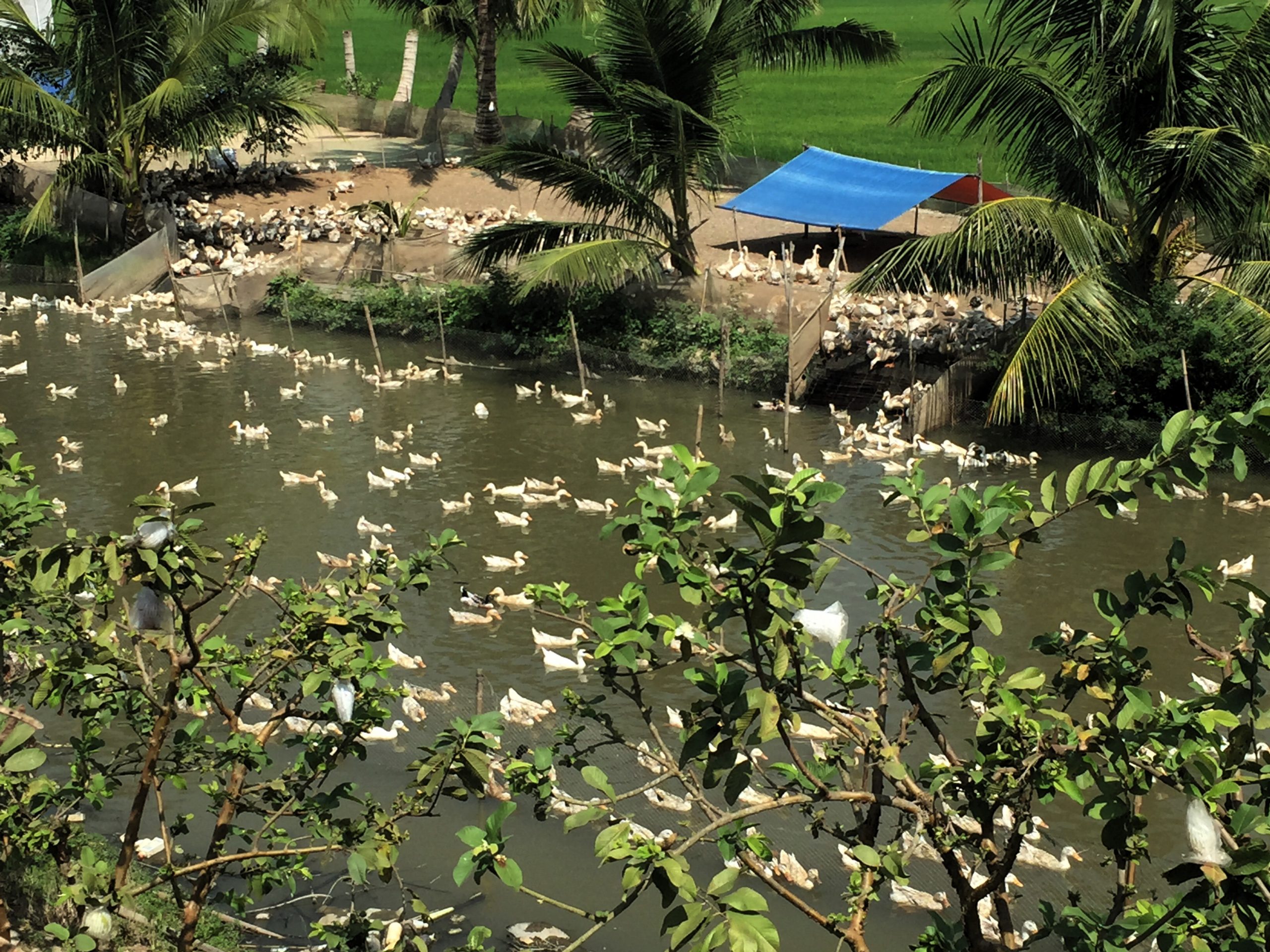
Only a few meters from the grocery store was the second and last ferry for the day. Within 10 minutes of crossing the river I found myself peddling along a dirt track parallel to a small branch of the larger river amongst rice fields. The land became sparsely populated with little farmsteads. I passed rice fields, duck farms, and what I think was a fresh water shellfish farm but not a single cafe or street vendor.
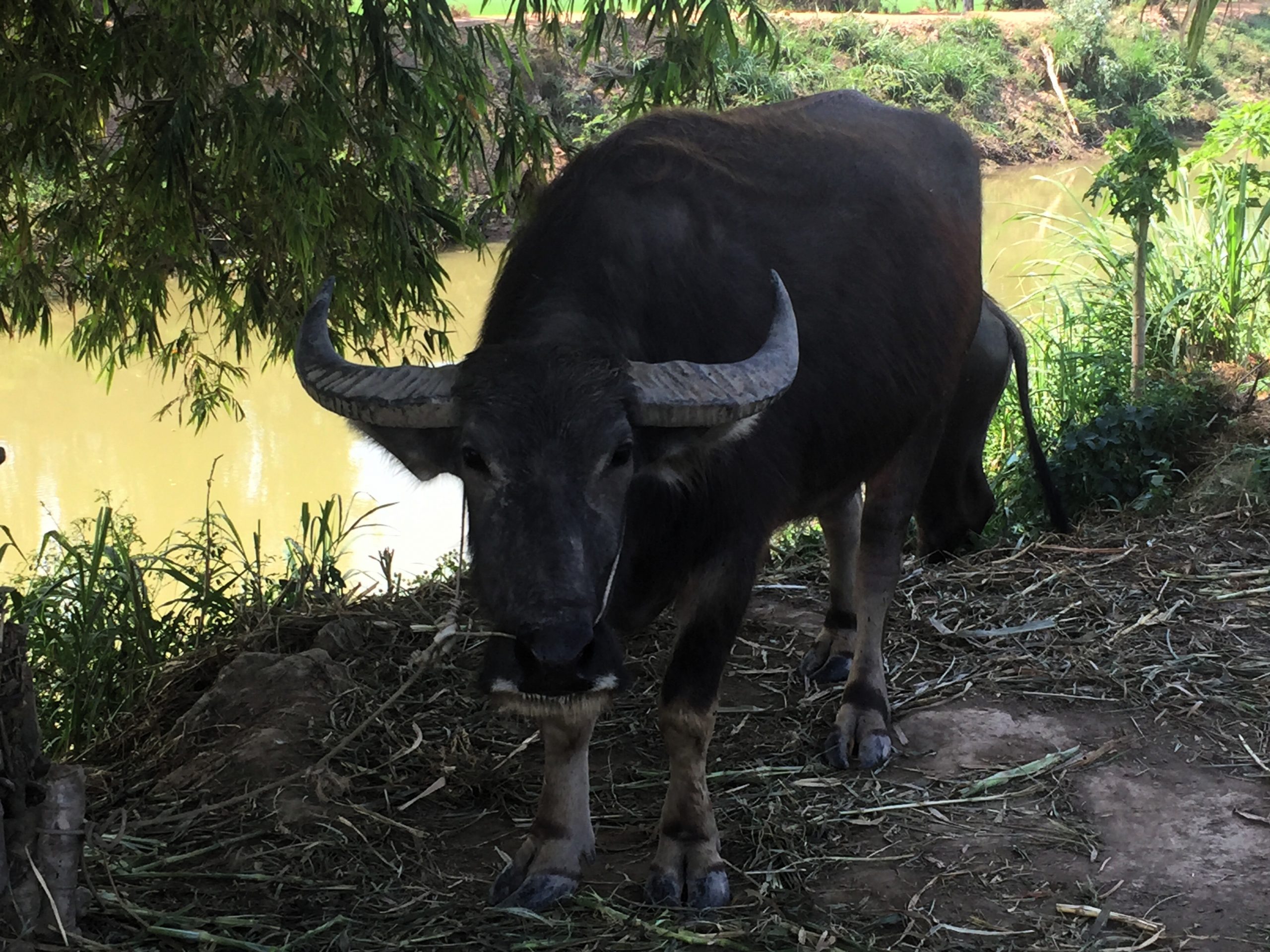
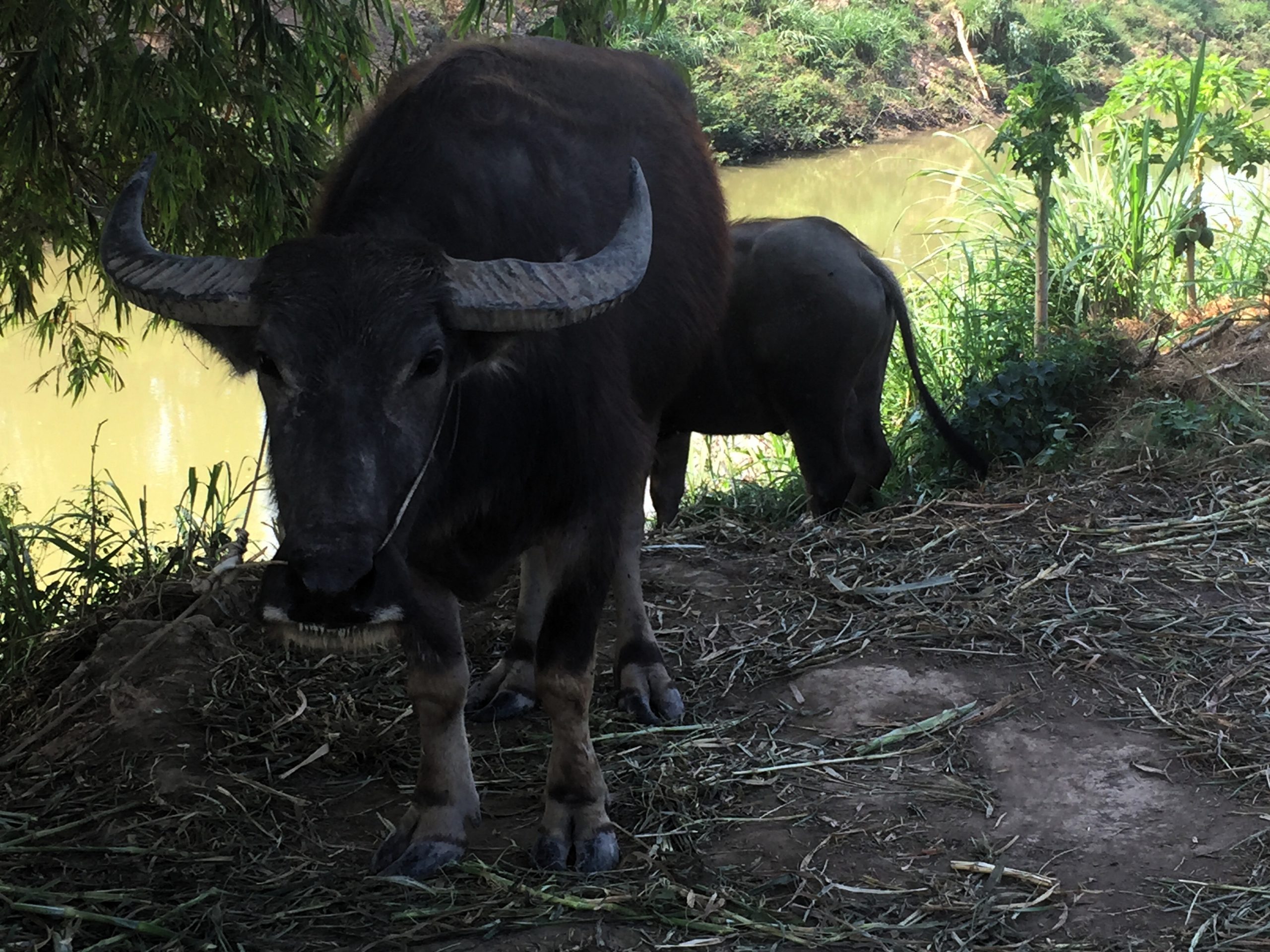
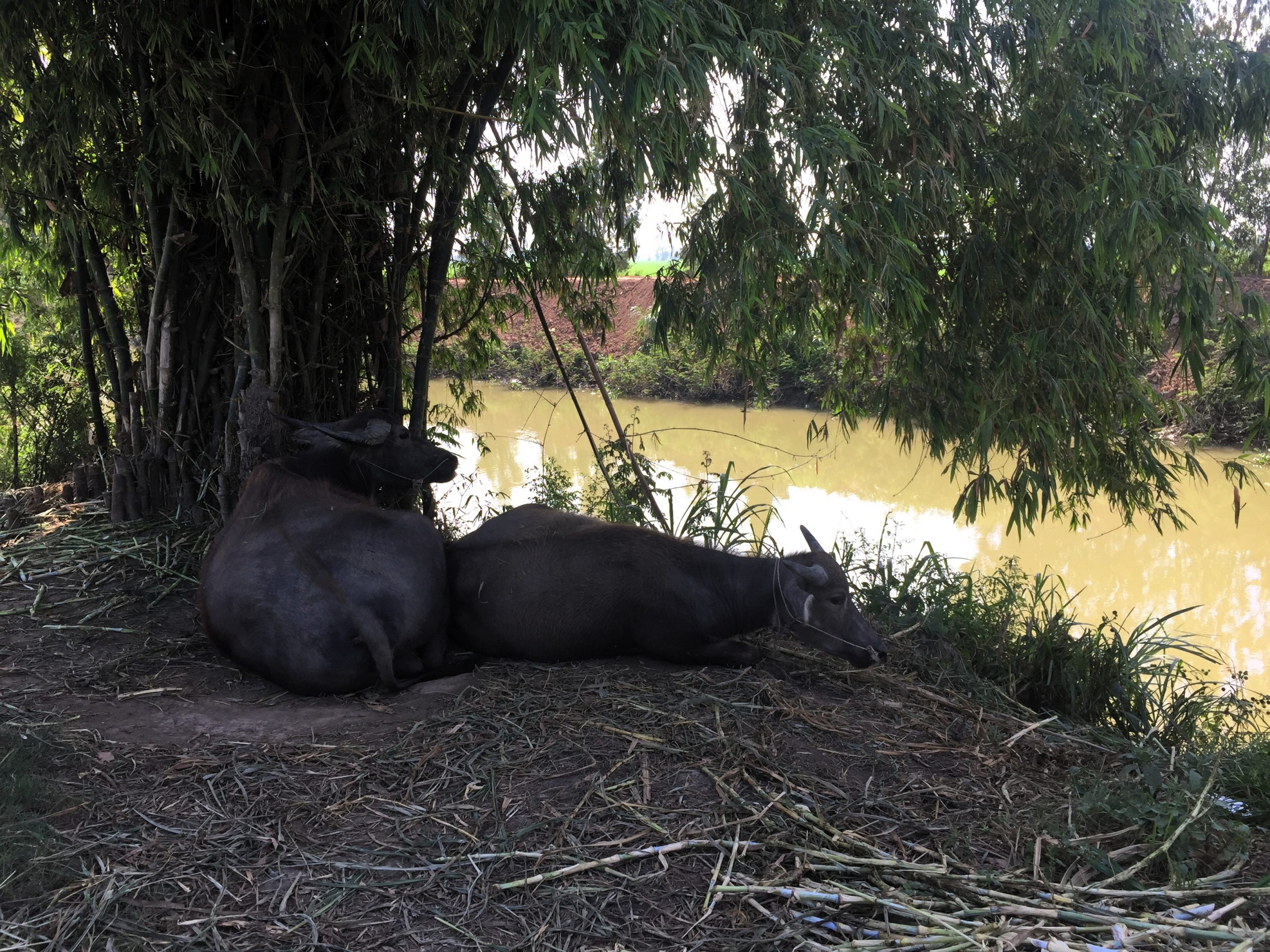
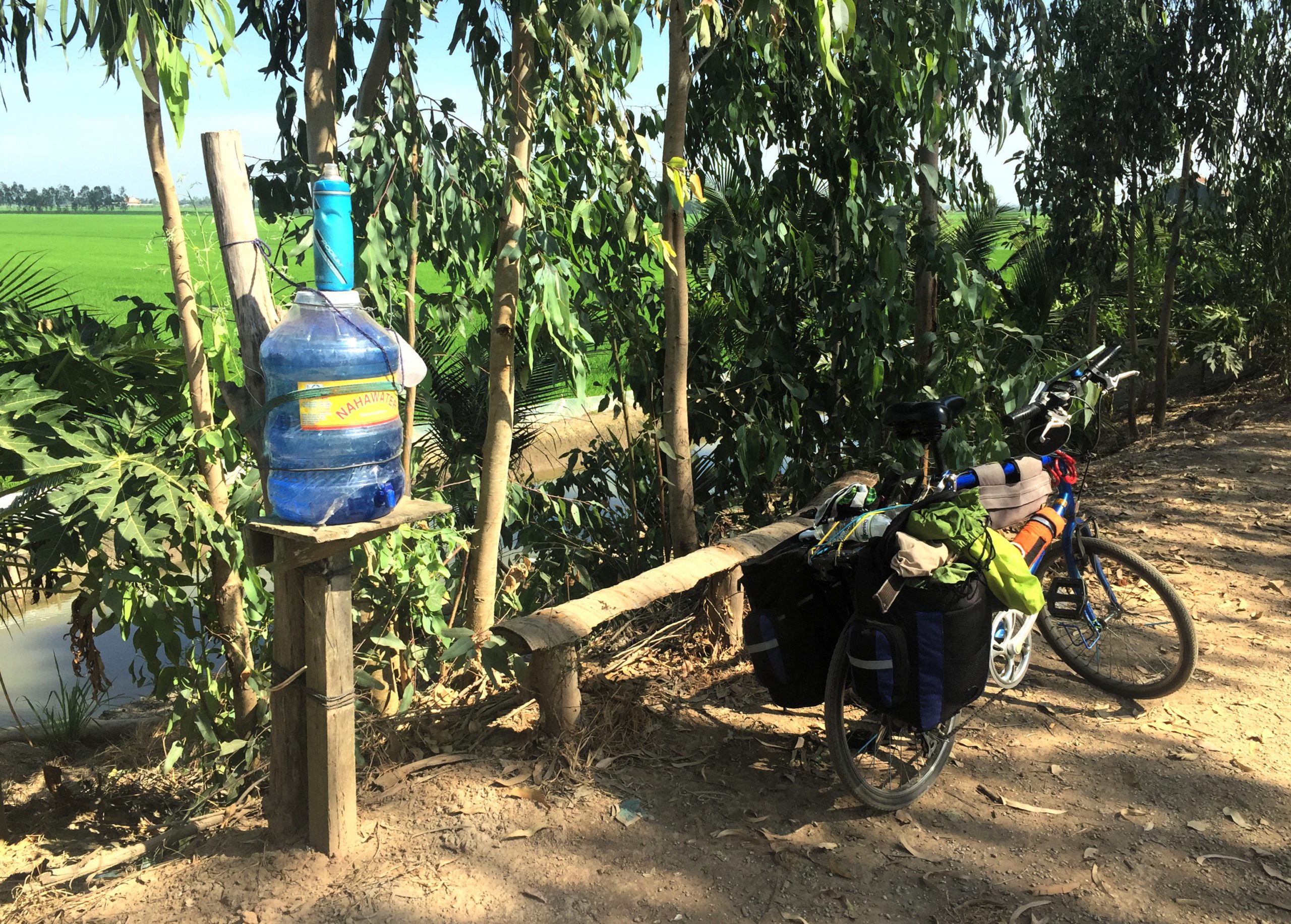
At first I wasn’t worried because I knew I was going to a large town and I assumed I would see more businesses sooner or later. It turned out to be later. 1:30 rolled around and there still wasn’t anything like food anywhere in sight. Cafe or no, I was hot, hungry and thirsty. I had to take a break. I noticed from time to time there were water cooler jugs placed alongside the road. When I found one of the jugs and a rotten, makeshift bench being guarded by two placid looking head of cattle I decided to stop for a break. Check out the video to see how all of this goes down.
Warmshowers Homestay
I stayed the night in Tan Châu with David, a warmshower’s host. He and his extended family were very kind and gracious hosts. It was my first time using warmshowers.org. Warmshowers.org is a web site where people who are willing to host bicycle tourists for a night or two can register. The response from most of the would-be hosts was very poor except for David, who responded quickly to all of my messages. I feel very lucky to have been able to stay with him. It gave me an opportunity to see past the front door of all the houses I passed on my bike. I was welcomed into the home and the private life of my host for a brief space of time.
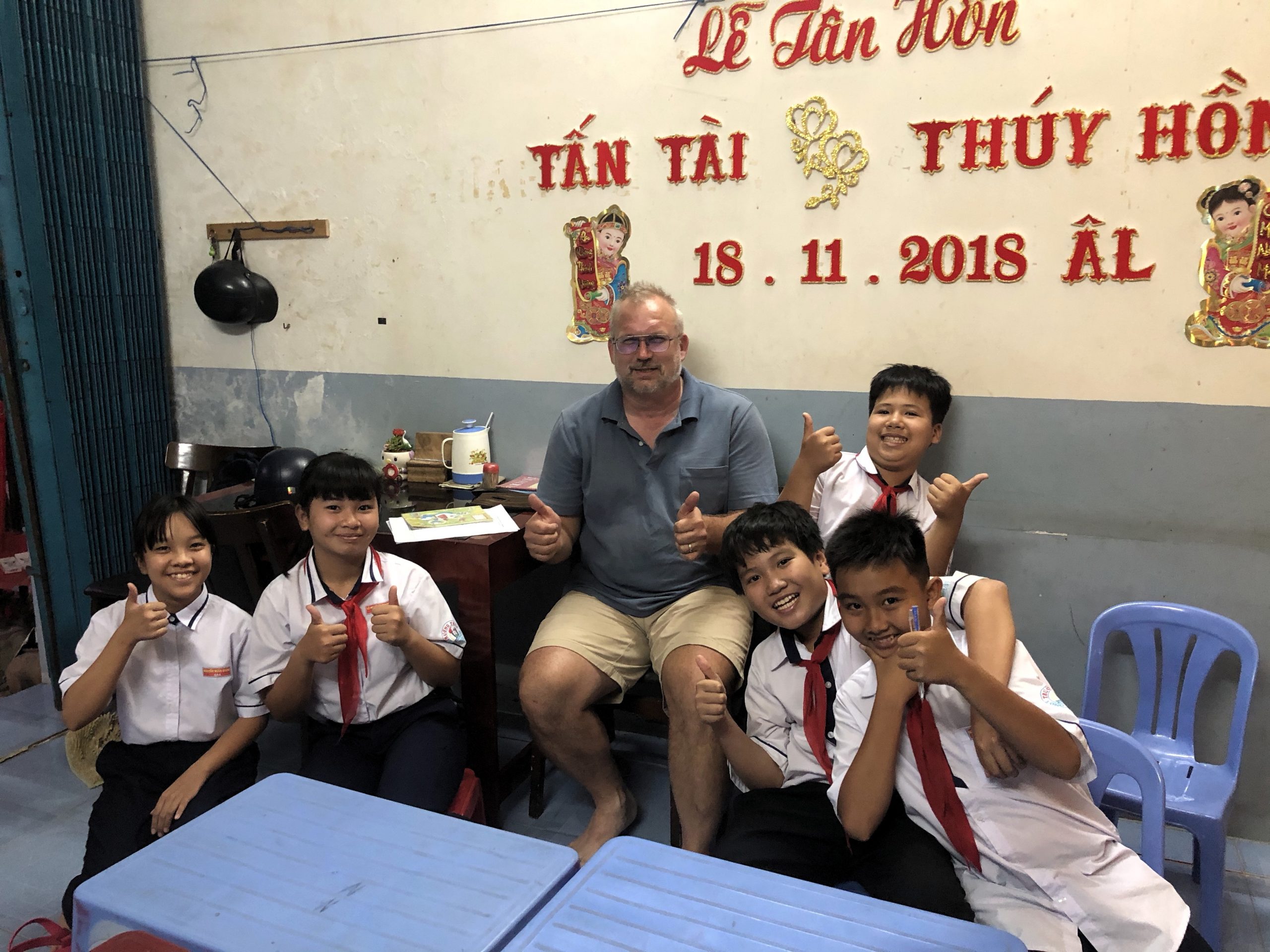
David asked me to visit his English classes. I was glad to make a guest appearance. It was a small price to pay for hosting me. And if my appearances helped enhanced his reputation as a cool teacher that can bring interesting foreigners to the class then I am glad to have helped.
I don’t want to talk too much about my experience with David because I fear it would be revealing too much of his private life. I do want to say that he fed me dinner and breakfast, provided me with a shower, a bed to sleep on, and I was able to wash my clothes which was a big help.
I realize that I didn’t take many photos or videos of his home and in retrospect I glad I didn’t for reasons of respecting his privacy. I will describe his front room as this is visible from the street and if you happened to pass by you could see what I am about to describe.
The front room is a large multipurpose room which is completely open to the street during the day and can be closed off by a metal shutter at night. The family uses it as a dining room, a living room where the family can relax, a place to entertain guests, and David uses it as a classroom for his private English classes. Because one wall is completely open to the street it is bright and airy. And because it is open the geckos are free to come and go as they please. During dinner I counted 9 geckos clinging to the wall facing me. I think the army of geckos are to thank for the lack of bugs in the house.
Lessons Learned:
Pack a little extra food in case you find yourself far from any restaurant or store at lunchtime.
Map out grocery stores and restaurants in advance.
Photo Gallery
Podcast
Video
[yotuwp type=”videos” id=”Xgx3REKl4m8″ ]
Home | Photo Gallery | Podcasts | Videos
]]>2019/12/16
Day 2
I was really reluctant to leave Nguyen Shack near Cần Thơ. I had such a good stay there that I wanted to stay longer. But, alas, I had a schedule to keep and the hostel was full the next night. I had no choice but to move on. I bid farewell to the hostel’s cat and puppies and set off for Long Xuyên and promptly took a wrong turn. The riding was so pleasant I neglected to check the map. I went a considerable distance out of my way before I realized my mistake. If I had properly mapped out this segment of my tour I could have cut out 10 or more kilometers. Ah well, these things happen.
Since I had come somewhat away from the main branch of the river (Sông Hậu River, a branch of the Mekong River) I worked my way back towards National Highway 91. In Vietnam the National Highways are accessible to all manner of vehicles, including those being pulled by animals. For cars, buses and trucks there is a toll in some places but bicycles and motorcycles can use them for free. In fact, at the toll booth there is a special lane next to the shoulder where two wheeled vehicles can get through without paying the toll.
Almost the entire day was spent on Highway 91. When I say highway you may be picturing a four lane divided highway with exit and entrance ramps and trucks and automobiles whizzing by at 75 miles an hour. It is nothing like that. You would be closer to the real deal if you pictured a county highway going through the outskirts of a small town. But even that image misses the mark. All along the road there are cafes and restaurants, street vendors and even clothing sellers. There aren’t many side roads between the towns so it feels like all the life of the country exists within a few dozen meters of the highway or in the cities and towns. I know this isn’t true but that’s the way it feels when you spend all day on the road and can’t see much beyond the buildings that line it. Perhaps I should have taken more detours off the highway. Maybe next time.
I don’t know what the speed limit on the National Highway system in Vietnam is as I never saw any speed limit signs the entire time I was in Vietnam but it seems like traffic was going no faster than 50 or 60 kph. At no point did I ever feel like I was in any danger. There are so many motorcycles, bicycles, and carts being pulled or pushed by people that I think drivers are used to slow moving vehicles. Something that is noticeable right from the start is that Vietnamese streets are noisy from all of the horn honking. There are many different tones and rhythms to the honking. Trucks, cars and motorcycles all have their own sound and there is a lot of variation among types. If this were in North America or Japan you would assume that the drivers are always impatient and irritated. But that is not the case. Honking the horn is just a way for faster moving road users to say to slower road users, “I am coming up behind you and I am going to pass you so stay where you are. Don’t meander.” I sometimes wished I too had a klaxon when I passed slower moving cyclists and pedestrians. Unfortunately, on the busy streets it is impossible to tell who is beeping at who.
For people who come from orderly, rule based countries Vietnamese streets may seem, at first glance, like chaotic places where there are no rules. I saw very few traffic lights during the hours I spent on National Highway 91 and the city streets of Can Thơ and Long Xuyên. Intersections seem chaotic but they are a lot easier to navigate than you would expect. The key to getting across the street is move slowly, steadily and in a predictable manner. This is true for pedestrians, bicycles and even motorcycles and 4 wheeled vehicles. If others can predict where you are going they will adjust their path to flow around you just as you are adjusting your path to avoid them. It just works. Just like Adam Smith’s invisible had.
You would be tempted to think that there were frequent accidents with serious injuries. During my time in Vietnam I didn’t see any accidents. I did see a woman have a little incident with her scooter in Long Xuyên. I heard a crashing noises. When I turned to look, I saw a woman picking her scooter up off the ground. I don’t know what caused her to dump her ride but she didn’t appear to be hurt and I didn’t see anyone else involved. I think one factor that might prevent a lot of serious injuries is the slower speed which traffic moves at. The axiom that speed kills is very true.
Another thing I noticed is the ubiquitousness of free Wi-Fi. Putting the dangers of free Wi-Fi aside, it was easier to get a Wi-Fi connection in Vietnam than it is in Tokyo. I stopped for lunch at a roadside eating place that advertised free Wi-Fi. (Calling it a restaurant would give you the wrong impression.) I asked the lady running the place for the password because I didn’t see it posted anywhere. She took my phone and entered the password herself. That was an interesting meal. I didn’t really have any idea what the place offered. Through the power of Google Translate I said something like “I would like something to eat. What do you have?” The woman said something I didn’t understand and I said “Okay”. I had no idea what I was going to get. It turned out to be a plate of rice with some barbecue meat (my guess is pork) and a little bowl of soup. It was delicious. While I was sitting at a low table eating my lunch, the woman’s little boy, no more than 18 months I would guess.) was toddling around the place. He was clearly curious about me but was a little shy. I smiled at him and made funny faces at him and soon he ventured to my table. As I said, the table was low and the boy could easily see me across the table. Without understanding each other we spent a few pleasant minutes playing.
A very common establishment along National Highway 91 are cafes. I saw many signs that said “Cafe Võng”. I saw so many of them I thought it must be a chain store. I found out later that it is not a chain store. It is just a type of cafe. The outstanding characteristic of Cafe Võng is that they usually have hammocks for the guests. You can get a cold drink and rest for awhile in a hammock. These are popular along the National Highway because it is tiring work riding a motorcycle along the highway. Riders like to pull off for a while and take a rest before continuing on with their business.
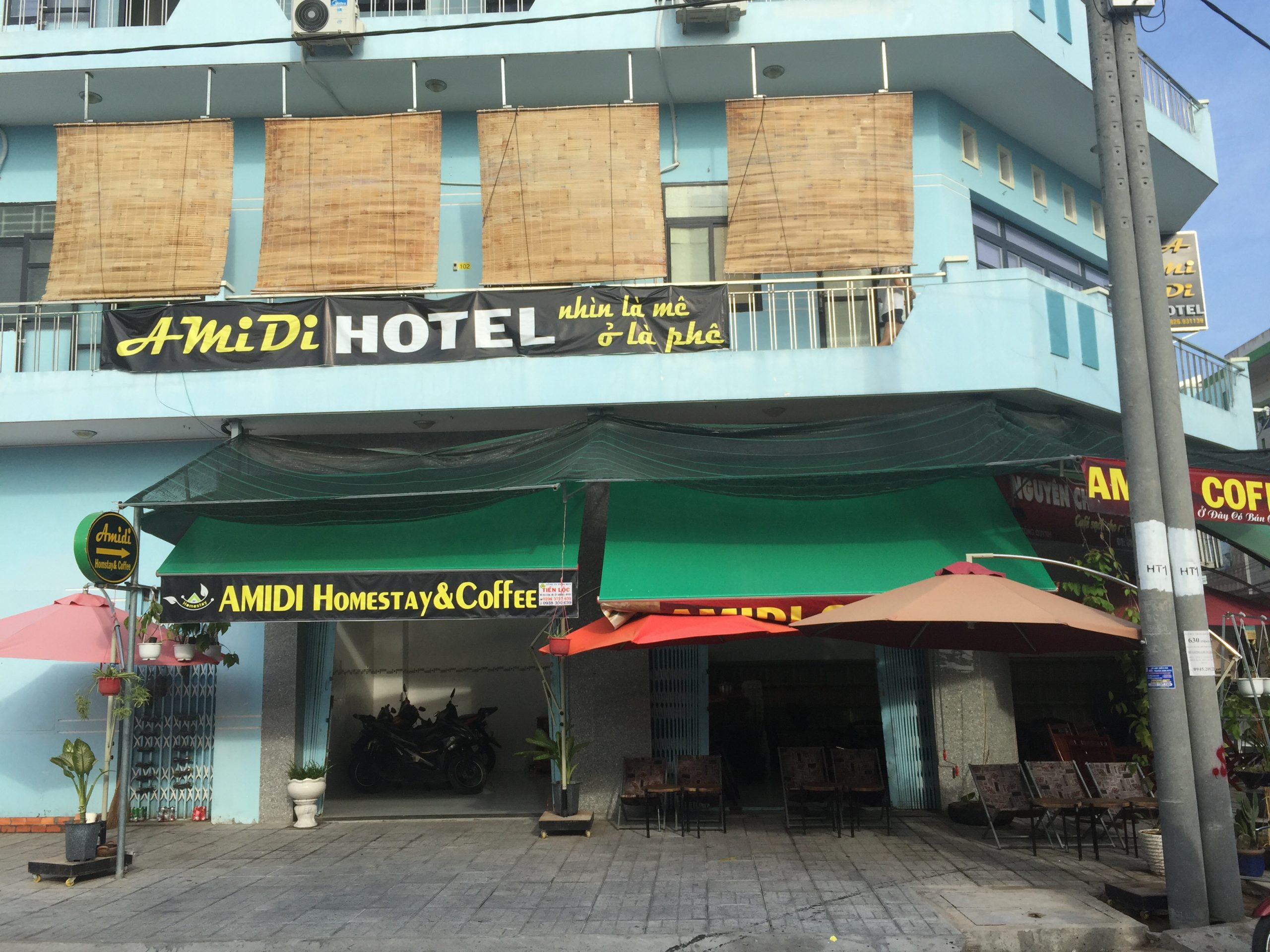
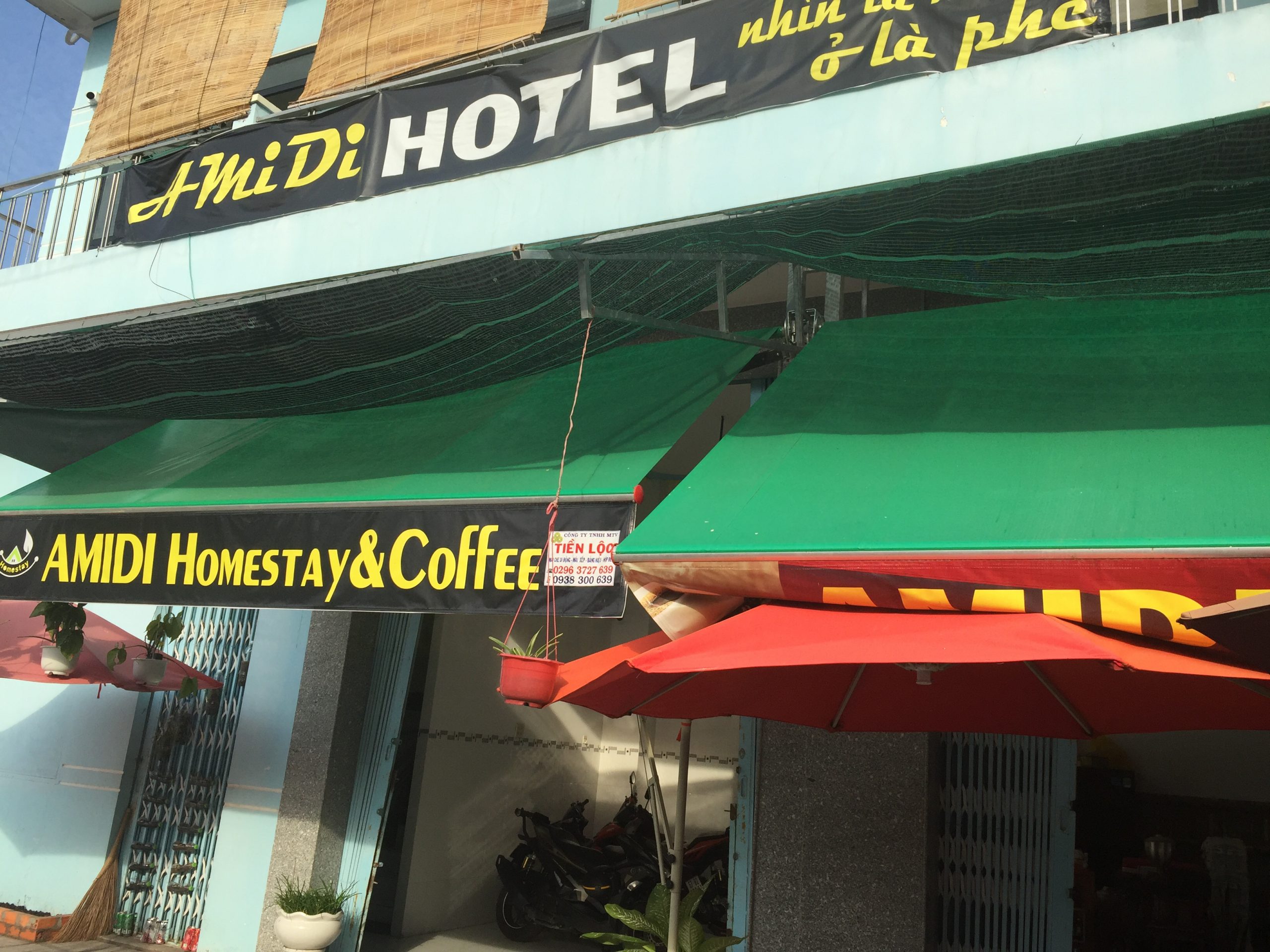
Thanks to my wrong turns and detours in the morning I road 80 plus kilometers. I arrived in Long Xuyên in late afternoon. Fortunately, I was able to find my hotel without too much trouble. I stayed at a place called Amidi Cafe and Homestay. The name is a bit misleading. It’s true, there was a cafe on the street level but it wasn’t a home stay. It is a good thing that I wasn’t expecting one. The girl working the front desk led me to my room on the second floor and gave me a card and a key. The card was for turning on the electricity in the room. The key was for the padlock on the door. That’s right. A padlock. The room didn’t have a proper doorknob with a keyhole. It had a handle and on both sides of the door there was a place to pass the padlock through to secure it to the door jamb.
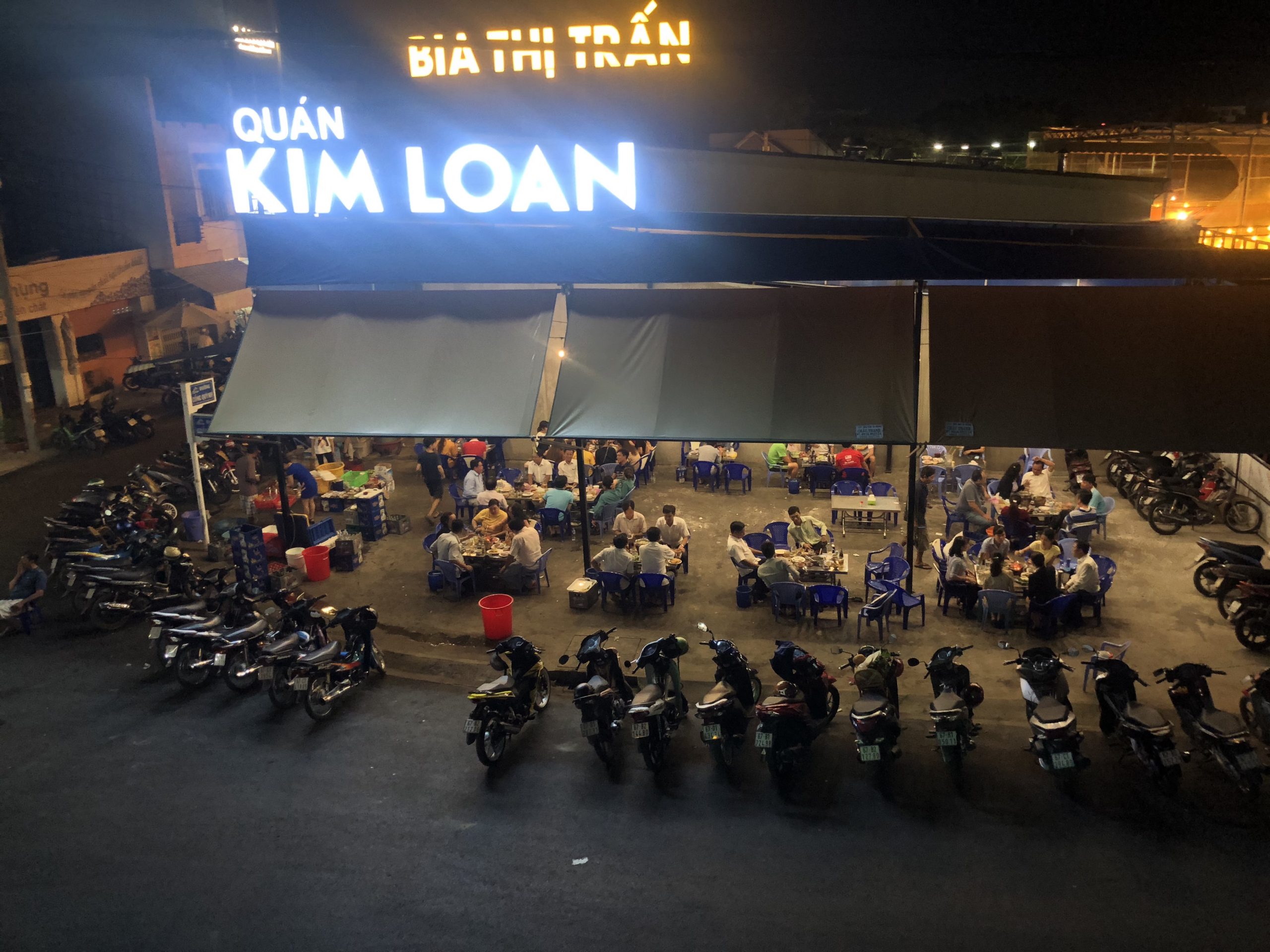
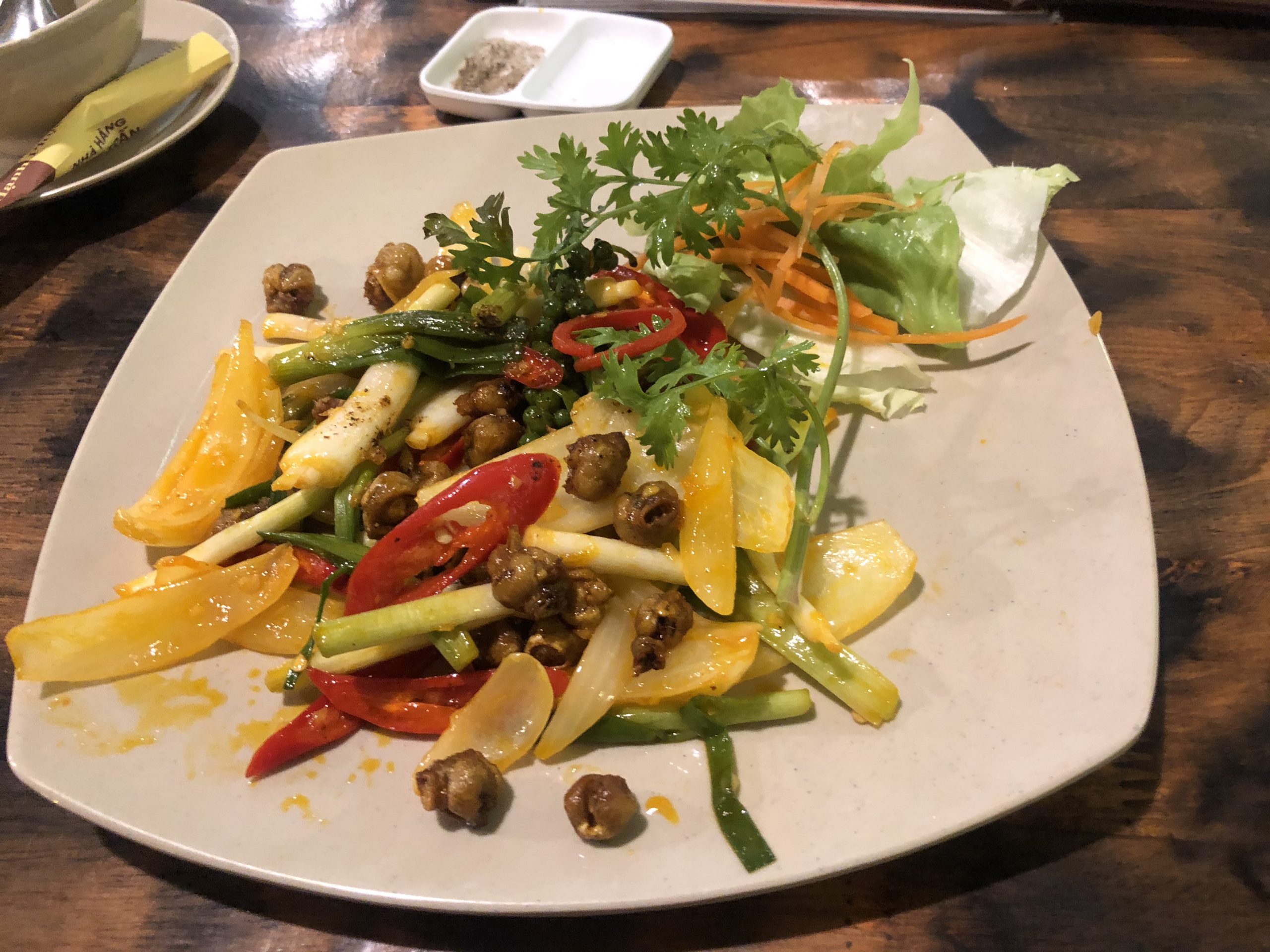
I laid down on the cool floor for an hour and inspected the inside of my eyelids for light leaks. For about an hour I found no evidence damage. As the sun went down I heard noise like a big party coming from across the street. When I looked out the door I discovered that I was across the street from 2 large open-air restaurants that were doing brisk business. I went down to the front desk to ask the girl which restaurant was better. With broken English she told me that they were the same and that there was another restaurant around the corner that was better. Taking the word of the local I went around the corner and found a very large, somewhat opulently decorated restaurant that was empty. I thought maybe they weren’t open yet but the waiter welcomed me in. That’s where it got difficult. Problem one: the menu was written all in Vietnamese. Problem two: there were almost no pictures. Like you see in many restaurants the main menu was a nicely bound book of several pages. Inserted into the menu book was one page of specials with pictures. This was kind of fancy restaurant so the prices, I feel, were a bit higher but I thought they were acceptable. I ordered the cheapest thing from the specials menu because the food in the picture looked like some kind of stir fry and I ordered a beer. It is good that I ordered a beer because the dish I ordered was a bit too spicy for me. I did my best to eat as much of it as I could but I had to order another beer to put the fire in my mouth out. I also spent about 20 minutes looking up words on the main menu with Google Translate until I found a dish I could understand. Spinach! I ordered the spinach dish as well. I was expecting a small to mediumish dish of boiled spinach. What I got was a large, heaping plate of spinach. It was good but far too much for me to eat. When I asked for the bill the waiter asked me if I wanted to take it with me. I considered only for the briefest of moments but I rejected the idea because I had no way to carry it.
Lessons Learned
1. Properly map out any side excursions and the route to and from your hotel in advance.
Photo Gallery
Podcast
Video
[yotuwp type=”videos” id=”Dh9pOmpKCf8″ ]
Home | Photo Gallery | Podcasts | Videos
]]>2019/12/15
Day 1
I give the Ngoc Lan Hotel 5 stars. What qualifies a hotel for 5 stars? That’s a fair question. I’m glad you asked. I was able to check in at 11:00 at night even though my reservation was canceled. The room was clean, free Wi-Fi, air-conditioned, on the first floor, spacious, everything in the room functioned properly. What more could you ask for? Maybe you would downgrade the rating because the fixtures weren’t solid gold, no concierge service, pool, workout room, breakfast or caviar in the mini fridge or a newspaper hanging on the door in the morning. Those are good things and who doesn’t like to be pampered once in a while. But none of that matters when you tired and sweaty and on the verge of a what may be an epic great trip or an epic failure. A comfortable bed, a warm shower and a safe room to sleep is all you really need. You can hear all about how I got to the Ngoc Lan Hotel in Soc Trăng by listening to my podcast or watching the video.
I awoke to to the rooster showing off his vocal abilities somewhere in the distance. I thought it was curious that there would be chickens in town but gave the topic no further thought. What I didn’t know is that chickens are everywhere in Vietnam except maybe Ho Chi Minh City.
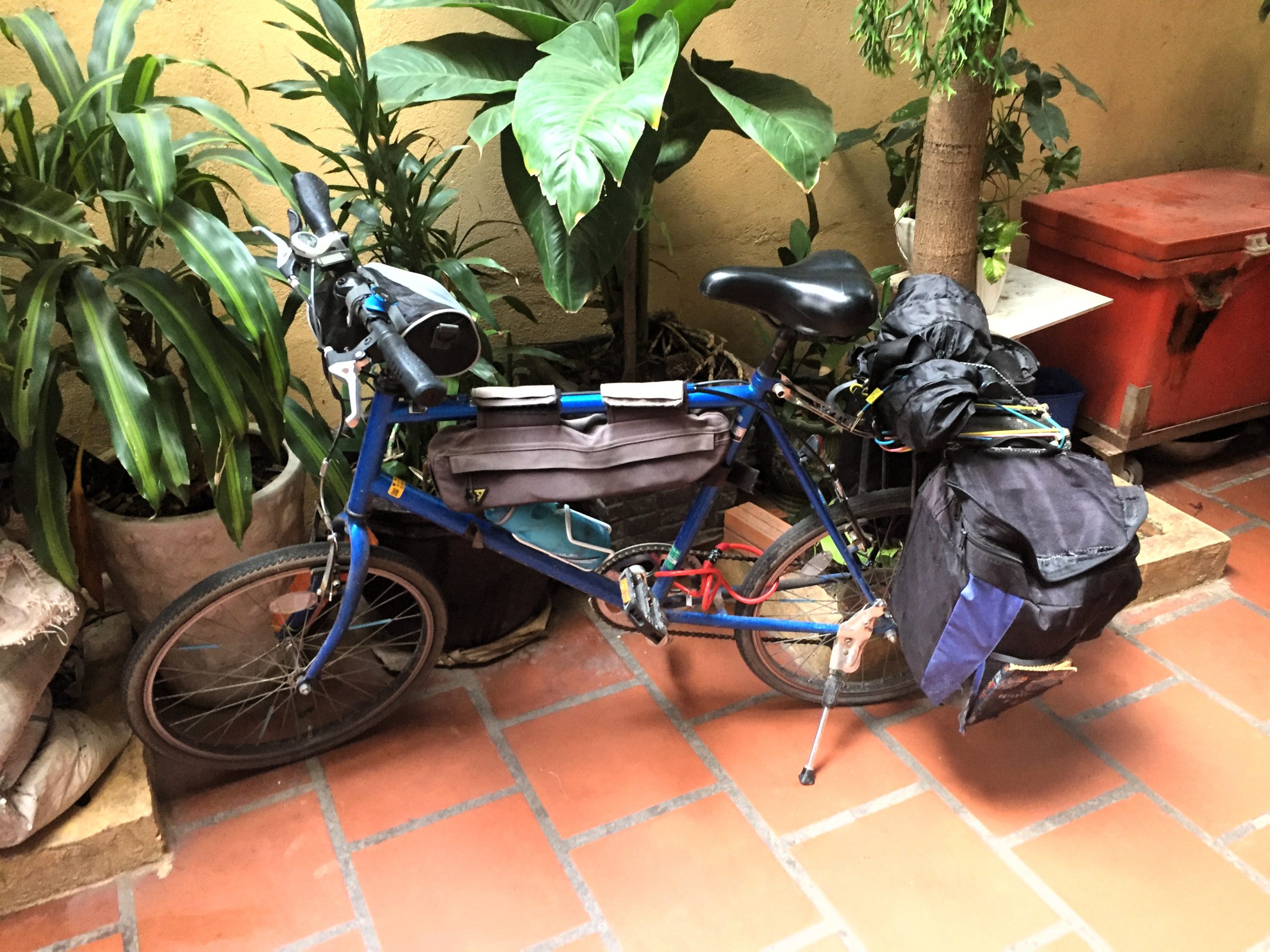
The first order of business was to reassemble Mini-V. I took her and most of my gear out of her cardboard enclosure. I was grateful that she wasn’t any worse for the wear. It took me about an hour to get the old girl back together and loaded up with my gear. Since the hotel did not have any breakfast service I decided to get breakfast out on the road. I straddled my iron pony and stood at the edge of the road and watched the steady stream of traffic and I wondered two things. One, which way do I go to start my journey? Two, how was I going to get across the street if my route required a left turn. I convinced myself that the way I needed to go was to the right. I think I was just intimidated by the traffic and wanted to ease my way into the flow. As soon as I started rolling the GPS on my phone got a solid fix and showed that my instinct to go left was right and my desire to go right was wrong. I took a right turn down a side street hoping I could loop back to my route. It didn’t work out that way. I ended up doubling back and retracing my tire tracks. On the way back I found the chickens and roosters that greeted me so vociferously earlier. They were under large wire cages that looked like a basket turned upside down. The owners can easily lift up the basket cage when it is time to take their chicken for a walk or steal their eggs.
I could no longer avoid making a left turn across traffic and you know what? It wasn’t so bad. I definitely survived. With that small victory behind me I gained confidence that carried me through the next couple turns. Uh oh! Trouble ahead. A huge roundabout! Thanks to my deep research on the topic of roundabouts (I listened to a Stuff You Should Know podcast about roundabouts and I have experienced roundabouts in such exotic locations as New Jersey, Australia and Kunitachi), I was ready for this. I boldly went where no mini-velo has gone before…across the street. It was a piece of cake. The traffic just flowed around the idiot on a bicycle. More evidence to back up my theory that no sane motorist really wants to run you over. So long as you are a predictable and visible bicycle rider your odds of surviving are better than your odds of surviving a double tall triple mocha espresso at Starbucks are?
As I rolled on to the National Highway 1 I couldn’t believe I had actually done it. Somehow, I had gotten myself and my bicycle all the way from Kodaira, Japan to Soc Trăng, Vietnam using trains, buses and taxis. I was cycling in Vietnam! I was so excited and fascinated by everything I saw during those first couple of hours that time and the miles flew by. As the morning began to warm up I realized I hadn’t filled my water bottles before leaving. I pulled off the road at a little general store where I could buy a couple bottles of water.
At this point I think it would be enlightening to talk about National Highway 1. It isn’t a highway in the same way that I-5 is or the Autobahn is. There is a toll but there are no exit ramps or entrance ramps, no high speed traffic. The road is lined with street vendors, cafes, motorcycle shops and businesses pressing hard on to the edge of the road. It is easy to pull off at any point for an ice coffee, a motorcycle repair or load up your motorcycle, pushcart, bicycle or ox cart with goods and materials.
Around 11:00 a.m. I realized that in my excitement I had forgotten to eat breakfast. I took a break at a roadside cafe. A word about Vietnamese architecture. Most buildings are wide open on the side facing the street. They may or may not have a shutter to close them up at night. This design allows for easy access from the street and breezes to cool off the interior. Many establishments have hammocks strung up. Sometimes the hammocks are for customers sometimes they are not. It appears most establishments are family run and the building does double duty as business and home.
Back on the road I pedaled for another two hours before the heat of the day started to wear me down. I took a break at a petrol station to rest for a bit in the shade before continuing on. I eventually left National Road 1 and the Sông Hậu River to find my lodgings.
I booked a bed at a hostel called Nguyen Shack. From the time I made my reservation I knew this place was going to be a great place to stay. The reviews for it on the booking site were all lavish with praise and the pictures were enticing. Nguyen Shack did not disappoint. The staff spoke English and were very friendly and helpful. The food was delicious and the atmosphere was relaxing and homey. Nguyen Shack is a hostel so it might not be everyone’s cup of team. While there were private rooms I opted to share a 4 person room. There were two men whom I guess were German but were listening to French music and what sounded like French language lessons. I don’t know what was up with that. I didn’t ask. They kept to themselves and I didn’t intrude. Amiable indifference. The other fellow was a Frenchman named Fabrice. We had a wonderful evening swapping stories and playing the hostel’s acoustic guitar. He was truly talented while, at my best, I’m just a ham-handed hack. I met other interesting travelers in the dining/lounge are. A retired couple from Washington DC who were traveling with a Vietnamese fellow who seemed to be working as their private guide. The American man was stationed in Vietnam during the war and seemed to be genuinely interested in how the places he knew as a soldier had changed. Then there was the young British couple that had been traveling in Vietnam for 9 weeks. They would stay in a city until they had seen and done all there was to do for touristsand then move on to the next. I also met a Spanish family of 4 who had come to Vietnam as part of a larger tour around Asia. For more about my stay at Nguyen Shack check out my videos and photos.
Lessons Learned
Sometimes you have to leave a place when you don’t want to. If you can, build some extra days into your schedule so you can be more flexible.
Photo Gallery
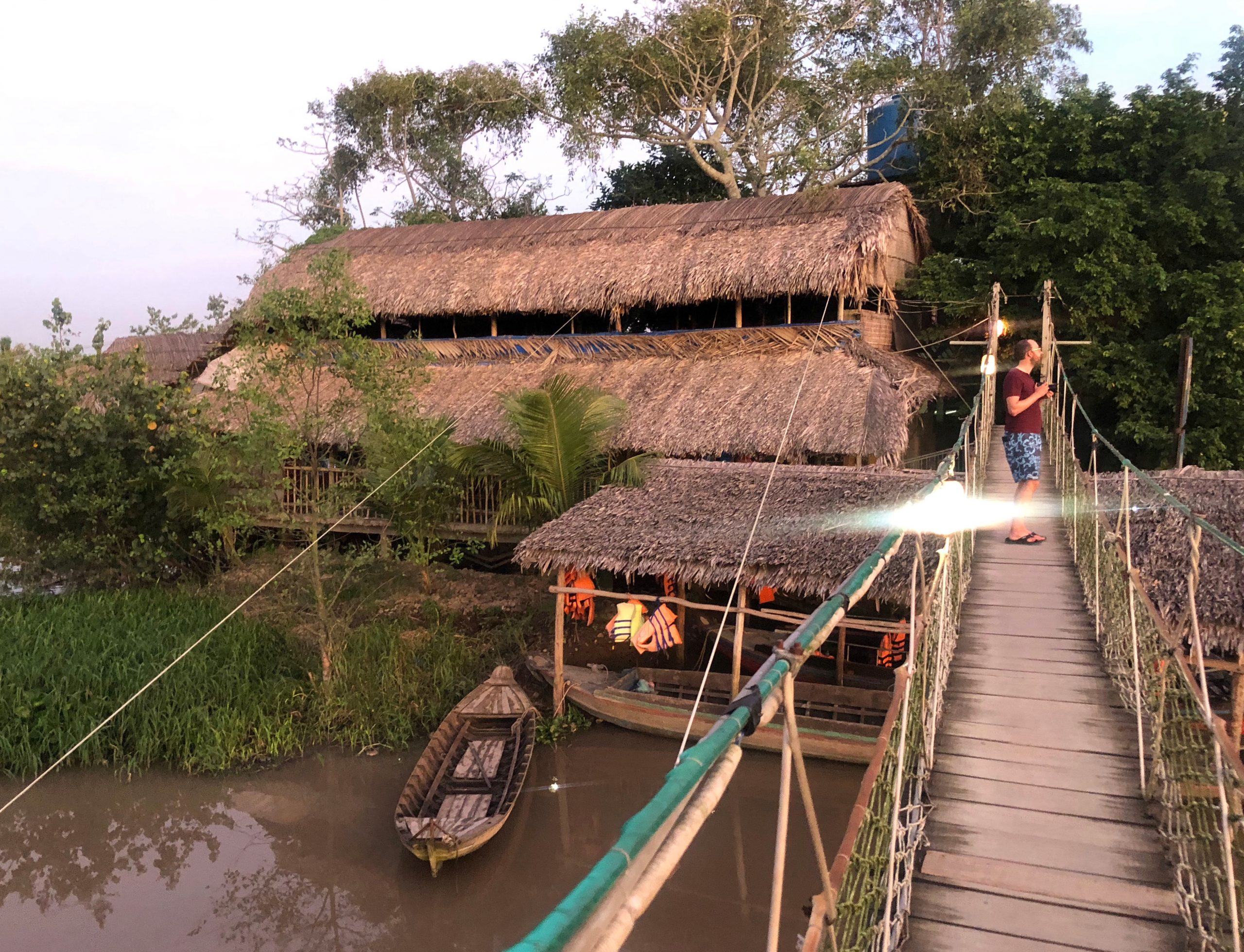
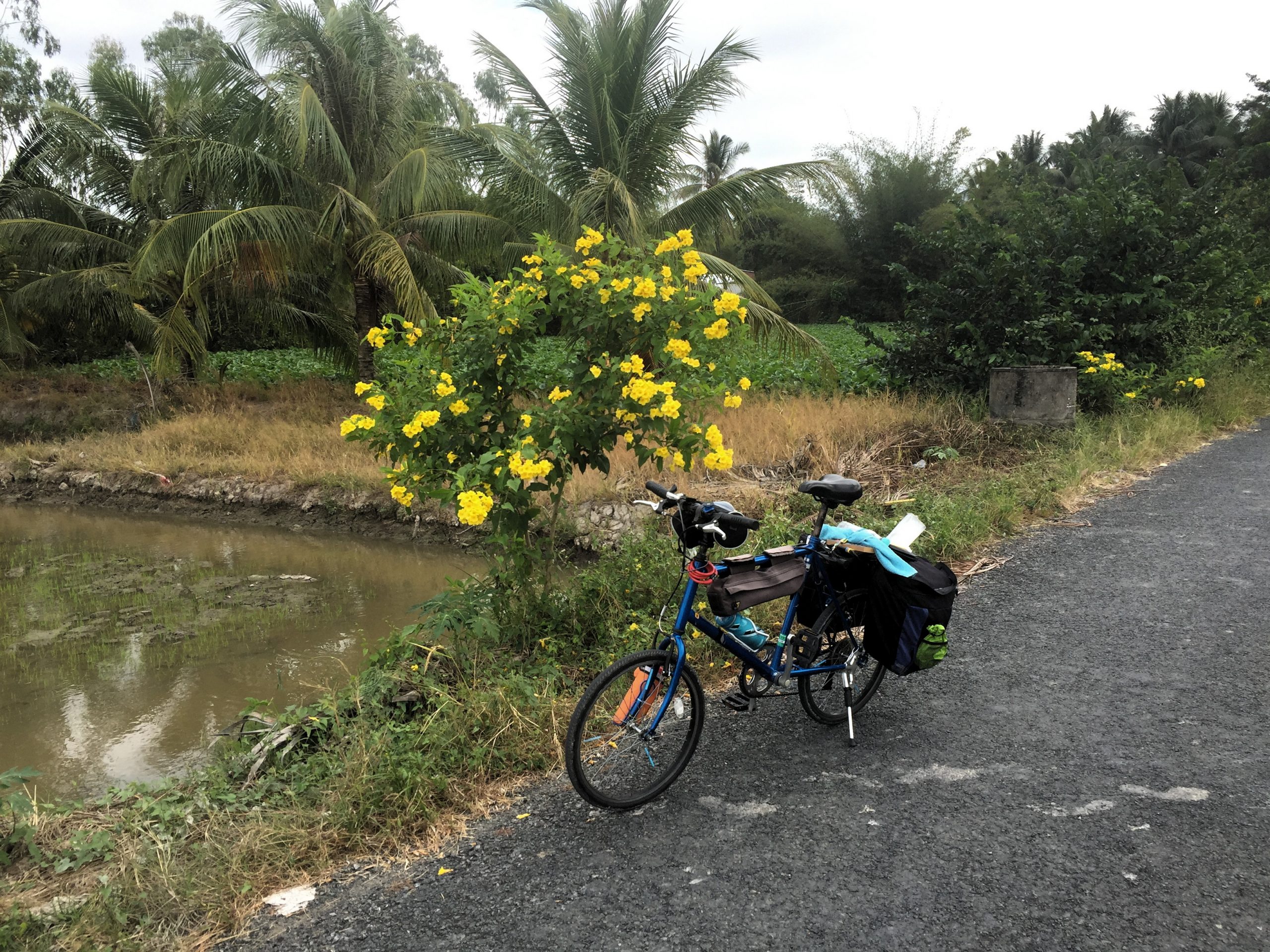
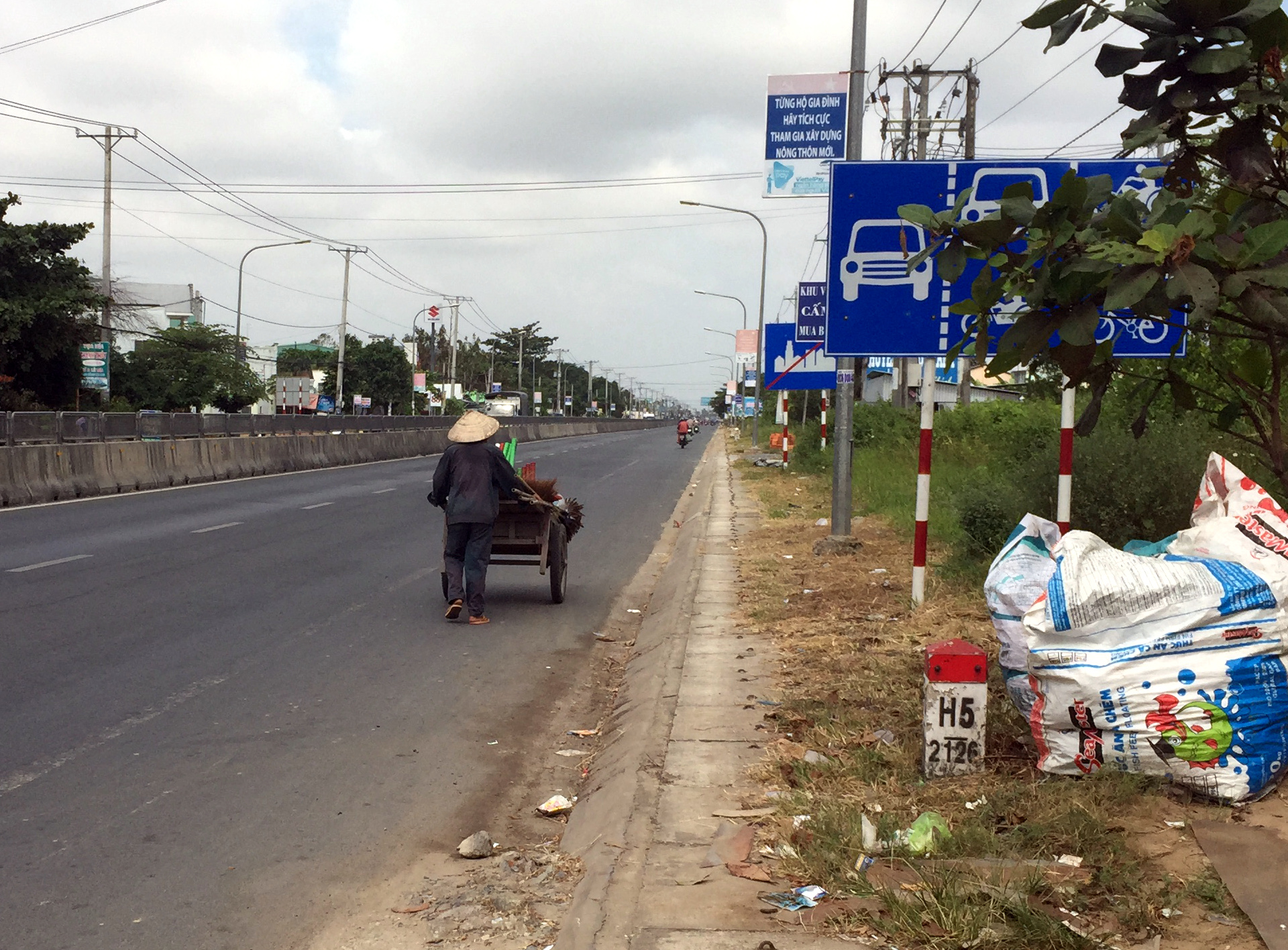
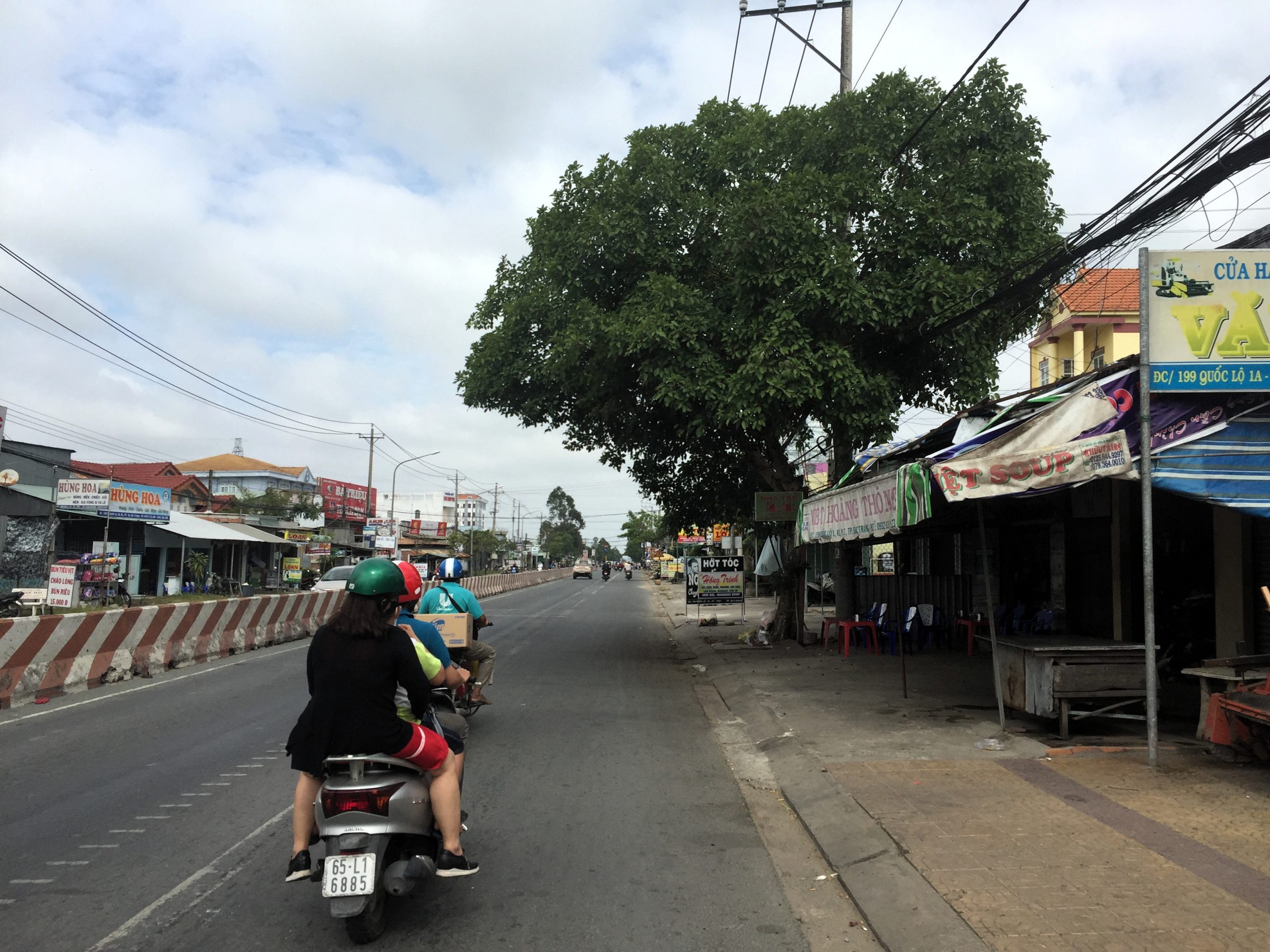
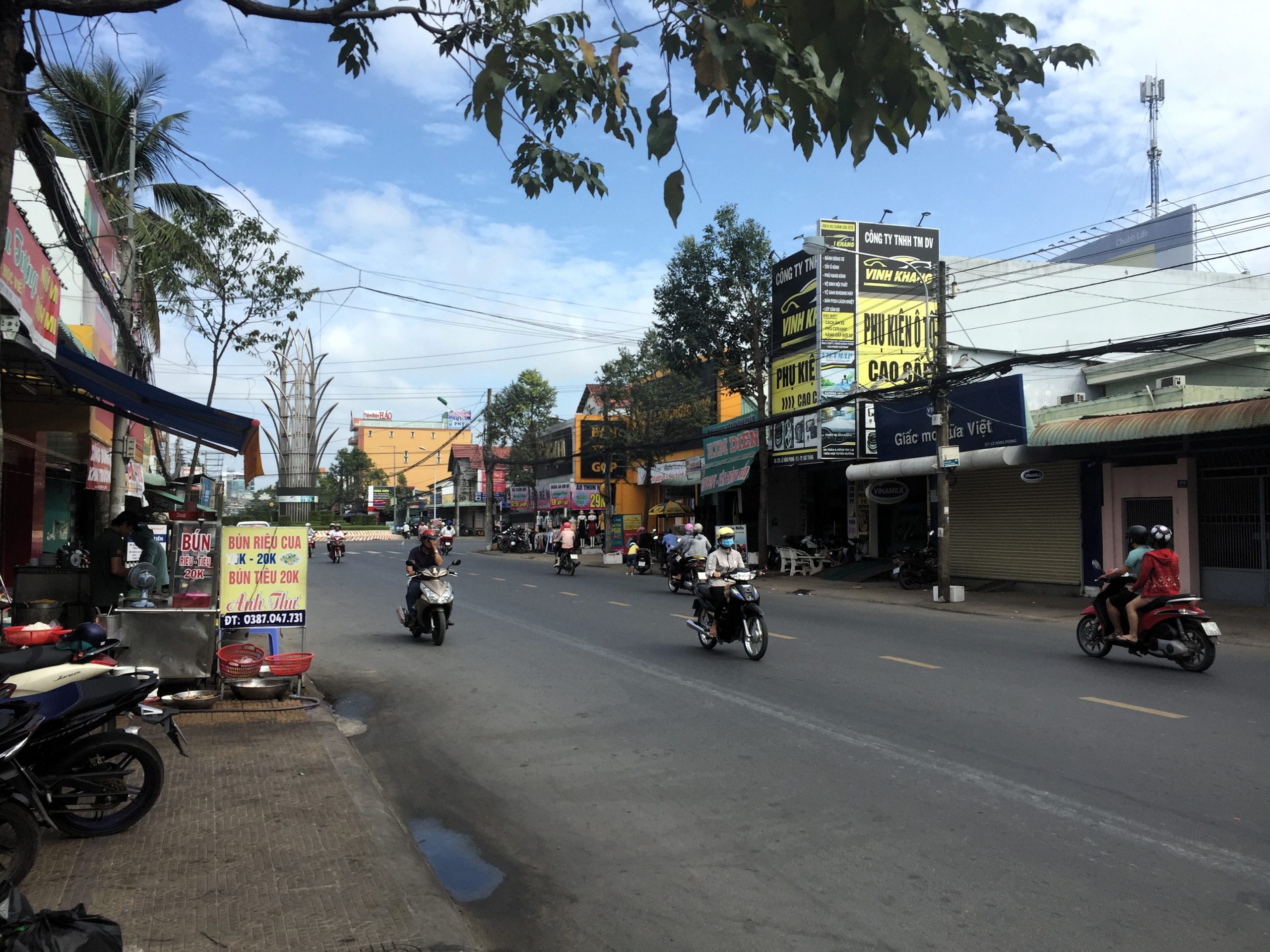
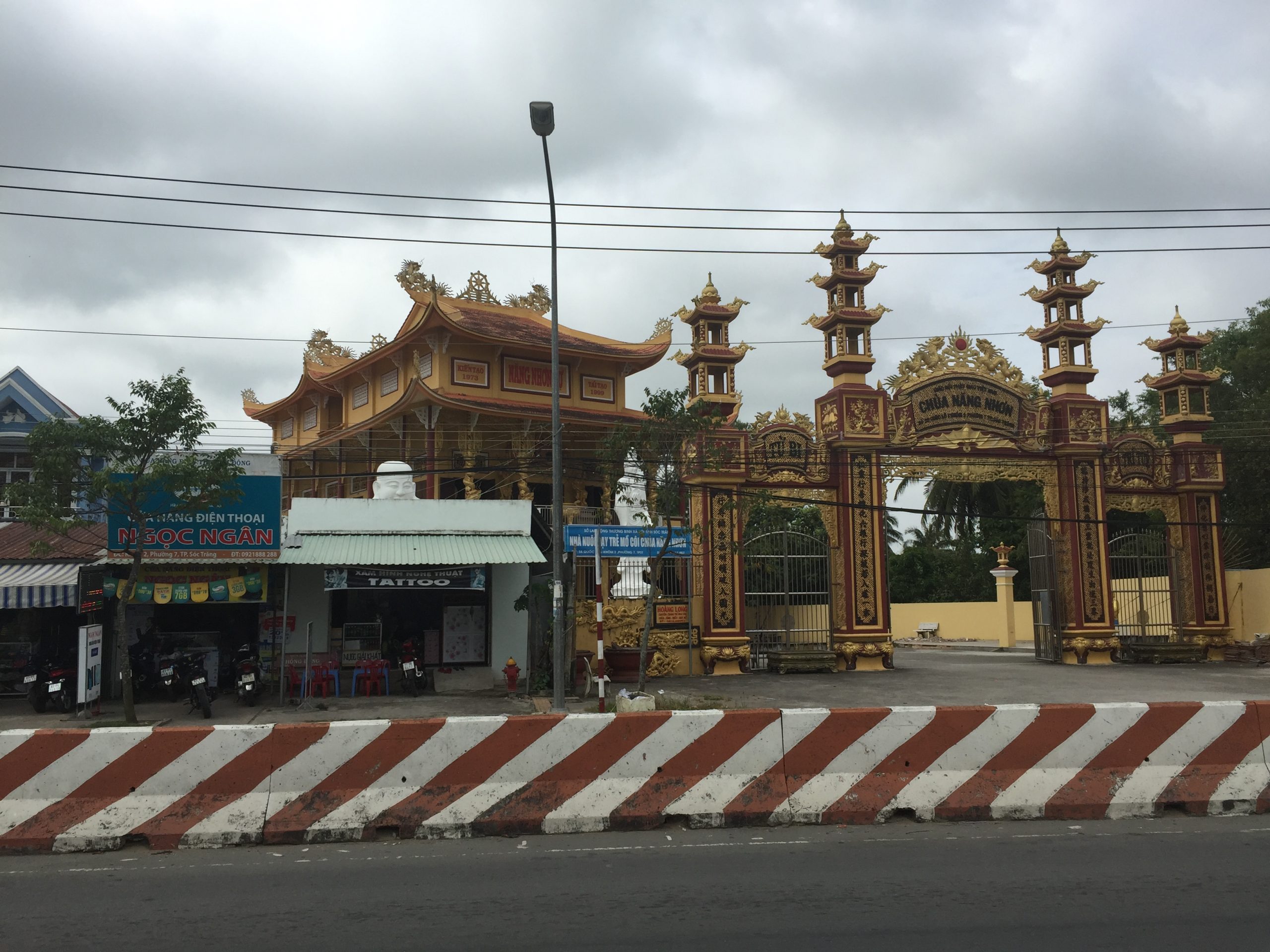
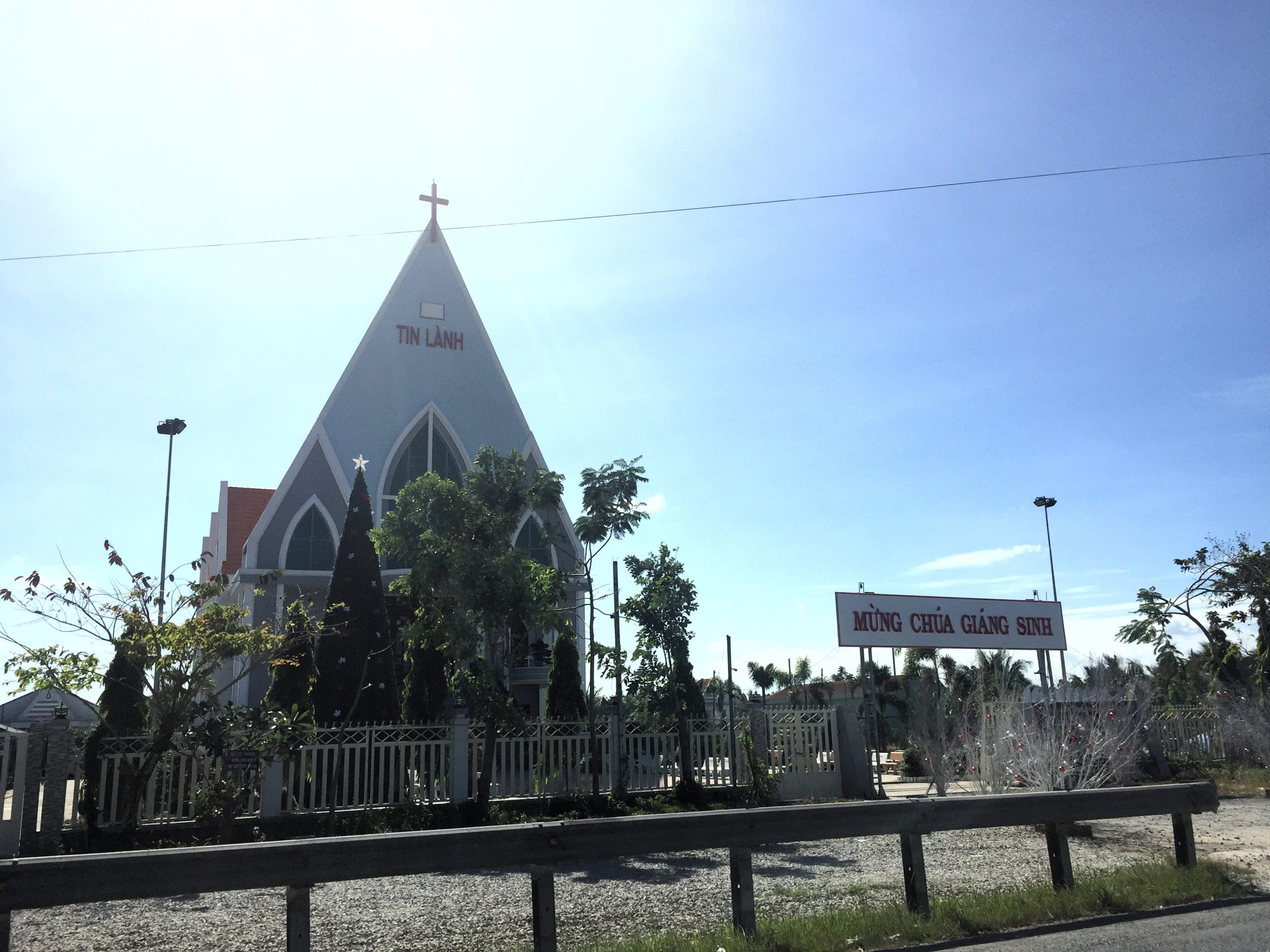
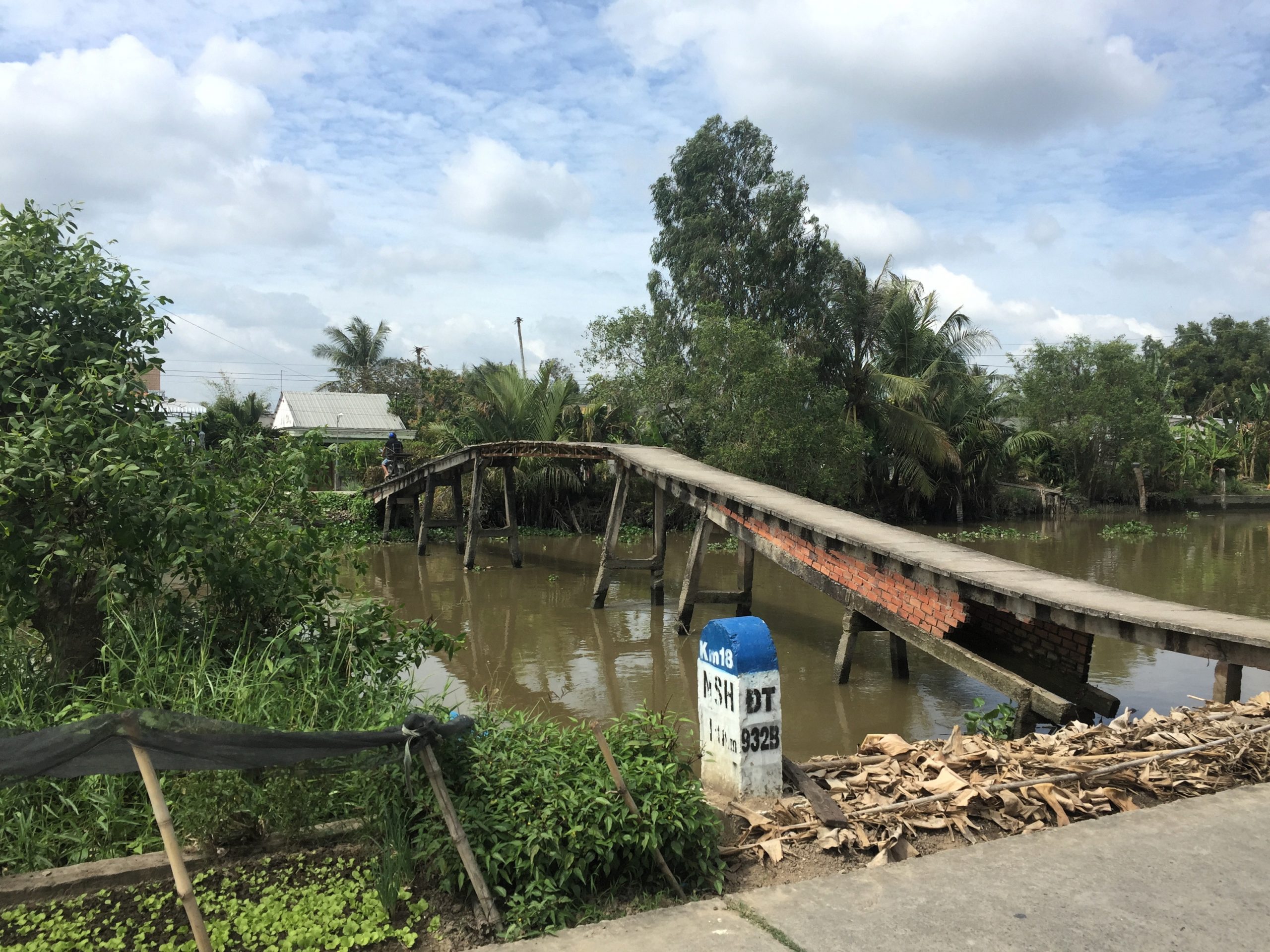
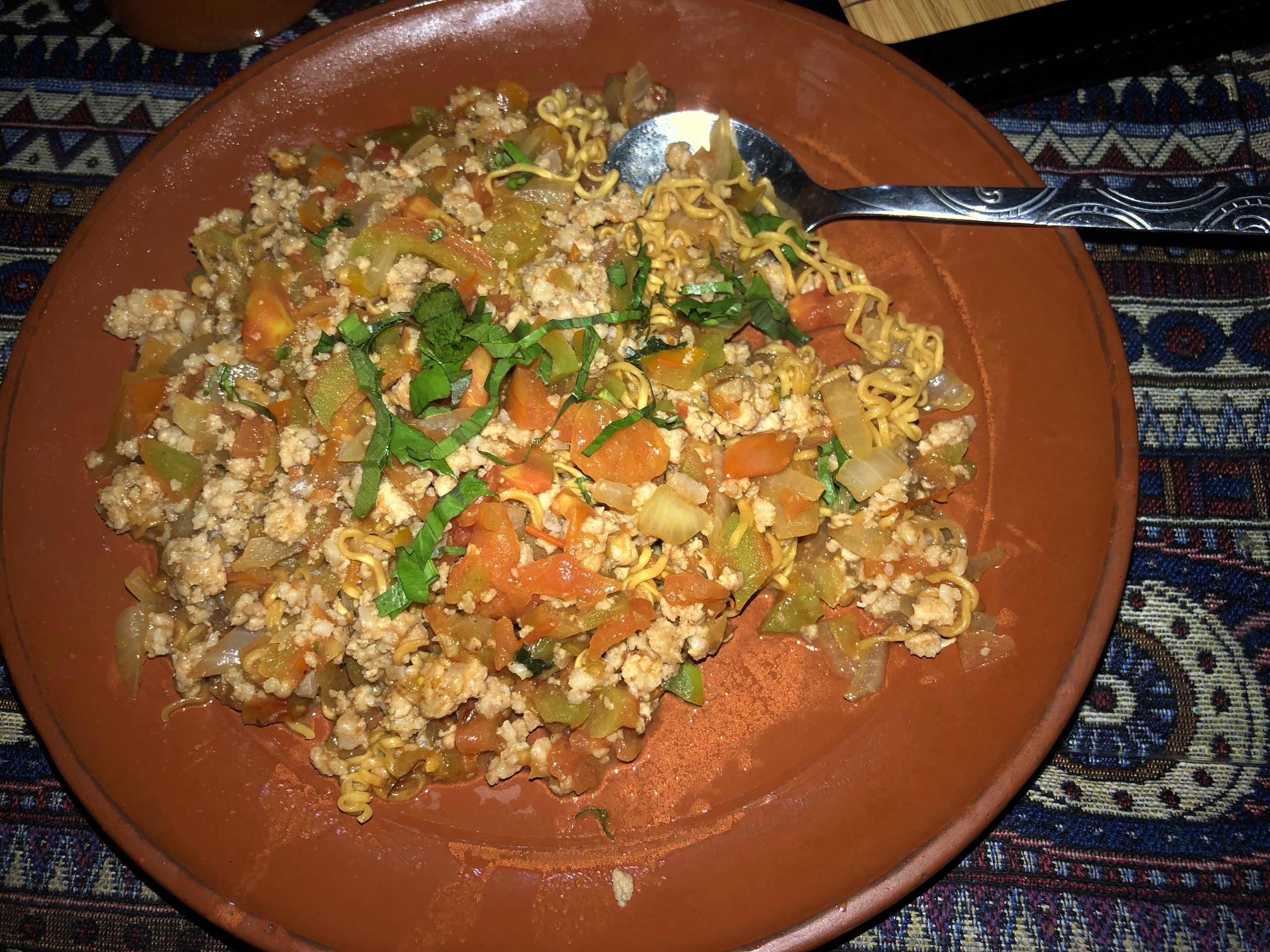
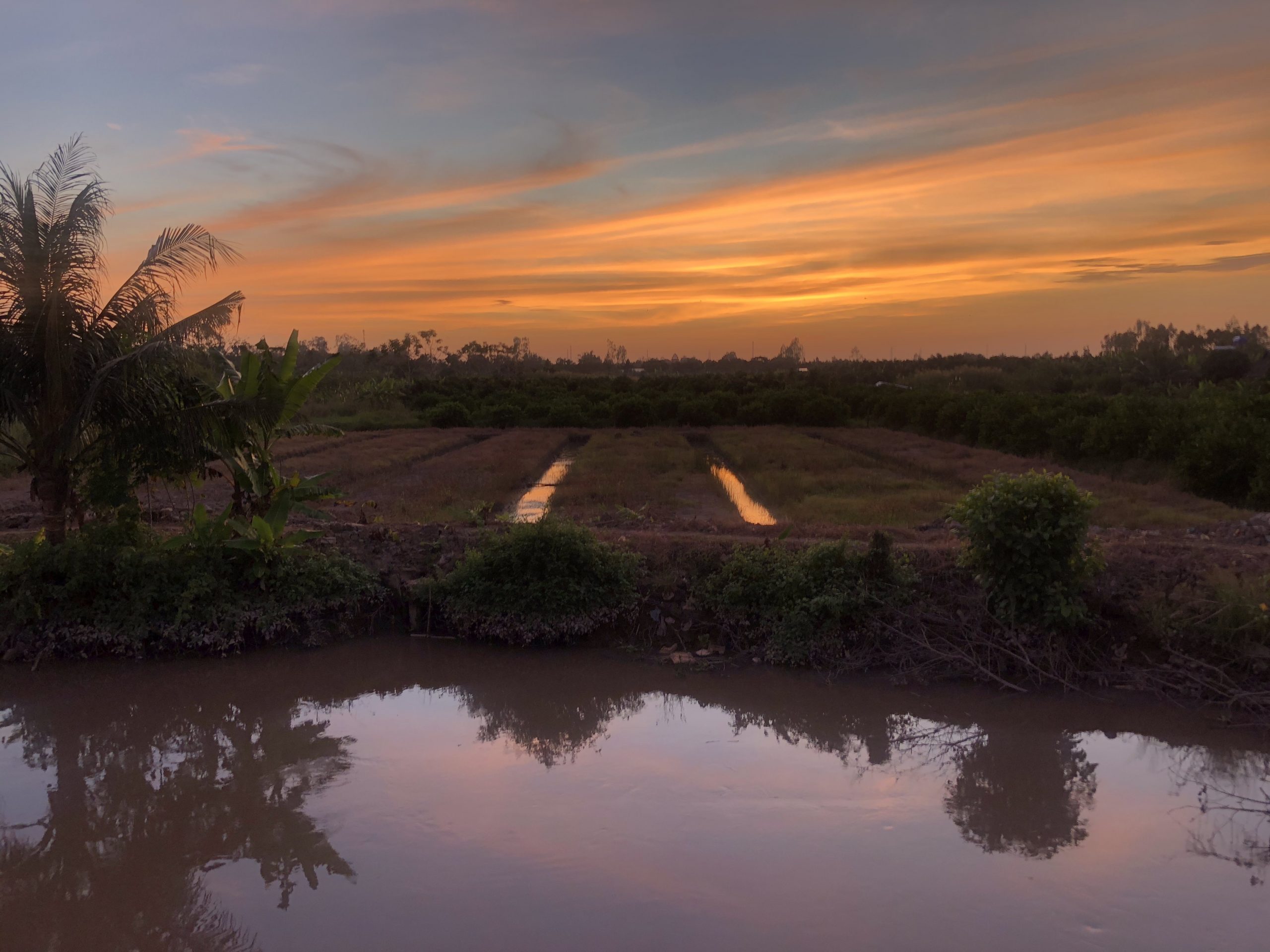
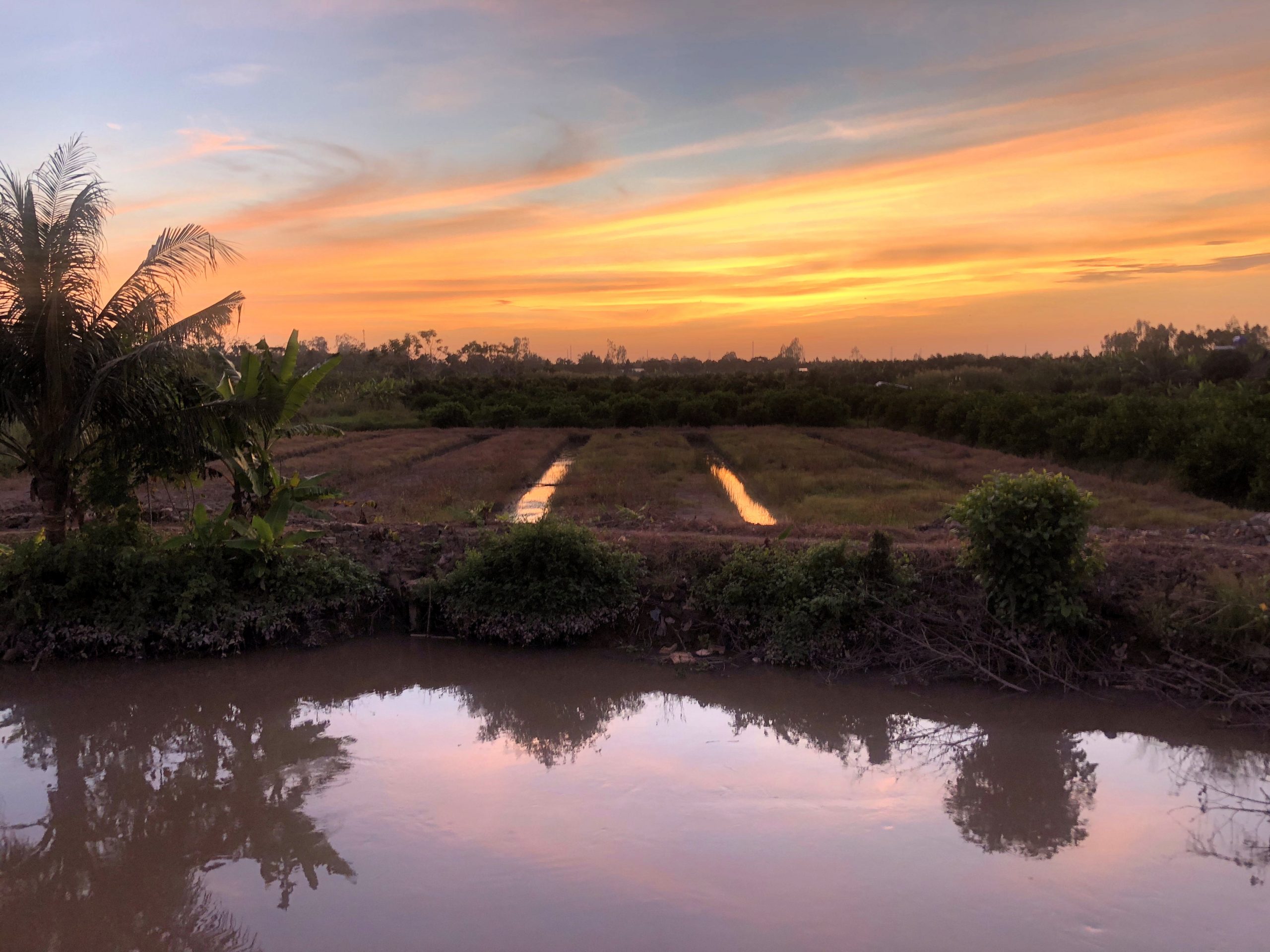
Podcast
Video
[yotuwp type=”videos” id=”i4cVCJOrH1M” ]
Home | Photo Gallery | Podcasts | Videos
]]>2019/12/14
Tokyo to Ho Chi Minh City
Just Getting to the Start
The day started way too early. I had to be at the Palace Hotel in Tachikawa by 5 am to catch the shuttle bus to Narita. My wife gave me and my big box a lift. I loaded it into the car the night before so I could get a few more minutes of sleep. I slept most of the way to the airport so the time went by quickly.
At the check in counter I hit the first snafu of my trip. I was informed by the check-in clerk that my big box of bicycle was going to cost me extra. I was expecting that. What I wasn’t expecting was how much extra. It was about twice as much as I was told when I called the airline. The box was 27 kg. Before the clerk told me how much extra I was feeling pretty good about how well I had done keeping the total under 32 kg. That feeling of euphoria disappeared quickly when I heard how much I would have to pay. I couldn’t even pay by credit card. At this point there was nothing I could do about it. I paid in cash.
How Much is Enough
That led to my next challenge. I had only withdrawn 60,000 yen the day before and part of that was already gone. How much currency should I exchange? When I was planning the trip I was keeping track of how much everything would cost and making estimates when I didn’t have actual numbers. My goal was to keep the entire trip under 100,000 yen including airfare. The biggest single expense being the airplane ticket and visa fees which were paid in advance. So how much should I exchange? I had to take into account that if I am able to stick to my itinerary I would be spending a couple of days in Cambodia. I would need some Cambodian currency too. I don’t even know what Cambodian currency is called let alone the rate. I did a little back-of-the-envelope calculation and decided on 20,000 yen for starters. I wanted to hold back some yen for later. While I was doing all of my desktop planning it didn’t occur to me to check if I could get Vietnamese and Cambodian currency at Narita. It turns out that Vietnamese Dong is available but not Cambodian mystery script. No worries. I will cross that bridge (or border) when I come to it.
I changed 20,000 yen and instantly became a millionaire. I received 3.6 million dong in exchange. A wad of bills so thick I had trouble closing my wallet.
The airline for this trip is Viet Jet Air. A budget airline for sure. The Viet Jet Air gate didn’t service the really big jumbo jets. The planes don’t taxi all the way to the gate. You have to take a shuttle bus from the gate to where it is parked out on the tarmac. A new experience for me. Even smaller jets seem really large when you are on the ground level looking up at them.
I was lucky. I got a seat by the exit so I had plenty of leg room.
I arrived in Ho Chi Minh famished. When I bought my ticket I didn’t realize my airfare didn’t include a meal or even an in-flight movie. I munched on trail mix and drank some water. I’m glad I packed trail mix. At the time I didn’t know how often it would be a lifesaver during this trip. Outside the airport, I went to the first restaurant I saw, a Pho restaurant called Big Bowl. The sign boasted that it was made with wagyu (Japanese beef). I don’t know if that’s true or not but it was tasty, nonetheless.
Taxi Ride
My original plan was to catch the yellow bus from the airport to the center of the city and from there get a taxi to the Futa bus terminal. When I saw that the yellow bus didn’t have a cargo bin underneath I decided it would be more efficient and easier to just get a taxi all the way to the bus terminal.
I was approached by one man who was asking 450,000 dong. I turned him down because I was looking at a sign that said taxi ride for 90,000 dong. I also remembered that there was a warning about unsanctioned taxis that would rip you off. I didn’t take the 90,000 dong taxi. I eventually settled on a 300,000 dong taxi. I don’t know why I didn’t even try for the cheaper taxi. Maybe I was just tired. There was a guy offering me and my big box a ride. I think the box was the deciding factor. I knew it wouldn’t fit in just any taxi and since the guy saw the size of my luggage I felt confident that he would be able to find a taxi that fit. Additionally, he wrote down the amount on a receipt so I felt that I probably wouldn’t be hit by any sudden and inexplicable inflation once I got in the car.
The driver didn’t speak any English but the man that set up the ride spoke a little English and I told him that I wanted to go to the Mien Tay Futa Bus Terminal. Despite this, I was still worried that they driver didn’t know where I wanted to go. We spent the majority of the trip trying to communicate. He had an app on his phone that he would speak into and it would translate his words into English. I could speak into it and it would translate my words into Vietnamese. Very convenient. This was my first time on the streets of Ho Chi Minh City and they seemed so crowded and chaotic to me. I was worried that the driver was going to hit someone every time he took his eyes off the road to look at his phone. At one point, we had a moment of levity when the app on his phone failed to transcribe his words correctly. The English translation said something like “Lin’s head is crazy”. I assumed that his name was Lin. It was clear there was an error but I couldn’t figure out for the life of me what he was trying to say. The driver must have realized that something had gone wrong from the confused look on my face. He looked down at his phone. He must have seen how crazy the transcription was because he started to laugh. I did too. The core of the communication hurdle was that the ticket booth for the bus and the actual terminal were not it the same place. When we were both satisfied that we understood each other I was free to watch the scenery as we drove through town. I was glad that I was not starting my bicycle ride here in Saigon.
We eventually arrived at the ticket seller. Mr. Lin offered to wait for me while I bought my ticket. That was nice of him. I admit the thought crossed my mind that this was a ploy to get more money from me. But I had no viable option. I negotiated the ticket transaction and returned to the car without any mishaps. He drove me to the actual terminal. There was an entrance fee for entering the terminal lot. It was my understanding that I would have to pay this and I was fully prepared to. When the time I see Mr. Lin struggling in his mind over how to tell me but then I saw him give up. Perhaps, he decided that the effort to communicate the request was not worth the result. Thus, I arrived at Mien Tay Futa Bus Terminal.
On the Bus
The Futa Bus Company runs highway buses from Ho Chin Minh City to many other cities in Vietnam. The bus terminal was a large and very busy place. The bus number was written on the back of my ticket. I was told the bus would be leaving a 5 pm. The trip from Mien Tay to Soc Trăng is a 6 hour journey so I was beginning to get concerned about my hotel reservation. Especially as 5 pm rolled around and there was no sign of my bus. While I waited I bought a soft drink from a woman selling drinks and other stuff in front of the waiting room and I bought 2 loaves of french bread from a man who was working his way through the bus stop selling bread out of a big plastic bag. The bread seemed like a particularly good deal.
The bus finally arrived. Futa buses are like no other bus I have ever ridden on. The buses are clean and air conditioned but they do not have a bathroom on board. That is not the exceptional part. They are unique in that they do not have regular bus seats. Instead they have something that resembles bunk beds. You cannot fully lie down but you can recline with your legs straight out in front of you or you can lay down with your legs bent. All in all it was reasonably comfortable. The only downside is that I had a top bunk which was very close to the ceiling of the bus and put me in danger of going into a coma from a head injury every time the bus hit a bump. You can see what the inside of the bus looked like if you watch the video or look at the photo gallery.
The despite leaving a half hour late we got to Soc Trang faster than I expected. Fortunately, the walk from the bus terminal to my hotel was only about 500 meters. At just a little bit before 11 pm there were few people out on the street to see me humping my 27 kg big box along the street to my hotel.
Photo Gallery

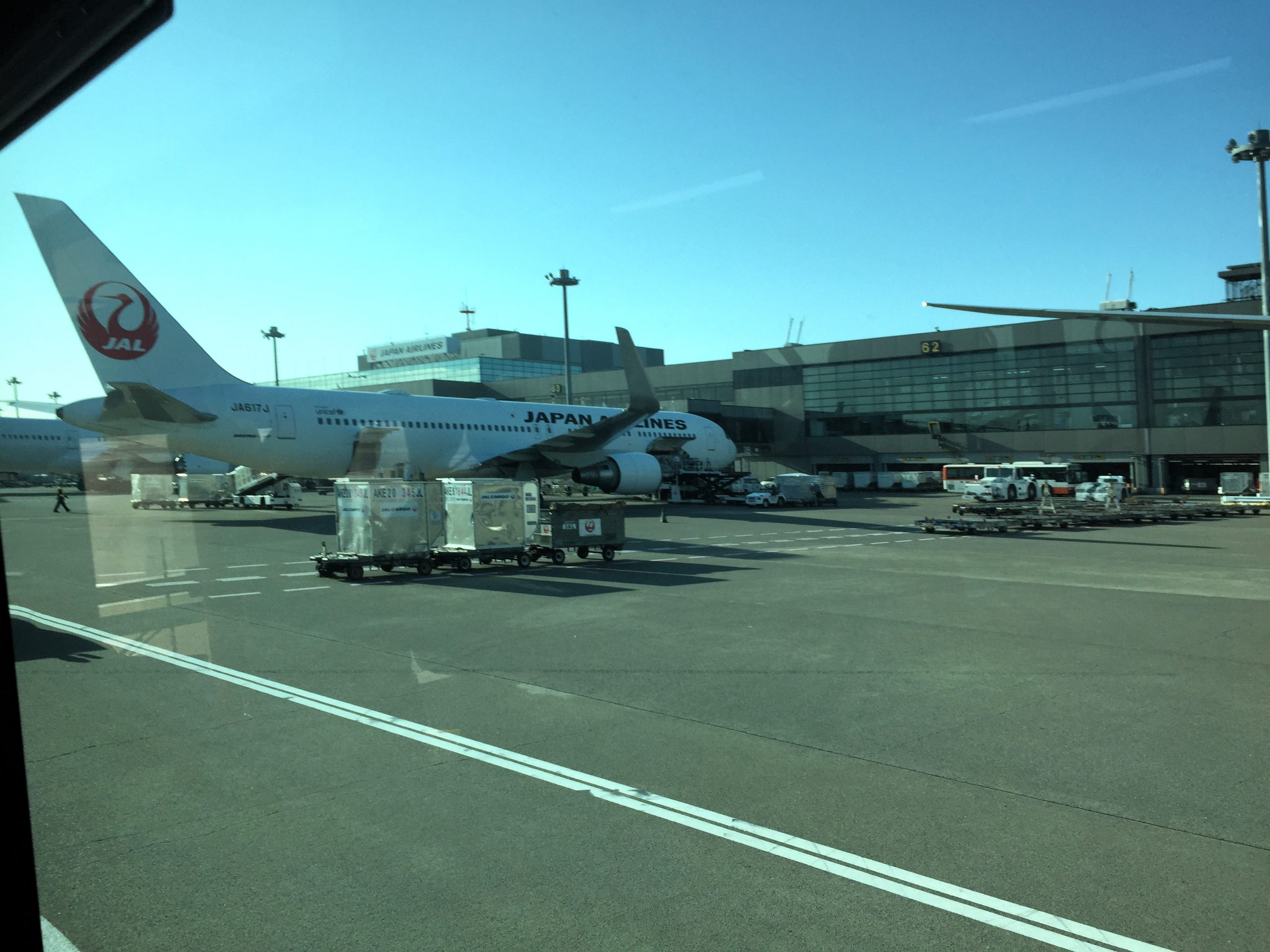


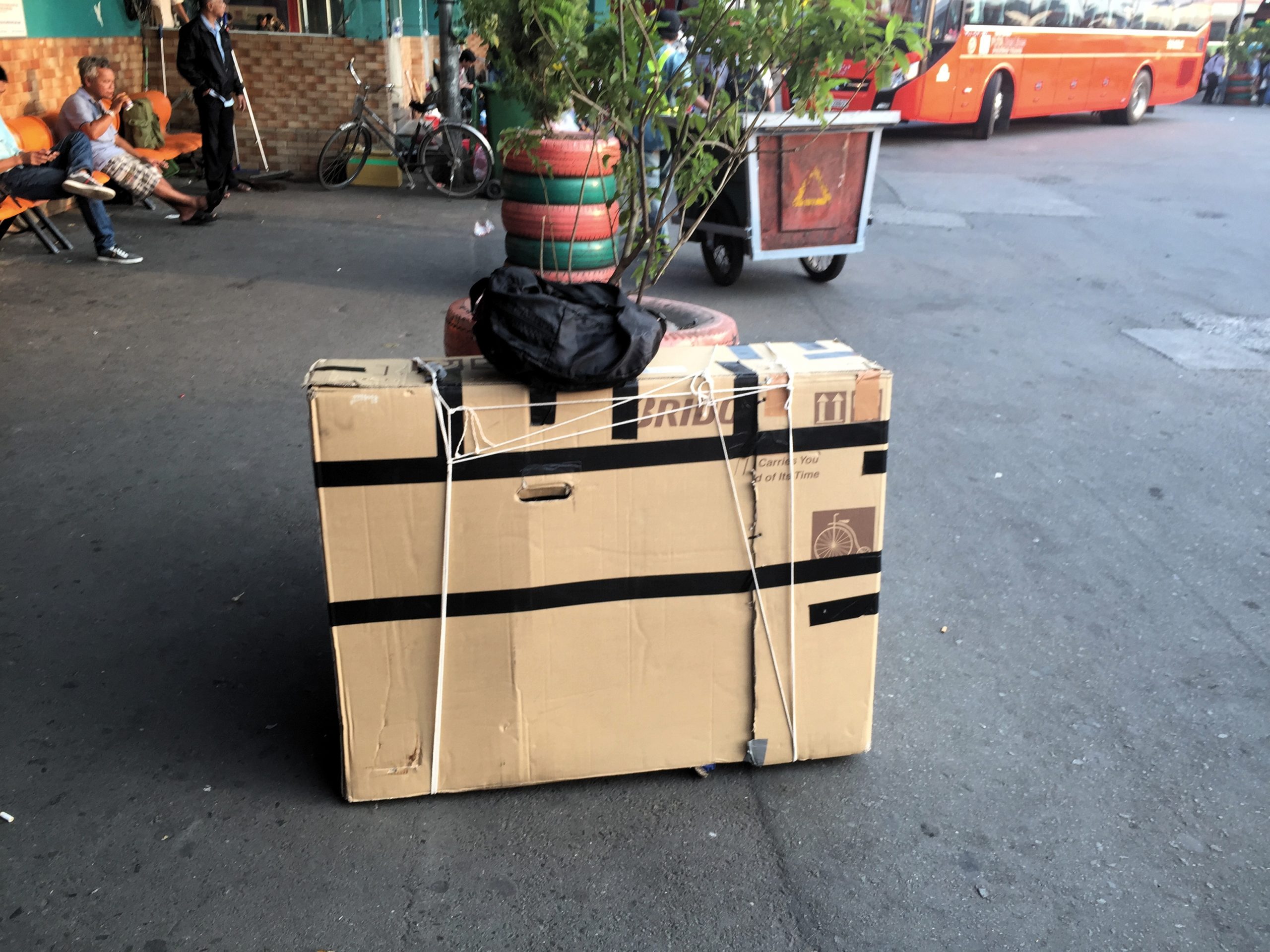
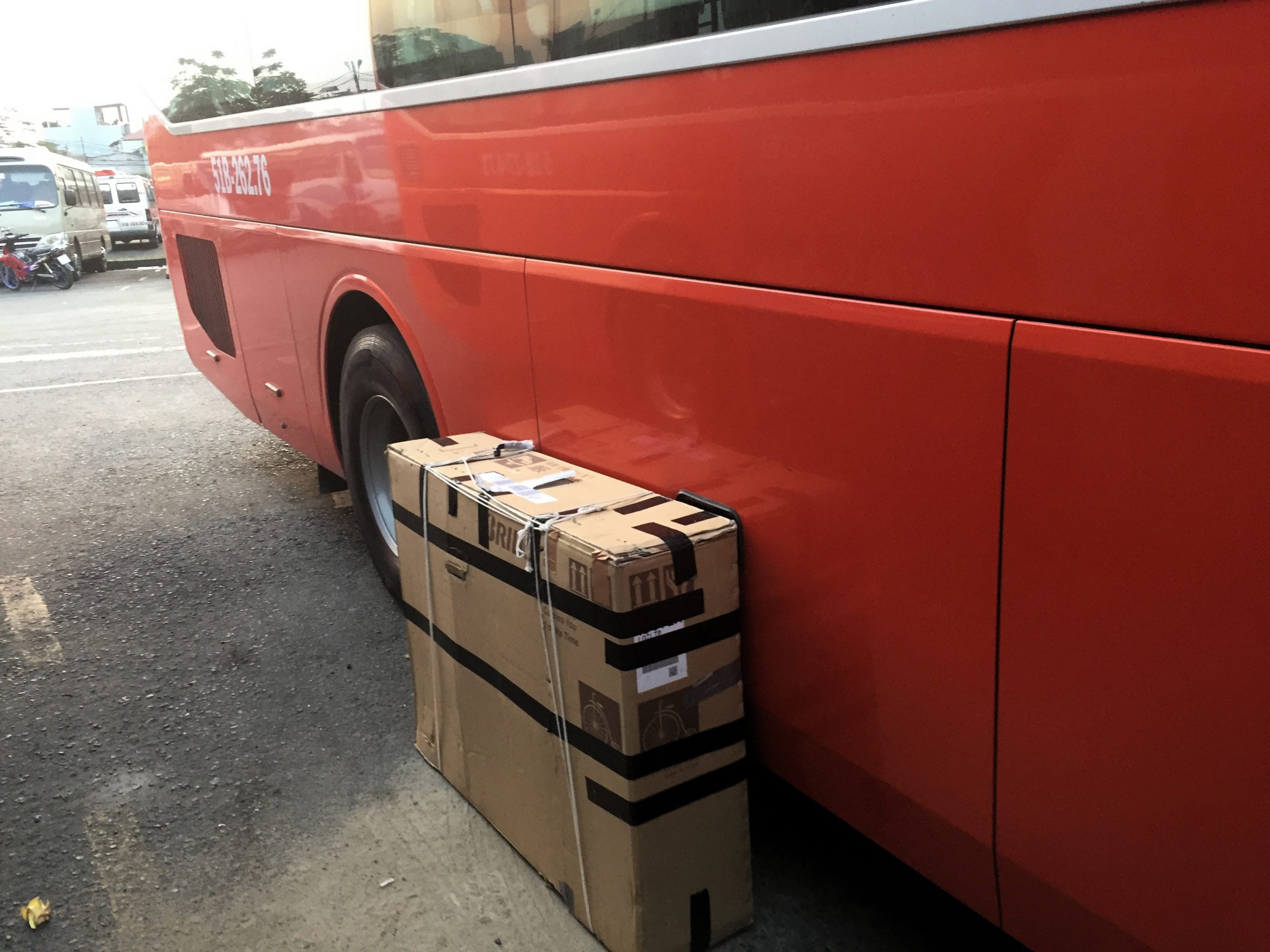
Video
[yotuwp type=”videos” id=”t3t3hd6_DWg” ]
Home | Photo Gallery | Podcasts | Videos
]]>Bike Ride, Bike Race, Bike Porn
2019/11/03 -2019/11/04
I bet that headline got your attention. It’s not as salacious as it sounds. Stick with me for another paragraph or two to see what I mean. Early in November I took an overnight tour to Makuhari in Chiba with my friend, Mario.
Every year there is a huge bicycle convention called Cycle Mode in Makuhari Messe, a very slick convention center in Makuhari Chiba, about a half hour ride or so from Tokyo Disneyland. Hundreds of bicycle and bicycle adjacent companies gather to pimp their wares on the hapless bicycle freds of Japan. If you don’t know what I mean by fred check out the now retired Fredcast podcast. Anyway, there were lots of gratuitous carbon fiber and brightly colored bicycle gadgets. There are quite a few events that occur in conjunction with Cycle Mode. One of those events is a cyclocross race at the nearby mountain bike and BMX park.
Mario and I struck out Sunday morning after kitting out his bike with my spare rack and panniers. We made great time rolling through the Musashino area of Tokyo Prefecture. The second worst thing about riding to Makuhari in Chiba is that you have to cross the breadth and width of central Tokyo. Both Mario and I are veteran Tokyo road warriors so we know all the least worst roads in Tokyo to cycle on. At least, when it comes to the western half of the city. There is a fairly large gray area on our mental maps once we get past the center of the circle formed by the Yamanote Line. I have ridden east of the Yamanote circle only twice before. And there is where we find the worst part of riding to Makuhari. A little section of road that passes through a suburb called Ichikawa. I’m sure (at least I think I am sure) that there are nice places in Ichikawa but the most direct route from my house to Makuhari doesn’t take me through those parts. Instead, it takes through the industrial part where there are factories, malls and bad traffic.
Once Mario and I got out of the snarl that is Ichikawa and Funabashi the ride got more pleasant. Unfortunately, by that time we were almost to our destination. Makuhari Messe is a world class convention center with its modern design, surrounding hotels, upscale restaurants, sports stadium and mid sized train station but you wouldn’t know it from the bike path a few kilometers away. The hotels and office buildings grew in stature above the trees as we drew bearer.
Despite telling Mario the plan for the weekend. he was still pleasantly surprised when we got to the mountain bike park. I should mention that Mario is Italian. I guess that much could be guessed by the name. His mamma and papa didn’t call their baby boy Mario because they met at a Donkey Kong arcade. Mario swears that he neither speaks nor understands English. However, he is a capable speaker of Japanese, albeit with a Kansai accent with occasional relapse into Italian. So, all our communication is in Japanese. No doubt, Japanese who hear us talking find it entertaining; two foreigners speaking Japanese. What’s wrong with them. Why aren’t they speaking English? Anyway, this lack of a common native tongue between us may contribute to Mario’s not fully grasping the full scope of our adventure until it happened. That is it’s own sort of fun.
The races had been going on all day but we only got there just in time to enjoy some exotic beer and watch the final race. A short word about cyclocross for the uninitiated. Cyclocross is not as we’ll known as road racing or even mountain bike racing. It is like the love child of passionate moment between road racing, BMX, mountain bike racing and a parade at Disneyland while parkour ate popcorn and watching on the sidelines. The racers follow a course tha includes pavement, some offroad tracks, up hills and dismounting occasionally to life their bicycle over obstacles.
My plan for camping was to set up our tents in the mountain bike park. The sun set as the winners we’re making their speeches on the podium stage. It was a bit too crowded to set up our camp so we got back on our steel steeds to search for a convenience store to get some food for breakfast and a beer or two to wash down our pasta. By the time we got back to the park it was good and a dark. The race organizers were winding down their clean up activities. We found an out of the way place to cook our pasta. By the time we were done eating we had the park to ourselves. We set up our tents and I enjoyed a bit of hot chocolate (appropriately seasoned with crime de menthe). We talked until about 9 when the rain that was threatening all day told us it was time to retreat to our tents.
Day 2
It rained steadily until about midnight. I hunkered down to watch a video or two on my iPad. Sometime during the night my head started to hurt and I was feeling a bit queasy. This happens to me sometimes while camping. I took some Ibuprofen and donned my raincoat for a stroll around the park. I eventually felt better and got a few hours sleep.
I discovered during my midnight perambulation that we were camped a few hundred yards from the ocean. It was just out of sight beyond some trees and thick brush.
Mario and I ate our breakfast and broke camp while the race organizers showed up to do one more sweep of the grounds to pick up trash.
A visit to Bicycle Mode was on the agenda for the day. But before going to Makuhari Messe we took a ride along the beach bike path to find a geocache.
Cycle Mode is a yearly bike convention that is held in Tokyo and Osaka. Bicycle manufacturers, bicycle accessory sellers and other of purveyors of cycling adjacent goods and services congregate to peddle their wares to the unsuspecting bicycle geeks of Japan. The vendors come from around Japan and even overseas. There is also an indoor demo course where visitors can borrow the latest bikes for a test ride. There is also a bike school for kids where they can get free lesson on two-wheeling and try out a variety of different types of bicycles. I think one of the most interesting displays were by various regions in Japanese promoting their prefecture as a cycling destination. The free cycle maps and brochures prodded my inner desire to travel farther afield looking for adventure.
Mario is an outgoing type and is quick to strike up a conversation with strangers. As we passed a booth displaying bicycles from an Italian brand he suddenly starts chattering with a Japanese salesman in Italian. It turns out, the fellow used to be Mario’s boss a few years ago. What struck me was that Mario was not at all surprised that he would meet someone he knew in a strange city 60 kilometers from home.
Here’s where we come to the not-really salacious part of the trip. Bicycle manufacturers brought their best to the show. I am a sucker for bicycles that are somewhere on the path less pedaled. I didn’t notice any wooden bicycles this year but I saw a bicycle with a frame made from bamboo that was absolutely intriguing. I also saw a bicycle that had a very steam punk-like vibe to it. Looking at it made me image riders with long black coats, aviator goggles and a Victorian London accent. I thought the longbox cargo bike was fascinating. There was a section dedicated to vintage and handmade bicycles too. I will ride almost anything at least once. Unfortunately, the most unusual and unique bicycles were for display only. One brand that both Mario and I found very fetching was Bruno. This European company makes a very attracting small wheel bicycle. This type of bicycle is called a mini velo. In most cases the frame is a regular road bike-like configuration. Perhaps, slightly smaller that average with small 20 inch wheels. The company makes a very a sexy versatile, mobile bicycle. Finally, I would guess that at least a quarter of the bicycle vendors offered electric assist bicycles in their catalog.
Many of the bicycles were priced way out any normal person’s bicycle budget. Most of us can only fantasize and lust over such bicycles from a distance. The show seemed a lot smaller in scope and a good deal less crowded than previous years. It feels like cycling has been booming the last few years but maybe the boom hasn’t translated into more bicycle sales.
We stayed a couple hours at Cycle Mode, ate some lunch in the food court and then hit the road to return. The ride home was uneventful with the exception of a detour to visit Funabashi Shrine. Mario has a hobby similar to geocaching. He visits Shinto shrines to get a goshuin stamp. Many of the larger shrines offer visitors to put their official stamp (goshuin) into a book specifically intended for the purpose. These books are just a fancy cover enclosing blank white pages. The stamps are the official seal of the temple. The shrine priest, caretaker or other shrine official will sign the books in very pretty calligraphy. The stamp and the signature only costs a few hundred yen. After the shrine we hid the road again. We took a break somewhere in central Tokyo at Mini-stop convenience store. Other than those two short stops we pedalled straight home.
Photo Gallery

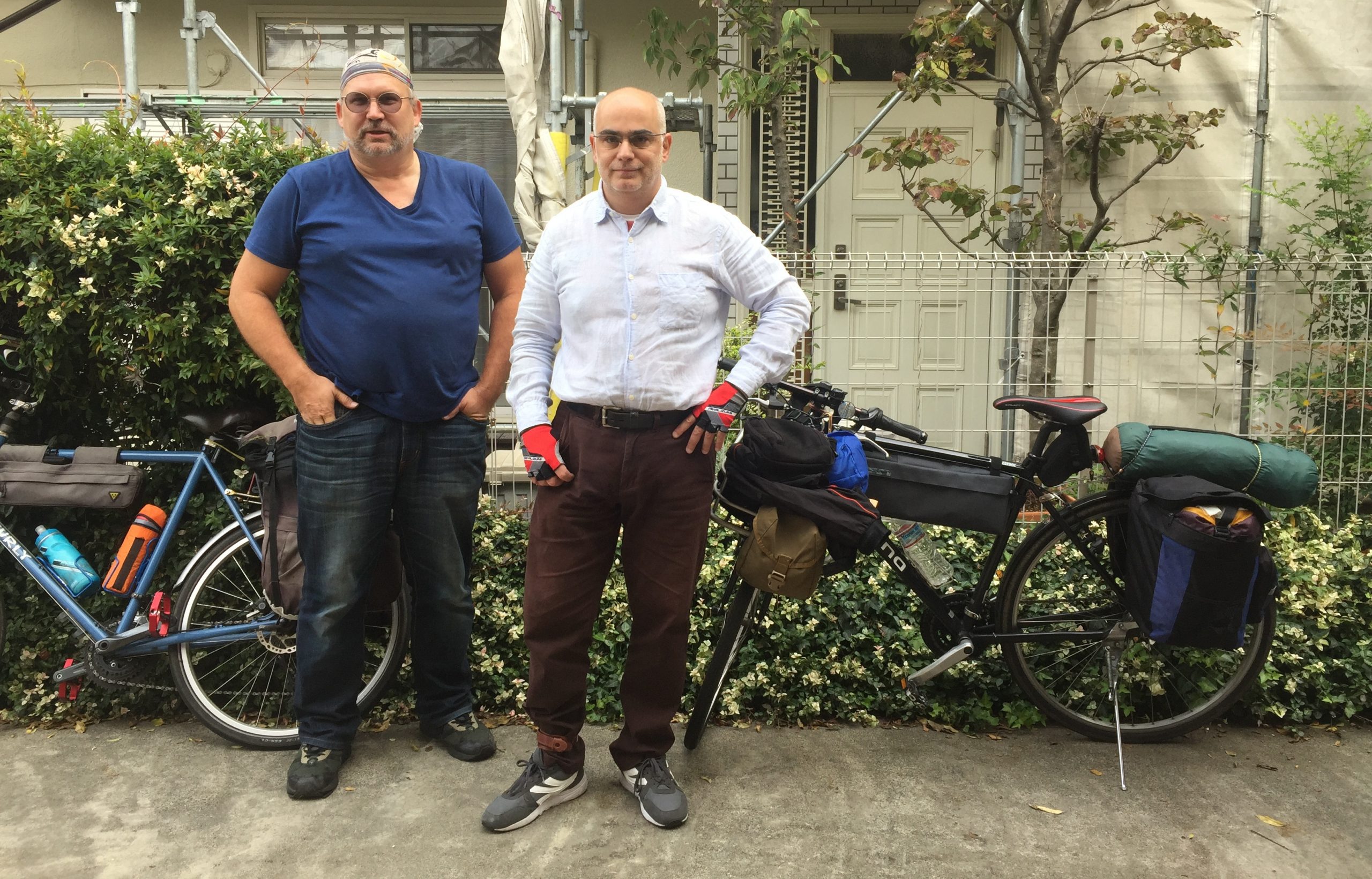
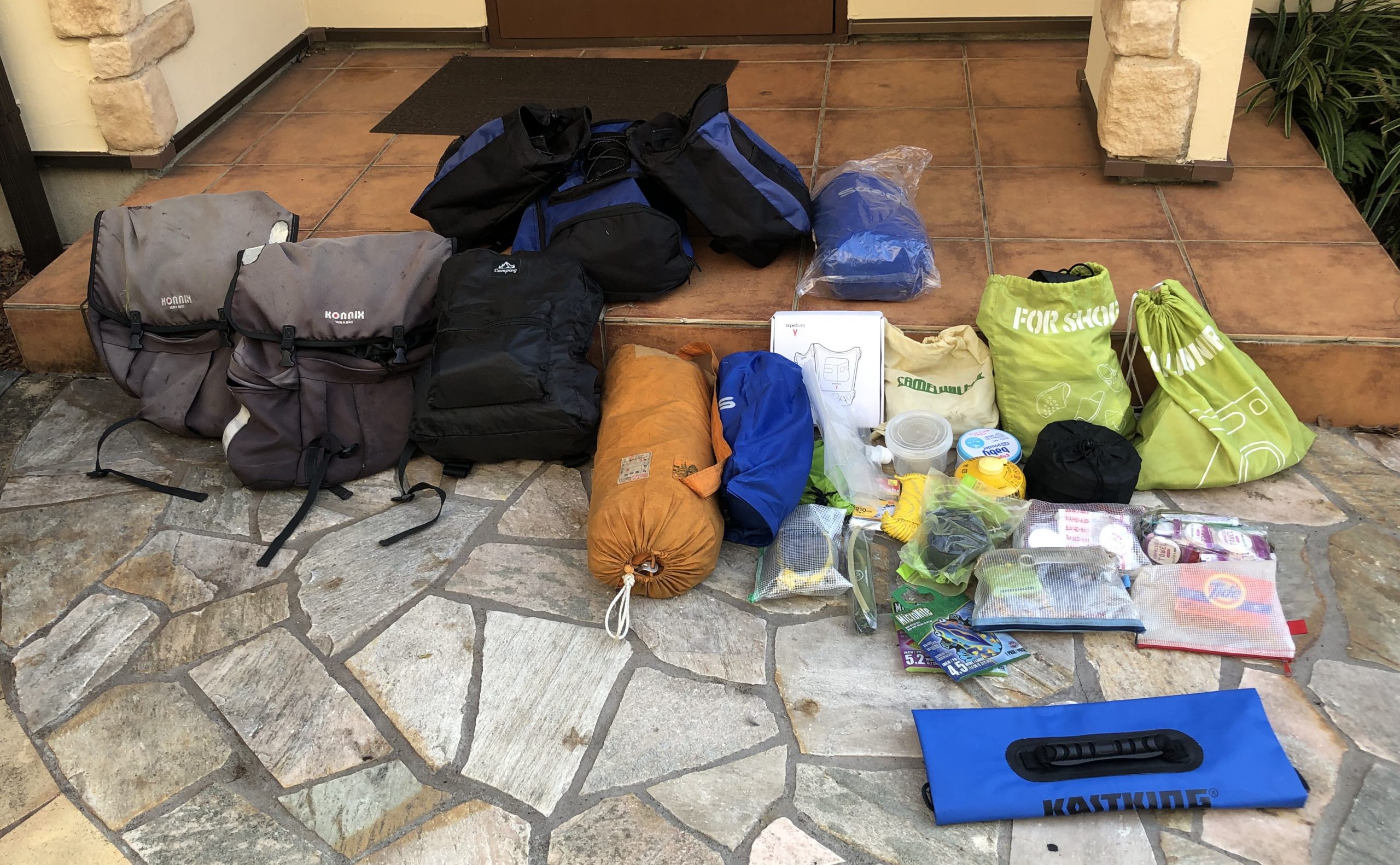



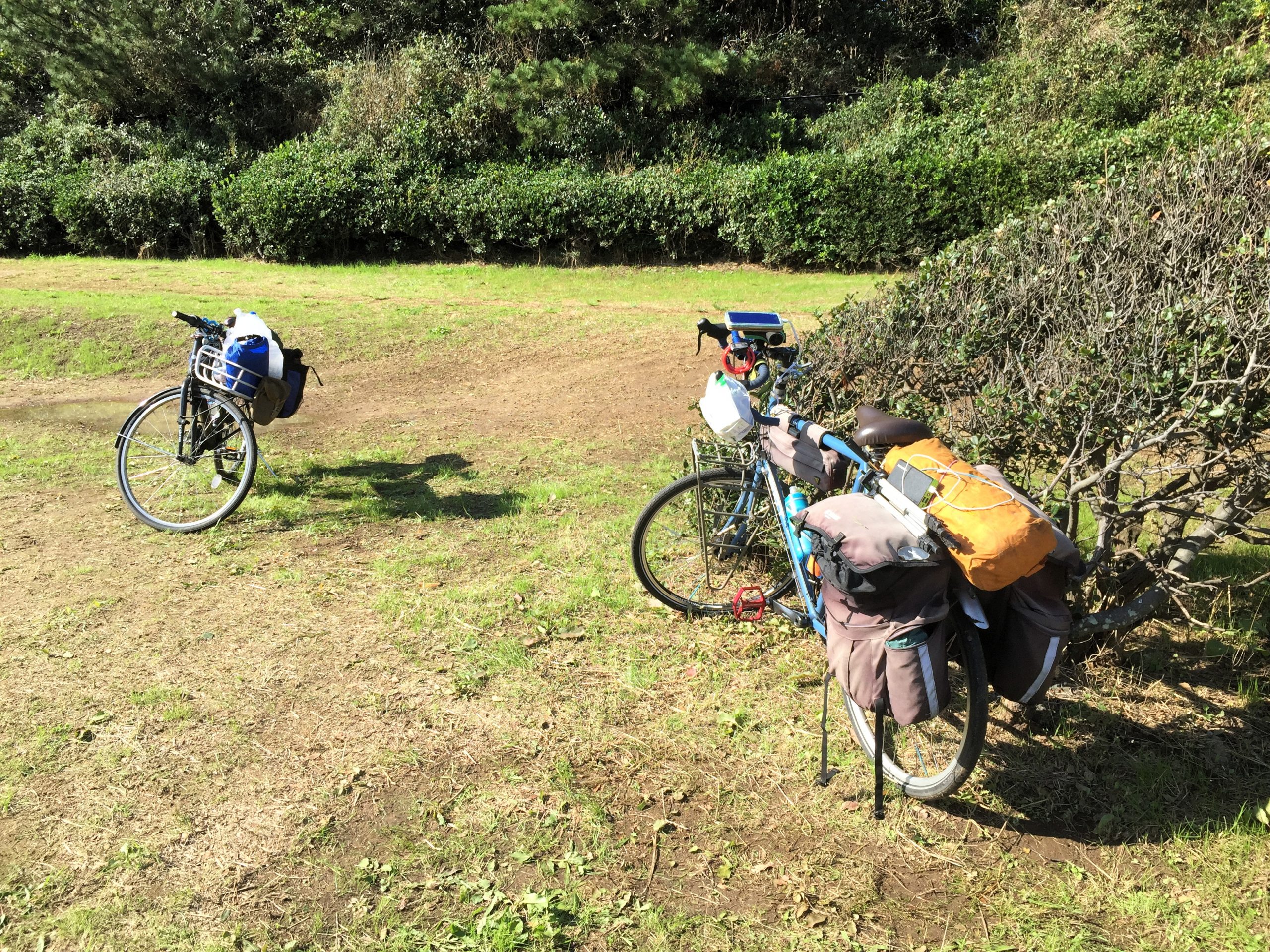




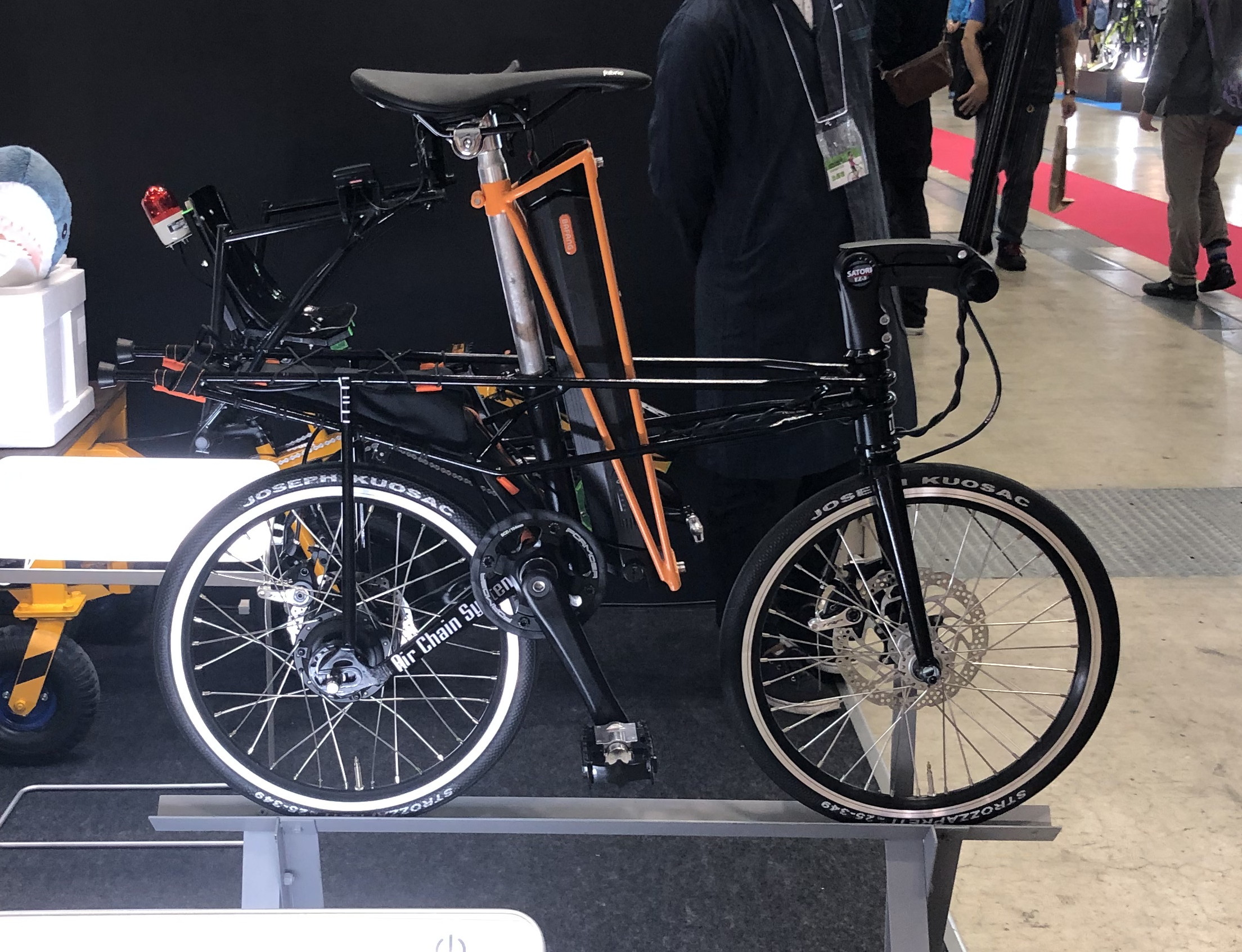
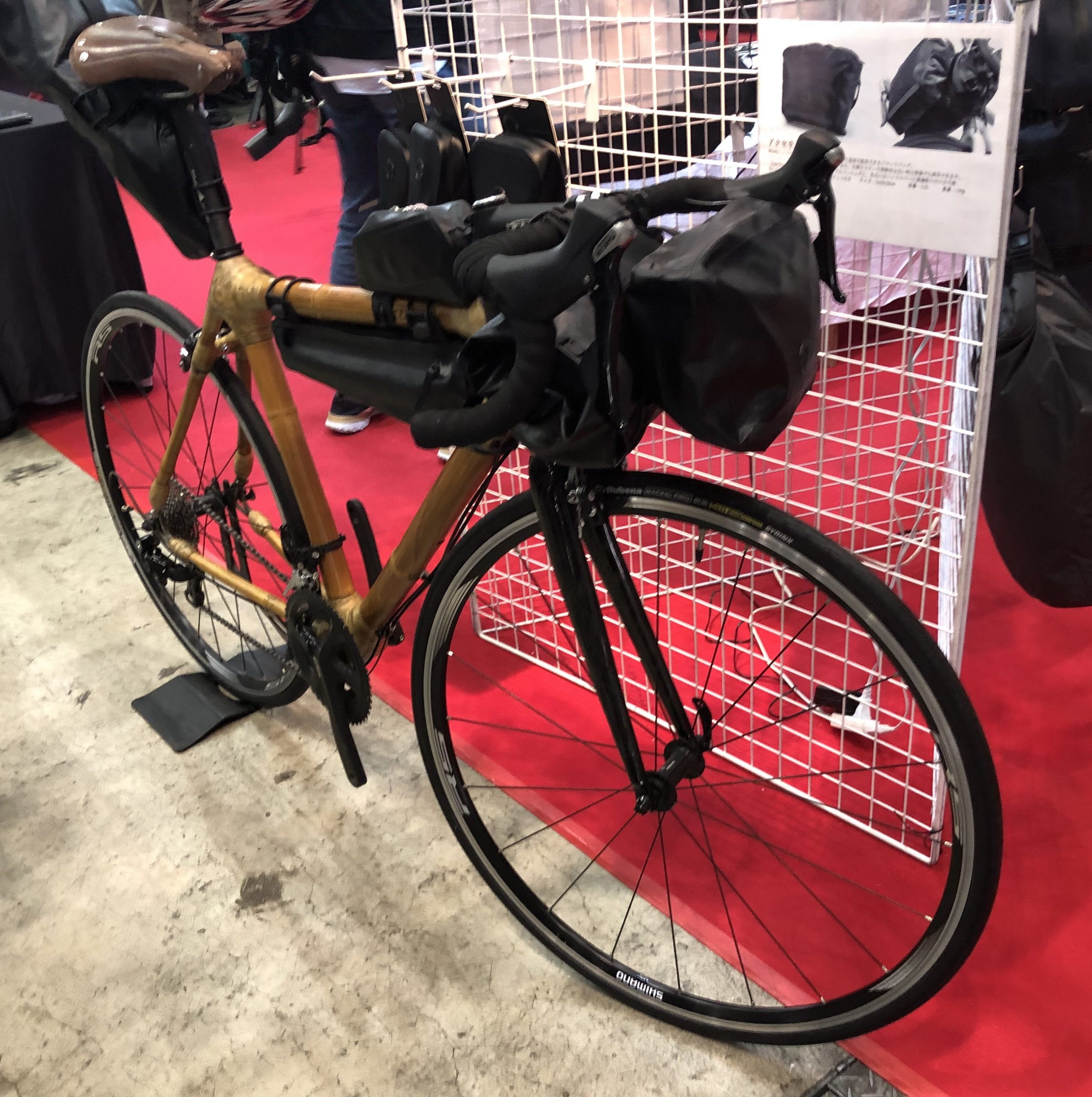
Video
[yotuwp type=”videos” id=”TI4IX_LAnhw” player=”loop=1&playing=1&playing_description=1″ effects=”video_box=ytef-grow”]
Home | Photo Gallery | Podcasts | Videos
]]>